The operations of Sugar Cosmetics, a high-end beauty and personal care business, are being strengthened by Unicommerce, one of India’s top e-commerce enablement SaaS platforms. Unicommerce is improving the brand’s retail and e-commerce operations by unifying its entire technological stack, guaranteeing a smooth consumer experience across digital and physical touchpoints.
Sugar Cosmetics has been using Unicommerce’s technology, such as its warehouse management and multi-channel order management systems, to optimise its e-commerce operations for over five years. The company has been able to effectively scale and manage its online sales because of this long-term cooperation, which has improved client happiness and made transactions easier.
Entering the Real Retail Market
In addition to maintaining a strong online presence, Sugar Cosmetics is expanding its network of physical locations throughout India. The business will be able to provide a ship-from-store service, guaranteeing quicker delivery and more convenience for clients, by connecting all of its stores and warehouses onto Unicommerce’s centralised platform.
In order to expand its operations to include store fulfillment, Sugar Cosmetics recently added Unicommerce’s omnichannel retail management system. With the help of this new feature, the company will be able to provide customers with a uniform and cohesive shopping experience across all channels, including online and physical retail touchpoints.
According to recent data from Unicommerce, the amount of beauty product orders increased significantly during this year’s Diwali sales, rising by 100% over the previous year. Growing consumer interest in beauty goods is reflected in this trend, which presents Sugar Cosmetics with a chance to bolster its online and offline presence.
Sugar Cosmetics is able to move orders between locations and optimise its inventory management through the integration of its stores and warehouses. In addition to exposing a greater variety of inventory, this also speeds up service, giving clients access to a greater assortment of products and quicker fulfillment.
Improving User Satisfaction
Additionally, Unicommerce’s technology will simplify the returns procedure, guaranteeing clients a hassle-free return experience. In addition to generating more chances for cross-selling and upselling, this optimisation helps to create a more comprehensive and seamless brand experience. As of Q2 2025, Unicommerce has over 3550 customers, including D2C brands, retail and e-commerce businesses, and logistics providers. The company has managed 8800+ warehouses and 3150+ omni-enabled stores across regions, achieving an annual transaction run rate of 930+ million order items with 260+ technology and partner integrations.
“In today’s rapidly changing market, it has become imperative to have omnichannel capabilities to offer excellent customer satisfaction,” stated Jasmin Gohil, Chief Technology Officer of Sugar Cosmetics, in reference to the company’s omnichannel vision and relationship with Unicommerce. As a brand that prioritises technology, Unicommerce’s technology has produced outstanding outcomes over the course of Sugar Cosmetics’ long-term collaboration. Brand will be able to better serve its clients and improve their online and physical purchasing experiences thanks to its omnichannel capabilities.
Company Profile is an initiative by StartupTalky to publish verified information on different startups and organizations. The content in this post has been approved by Beyond Identity.
With more and more businesses, individuals, and governments increasingly relying on the internet, bad actors erode trust, steal intellectual properties, and pilfer funds. And to protect systems and networks from cyberattacks or hacking-related breaches, people consider relying on passwords.
However, passwords are fundamentally insecure authentical models because these ‘shared secrets’ transit networks are stored insecurely in databases, shared among family and friends, and reused across multiple applications. It’s when Beyond Identity came with the passwordless architecture allowing businesses and individuals to run computers and phones securely without having passwords or credentials in the system.
Let’s dig in to learn more about Beyond Identity, from its startup story and founders to its business model, funding, products, and growth.
Beyond Identity is the developer of the most secure, passwordless authentication platform for tech forward-thinking enterprises. The company breakdown the barriers between cybersecurity, identity, and device management. Beyond Identity does so by changing how the world logs in by eliminating passwords and providing users with a frictionless multi-factor login experience.
Beyond Identity – Industry
In 2022, the global cybersecurity market was estimated at $173.5 billion. And the market is projected to reach $266.2 billion by 2027 with a CAGR of 8.9%. The increased number of data breaches, rising digitalization, and advanced cyber intrusions are some cybersecurity market growth driving factors.
During the pandemic, many companies shifted to remote working culture and, thus, deployed cyber security solutions, resulting in market growth. Moreover, the market is expected to continue growth due to the hybrid working trend that is anticipated to stay in the future.
Some prominent players capturing the large size of the global cybersecurity market include McAfee, Palo Alto Networks, Cisco Systems Inc., and Trend Micro Incorporated.
Jim Clark and Thomas Jermoluk are the co-founders of Beyond Identity.
Jim Clark
Jim Clark is a serial entrepreneur who earned a bachelor’s and master’s degree in physics for the University of New Orleans. He co-founded Silicon Graphics in 1982, Netscape in 1994, and Healtheon in 1995. In addition, he co-founded Beyond Identity in 2019 and working as the company’s Chairman.
Jim Clark – Co-founder and Chairman, Beyond Identity
Thomas Jermoluk
Thomas Jermoluk studied at Virginia Tech. He is a Silicon Valley inventor in leading companies like Netscape, Silicon Graphics, and WebMD. Moreover, he is the Venture Capitalist at Clark Jermoluk Founders Fund and Board Member at Ibotta Inc. Jermoluk co-founded Beyond Identity and now holds the CEO position in the company.
Thomas Jermoluk – Co-founder and CEO, Beyond Identity
Beyond Identity Team
Jasson Casey – Chief Technological Officer
Bill Hogan – Chief Revenue Officer
Patrick McBride – Chief Marketing Officer
Kurt Johnson – Chief Strategy Officer
Beyond Identity is a team of 170 employees.
Beyond Identity – Startup Story
The co-founders of Beyond Identity – Thomas Jermoluk and Jim Clark, were originally working on a “Smart Home” solution but faced the change of user authentication. However, they wanted to create a system that automatically recognizes the user without a password. Jermoluk considered passwords as one of the ‘original sins’ of the internet as it shared secrets. It was how Jermoluk and Clark started the whole thing of launching Beyond Identity in 2019.
In 2021, Beyond Identity released a free version of its ‘Passwordless’ technology. A few months later, in 2021, the company announced a new platform upgrade featuring behavioral biometrics. Furthermore, Beyond Identity announced its expansion into Europe in May 2021. It launched Zero Trust Authentication in 2022.
Beyond Identity – Mission and Vision
Beyond Identity aims to empower all individuals and businesses to securely, effortlessly, and privately control their digital identities.
Beyond Identity – Business Model
Beyond Identity is FIDO2 certified, extending the standard with an organization-ready platform that secures hybrid work environments. The platform prevents credential-based breaches by eliminating passwords and ensuring user and device trust. Moreover, the company’s cloud-native Universal Passkey Architecture delivers secure and frictionless multi-factor authentication to ensure the enterprise’s data is accessed from secure, authorized, and identity-bound devices.
Beyond Identity – Revenue Model
Beyond Identity is a cloud, SaaS-based platform with an annual pricing model.
Beyond Identity – Products and Services
The products that Beyond Identity offers are Secure Workforce, Secure DevOps, and Secure Customers.
Beyond Identity – Funding and Investors
Beyond Identity raised funding worth $205 million over 3 rounds. Its latest funding round – Series C Round, was raised on February 21, 2022, and acquired $100 million. 7 investors fund the company, including New Enterprise Associates (NEA), Koch Disruptive Technologies (KDT), Silicon Valley Venture Capital firm, and Evolution Equity Partners.
Date
Round
Number of Investors
Money Raised
Lead Investor
February 21, 2022
Series C
6
$100 million
Evolution Equity Partners
December 8, 2020
Series B
3
$75 million
–
April 14, 2020
Series A
2
$30 million
Koch Disruptive Technologies, New Enterprise Associates
Beyond Identity – Growth
Beyond Identity tripled its annual revenue and customer base in 2022 when compared year-over-year (YOY). Moreover, the company’s annual recurring revenue (ARR) rose 330% from 2020 to 2021, and its roster of customers grew 640%. In 2022, Beyond Identity achieved a valuation worth $1.1 billion. And its employee count increased from 70 in 2020 to 200 in 2022.
Eliminate Credential Based Attacks with Beyond Identity
Beyond Identity – Partners
Beyond Identity partners with leading technology vendors, system integrators, distributors, resellers, and managed service providers.
Beyond Identity is the developer of the most secure, passwordless authentication platform for tech forward-thinking enterprises. The company breakdown the barriers between cybersecurity, identity, and device management.
Who are the founders of Beyond Identity?
Jim Clark and Thomas Jermoluk are the co-founders of Beyond Identity.
Who are the main competitors of Beyond Identity?
Salesforce Platform, Microsoft Authentication, Ping Identity, Duo Security, and LastPass are a few top competitors of Beyond Identity.
You’re living under a rock if you don’t know what software is. We use it every day, day in and day out. Even if you don’t work on software, you know it. A game is a software made for leisure purposes, there is specific work software. The apps on your smartphone are also software. The point to be clear is basically we are drowned in software. Welcome to the 21st century.
There is no lie in the statement that software has invaded the world. It has penetrated the deepest of our lives. As tech becomes more and more accessible, there is a sure chance it will grow manifolds. It has also penetrated the walls of industries, every company now is a software industry first and a product/service company second. SaaS, software as a service is the new trend. It has transcended boundaries and has leapt to the insurance world. This article talks about SaaS and its application in the insurance industry.
Even if you are naive, you will surely know something about this synonym. SaaS or software as a service is a business model that has been intriguing every business mind out there. It is a model in which software is used as a service and a whole business organisation is built around the walls of these services.
The reason for such popularity of software as a service model is simple to think of. They are easy to operate. Software is the best thing that has happened to humans after hardware tech. They are easy to use, have more efficiency, and are more effective for any scale of organisation. For example, Canva is a popular graphic design platform founded by Melanie Perkins, one of the world’s fastest-growing saas companies. It is valued at $40 billion.
Most people are insured but why is the sector even needed? The insurance sector works on a very easy model of work. You love someone/something and you want to make them safe. So, businessmen came up with a cash-making idea. The model of insurance was made.
Insurance companies will assure you of the monetary safety of the things/person you love and in return, they charge a little fee every month. That monthly charge is known to us as an insurance premium. And yes, you can even include yourself in the category of insurance and not just the precious things. The whole business is made on the basis of fear, or we can call it love. Many celebrities also ensure their body parts.
Insurance companies work for a lot of people, thus, they take insurance premiums from a lot of people. Now the hook is that there are fewer chances of ‘disaster or ruin’ happening every day so they just save and invest the premium money. Or the insurance companies can use some of that money to pay claims for some disaster that may have happened to some insured.
Insured things/people do not get ruined/die daily, so insurance companies save the premium and these earnings are invested. Making the whole business profitable.
Now that we have discussed software and the insurance industry, it is safe to walk on the path of the intersection. Software is known to manage digital data and make sense of data of any magnitude. Insurance companies are companies that operate with a lot of people (Insurance clients). The intersection does make a lot of sense.
Software as a service has penetrated all the domains that humans have known, we mean, mostly though. In the industry of insurance, it has even more demand. It has made things simpler, easier and faster. That makes the work of the company, the firm and the client.
This hassle-free functioning was not possible before this new entrant in the domain. The insurance industry now saves a lot of time and money that can be used somewhere else. Which clearly is a benefit in daily operations as well as in the long term.
SaaS uses a licence and a delivery strategy that provides all the listed benefits of the insurance to the clients without even contacting the brick-and-mortar office. They kill the mediatory and increase the overall efficiency without even taking the support of a third-party source. This is cool and most people would love to pay for this software which actually gets the work done. SaaS provides the most up-to-date information to you and works on the new normal of the Internet.
Talking about the cash of the business, most software doesn’t take a cut for themselves while they cater to a company. By most, we meant the on-premises and hosted systems. The fact that this software in the insurance industry has to deal with a lot of data, does not really bother their efficiency.
Is there a Need for SaaS in Insurance Sector?
There are a lot of activities that an insurance company has to do. They have to constantly improve performance, speed up the writing and acquire new and new businesses (Investment) as soon as possible. With all these hassles, the insurers also have to increase efficiency and cut expenses, and the more the better.
With all this hard work, they still have to manage the clients’ risks well. They have to give strong competition and keep the existing customer happy while maintaining a good amount of new client base. All this can be easily overwhelming. This is the point in the picture when appropriate software comes into play.
If chosen suitable and relevant software services for an insurance firm, they can do wonders. Otherwise, it is not to mention that any insurance company is fragile and can come down like a house of cards. A suitable software as a service results in a fast and developed approach and better work management. Let us see how SaaS is shaking things up in the insurance world. Before we prepare a firm to jump into the software train let us read the benefits.
Benefits of SaaS in the Insurance sector
As discussed above, the insurance sector has a lot of work to do and a lot of data to manage. Incorporating suitable software can help address those mentioned challenges. This will enable the company to focus on its core business model and be more profitable. This is the basic thing that technology does. It simplifies things at any scale.
Catering to customer demands, lowering costs and providing security at a much better level are some of the benefits. Insurance companies can even entail cloud computing to use already-made configurations. Let us discuss the benefits in a little clear way.
Forward-thinking
Tell someone that you don’t want to use the software in your business, and watch them laugh. Forward-thinking is the phrase that properly explains the new innovations and the efficiency that they provide.
If an insurance company uses the best software in line, and they have everything automated, it is obvious that it will attract more customers. This is a great method to stay competitive. As this is a really good competitive advantage.
There are plenty of SaaS platforms like the Invoice cloud that companies can choose from and let them do the magic. Efficient software helps the IT department of an insurance company to manage more data with even more efficiency. Changes can be made easier and more rapidly than ever with no additional workloads.
This makes the business a little more flexible and we all know flexible businesses survive the most. There is also personalised software that crosses paths with users. You can customise, and enable-disable workings as per your specific business needs and requirements.
Greater customer retention
Customers or clients are good for any business out there. If you can increase the comfort for them, it will bounce back and they will be more loyal to the business. The insurance business is a big hard business and there are many rivals in the market.
In a market where everyone is trying to create differentiating factors, a great customer experience can go a long way in increasing retention. The software can make everything easy today, they can manage data, manage payments and improve the overall customer experience.
SaaS is easily expandable and is updated from time to time. The software can make things possible like automatic renewals, and automatic payments of premiums from bank accounts and there are a lot more ways. This is an investment in the comfort of clients and will pay in future retention rates.
Customisability and Scalability
Most of the Software that is provided as services is tailor-made to the needs and wants of organisations. They are super customisable and highly scalable in this sense. As the industry of insurance demands more and more rapid growth and scale. It becomes imperative to improve working management. If they are not calling fast and maintaining efficiency, they will not be able to hold customer demands and eventually lose customers. Thus, the software does the work for them, most software is extremely flexible and highly customisable that can take the shape of any organisation.
Data Guard
Data is the most important and precious asset in this digital world. If a company does not know how to keep its data safe then it is bound to not survive. In the insurance sector, they deal with millions of clients who are unique and have their own set of information. If the insurance company is unable to keep the data safe and secure then they will soon vanish from the competition.
SaaS systems are built with keeping in mind the security and guarding data that they will hold and manage in future. They have the capability to handle large sets of data with the same constant and clear security. They make sure that the insurance firm is never vulnerable in terms of data. These platforms are built with the thought of managing the data of each and every client while keeping a guard as they work and make sense of data for the company.
Insurance firms save the two most needed assets in the world today. With good, efficient software they save time as well as money. The Information technology department saves time by focusing on more important things. The finance department saves money to invest more and earn more returns in present as well as the future. Customers are happy too. For example, a firm can include a chatbot for prospectus clients that can improve the experience.
Albeit the fact that insurance software is effective and efficient, it is hard to prepare a company to incorporate software into the system. They have to look after many things before jumping into the storm. Let us see a few checkpoints before adding SaaS to an insurance corporation. For example, they have to plan everything in advance which can help decrease the hindrances in the process. Most software incorporates skill sets to handle all the data of the business architecture but they still have to be made personalised.
Insurance companies also have to look at integrations that they can provide. Once the software is at work, they have to check the value added to the company. If something is not bearing fruit, it is important to cut that part off. Only allow integrations that serve the users in a better way than before.
We discussed that software is the new ‘workers’. Needless to mention that these workers are a million times more efficient than their human counterparts. That is the reason why software is transcending barriers and now is used in almost every domain. They are now even in the risky business of insurance.
Insurance companies can soar high with the help of these little thingies. They can manage data efficiently. They can improve the client experience which will help in more retention rates. They can save time and money with the help of suitable software.
All of these benefits while still managing to be more secure and alert with data security. This is almost heaven for the insurance world. Never before this was possible and it is delightful to see how companies can perform with these technological aids.
FAQs
What is SaaS insurance?
SaaS insurance is a delivery strategy that provides all the listed benefits to the clients without contacting the brick-and-mortar office. They kill the mediatory and increase the overall efficiency without even taking the support of a third-party source.
What are examples of SaaS?
Adobe, Google Workspace, Salesforce, ServiceNow, and Atlassian are examples of SaaS providers.
Who is the largest SaaS provider?
Adobe Inc, which has a Market Cap of $198.9 billion, is the largest SaaS provider.
What is SaaS in business?
SaaS is a software-as-a-service model where an application is delivered over the internet and can be accessed from any device with an internet connection.
Why do companies use SaaS?
SaaS eliminates the cost of purchasing and installing software and maintenance. Also, SaaS applications are easy to install and maintain than hardware installations.
What are the most important aspects of SaaS?
It is easy to use, has enhanced security, saves costs and is scalable.
In the world of the SaaS (Software as a Service) industry, apart from the business model, demo videos help in attracting collective masses and also in influencing the audience towards a particular SaaS brand. It provides more value to new users who are visiting the platform for the first time since they require a first-hand guidelines on where to go, exact features, how to get started, and access. The more illustrative demos and tutorials are, the better.
In most simple words, it’s similar in a way, just like representatives campaign themselves before elections, by providing an outline of what could be the upcoming policies and promises. It’s more like a tool throwing shades of demonstrating content along with benefits, features, and uses and may generate adrenaline shots to influence more audiences. Hence, demo videos may contribute towards a steady and gradual rise in sales.
So if you want to create a unique demo video, Take a look at the steps below.
ECG- Evolving, Constant, Growth-Oriented Model. Before deciding the niche for the first video or every consecutive video, one must keep this model in mind.
Evolving
It refers to evolving content (the demo video) that must have the latest volume. The video should track the ongoing trends and public interests zone. If the outline and plot of the video are story-based, it can either focus on presenting an ancient story with the latest touch and trends or it can have its own unique script.
Constant
It is dedicated to all the demo videos, a company launches irrespective of the niche. Each of them must have a few necessary sections demonstrating the guidelines; how the platform can be used; where to head; and other records so that the new users are not perplexed on their first visit.
Apart from the guidelines, the video may end up with a note of communication on how customers can reach, with provided emails or phone numbers for queries. However, this note of communication is not necessary to be present in the constant run.
Growth
This segment can have features of the service or the platform which make it stand out. This is the segment where founders can add their creativity and demonstrate how the platform is the best and make it their signature product, different from the existing ones in the run. This should tell why users should choose their (the company who launched the demo video) product. A positive answer to this ‘why’ will incline towards growth.
The mixture of the above-mentioned can create a unique demo video for SaaS players.
2. Stick To Your Niche
Stick to the kind of services provided on your platform, it’s better to highlight it by zooming in on that region/button. Elaborate on the ease and convenience after pressing the submit or start button, nothing needs to be done after that.
It can also contain how the work is done behind the screen (maybe the calculations and computation), which will strengthen trust and transparency. Also, how the content can be arranged in a neat and accessible manner, how users get engaged etc.
3. Note Down Your Plan
It’s always a better way to note down things and create an outline of what the demo video is going to be. It must have the proper sequence of events and activities with suitable graphics, matching the scenes. Segments of animation are separated from realistic visuals.
4. Use Rich Graphics
Rich Graphic Design used in a Demo Video
Rich graphic design is no less than a blessing to the script of a demo video. Oftentimes it acts as a game-changer factor for the rise in reach and sales. Components of the video may have various graphics ranging from captions, voiceover, animation, shapes, arrows, headers, highlighters, and a lot more.
Graphics should also match the targeted audience. If it’s targeted towards teens then it can have animation and worldwide-known anime characters. A boring script can be illustrated fascinatingly if graphics are used in the right way.
Either it can set a trend (through core creative ways), dig out some old popular trend, a bouncer (by studying the pasts graph or maybe the 90s trend), or stick to the ongoing trends.
5. Categorize Your Target Audience
If a platform has ample existing demo videos, then the next step could be creating one which has specific information related to a particular age group, industry, or segment of society. This will help to attract collective conscience from a particular domain, convincing new users and existing ones to continue and stay on the platform.
If the product is a bit complex and new to the audience, could be coding and software, then the components of the video must be evocative and should not contain highly technical language and terminologies. This will not only help in increasing the statistical data of engagement among the known minds but also, will act as a mini explainer to a layman. Hence, it may also help to ignite the viewer’s thought process.
Here’s a post-content creation step, which has a significant role. Choosing the application where the video is to be posted or launched. It’s better to launch it on multiple outlets. YouTube is a well-known platform that can help in public relations and outreach. Follow these steps and create an incredible demo video for your SaaS product.
FAQs
How do I create a great SaaS demo?
Create a video keeping in mind your targeted audience, Keep it simple, Address the pain points of your customers, and add customer success stories.
What is a SaaS demo?
A SaaS demo is a demo focused on customers that are new to your product. The demo video demonstrates how to make the best use of the platform while highlighting its features.
How do I create a SaaS product demo?
Focus on the pain point of your customers, show them how your product is better than the competitors, and use rich graphics in the video.
Marketing Miner is an SEO tool for data-driven marketers or simply a data mining tool. It was founded by Filip Podstavec in 2015. The main focus of the tool is to gather marketing data insights.
Marketing Miner has been given a near 5-star rating on g2, Software suggest, and many other similar tool reviewing websites.
The target audience of this app includes marketers and entrepreneurs. As per the company, they offer 40 different features useful for search engine optimization.
In this blog, we will discuss the features as well as pros and cons of Marketing Miner to see if they could deliver what they promised.
Marketing Miner is loaded with the following features:
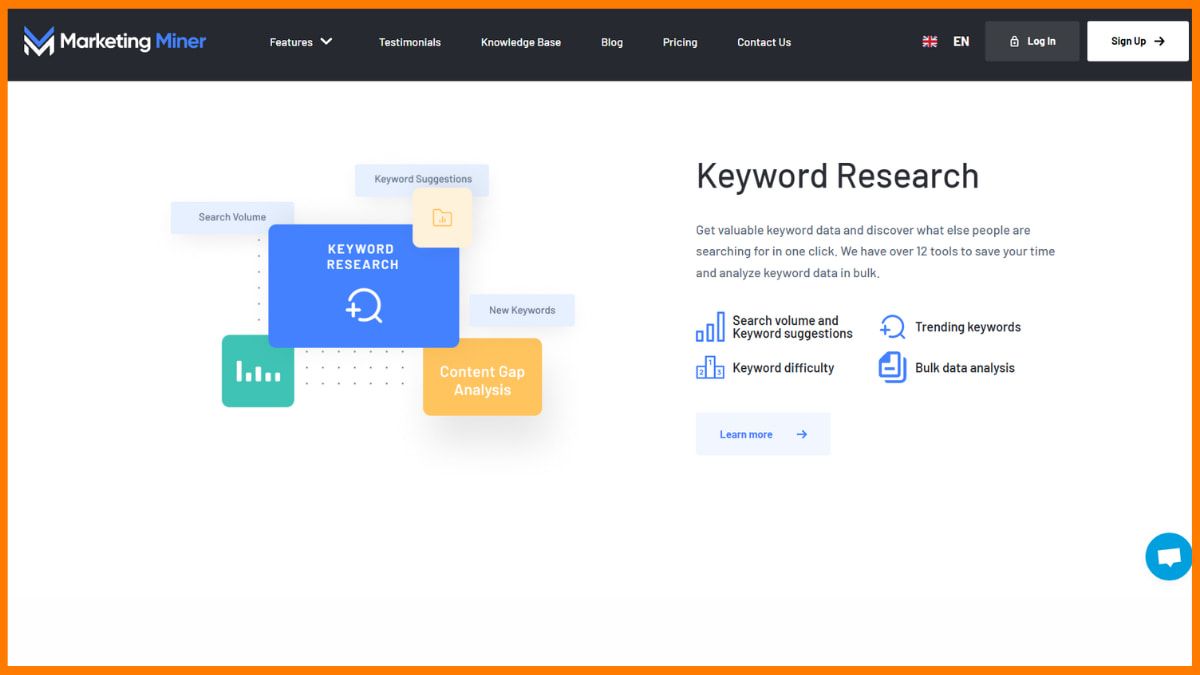
Keyword Research
Keyword Research Feature of Marketing Miner
Based on your search query this feature analyzes the important SEO metrics such as search volume, keyword difficulty, trends, CPC, SERP, etc.
The trending keyword feature lets discover popular keywords similar to your search. Moreover, it also suggests the new keywords that have gained popularity recently.
This feature is meant to detect the technical issues on your site that may be hindering your rankings. You can analyze the indexing status to understand which page of your website is unable to attract traffic.
Another feature lets you check response codes for a webpage so you can find errors and resolve them. This app also identifies which of the external or internal link/s given on your website is broken so you can fix it.
Marketing Miner is also said to reduce keyword cannibalization in your text and help you improve your online visibility.
The search visibility feature estimates the traffic for a page and analyzes ranking keywords for both paid and organic traffic.
The alert notifies you of the technical SEO changes and keeps you updated.
Rank Tracking
Rank Tracking Feature of Marketing Miner
This helps you get detailed information on the performance of your website. The position tracking helps you see the progress of your keyword ranking on regular basis.
A bulk keyword rank checker helps you check ranking for multiple keywords.
Competitor Analysis
Competitor Analysis Feature of Marketing Miner
They offer the competitors insights like which keyword they are using to rank higher. The estimated traffic on the website together with an analysis of their performance based on organic and paid traffic.
This also reveals to you the top-ranking pages of your competitors and helps you make data-driven decisions. Overall, you can obtain the list of sites that always appear as your competitors in Google search.
This tool also makes brand monitoring possible by checking what other people have to say about your competitors. This also keeps a keen eye on the competitors and notifies any changes in their website immediately.
Brand Monitoring
Brand Monitoring Feature of Marketing Miner
This tool detects the online mentions of your brand and how others reacted to it. Thus, helping you build new partnerships.
You can also set an alert for your mentions, so you can immediately respond to them. Also, it tracks the mentions of keywords and phrases related to your niche to keep you updated with the latest trends.
Link Building
Link Building Feature of Marketing Miner
Telling you about the mentions in this app gives you an opportunity to build new links and strengthen your backlink profile. It also notifies if and when the links are removed.
It gives an insight into the websites that rank for the same organic keywords as yours. It also provides the contact details such as email addresses and social media handles that may be interested in working with you.
API
API Feature of Marketing Miner
The Application Programming Interface (API) helps you to extract data without manually logging into the tool. The app provides over 10 endpoints such as search volume, keyword suggestions, etc. to extract data.
The accurate and fresh insights are quite useful in enhancing your SEO strategy while dealing with bulk data.
The REST/POST APIs are flexible and support working on your own dashboards or applications. Project APIs are meant to extract worthy data from your projects.
It is an all-in-one program that reduces the need of using any other SEO tool.
It has quality click-stream data for SEO specialists.
It is relatively inexpensive in comparison to other similar tools.
The data provided is authentic and reliable.
The keyword analysis feature gives you an insight into the customer demand and needs.
It gives real-time alerts of the mentions. Thus, helping you respond quickly.
It has the ability to work with a large amount of data.
It offers simple and intuitive reports.
It is time-saving.
Provides Bulk Data analysis. You can analyse up to 100,000 keywords, domains and URLs
Marketing Miner provides a free version and their paid plan, which starts from $13, is affordable for small businesses and freelancers, in comparison to all the biggest players in the SEO tools market.
Cons of Marketing Miner
The interface can appear crowded owing to a large number of features.
It may be difficult to use in the first instance. So it may take time to accustom to the interface.
The final reports may sometimes appear technical for a layman and may need a little description.
Conclusion
The best part about Marketing Miner is the authentic and reliable information provided by the app. The ability of the app to work on a large amount of data simultaneously gives it an edge over other similar apps. The reports are mostly simple and easy to read.
Still, we cannot deny certain drawbacks to the app. But, the best part about it is that the team is regularly working on updating and improving the features. Our suggestion to them is to first improve their customer care services to hear and help people.
Overall, the app appears good. Most features work efficiently while a few may cause trouble at certain points in time. Comparing the promised and delivered features, the customers are able to take advantage of 95% of the features promised by the Marketing Miner easily which is a really big achievement. Therefore, our suggestion is to give this app a try.
FAQs
What is Marketing Miner?
Marketing Miner is an all-in-one SEO tool for all the marketers and SEO professionals to rank higher on google and grow their business.
What are the features provided by Marketing Miner?
Marketing Miner provides SEO Audit, Keyword research, Link building, Rank tracking, Competitor analysis and more.
What is the pricing of Marketing Miner?
Marketing Miner has 3 plans Miner, Digger, and Machine each cost around $29, $59, and $99 respectively. It also has a free plan that offers 1000 queries for one month.
Company Profile is an initiative by StartupTalky to publish verified information on different startups and organizations. The content in this post has been approved by TrainerCentral.
In the last decade, edtech’s growth has been exponential and has transformed the way in which people teach and learn. People have become more welcoming to remote learning, thanks to the easy accessibility of the internet.
The conventional concept of requiring the physical presence of a teacher to teach a trade has become dormant. More and more people are moving towards online course platforms to share their knowledge with the global audience. The ability to share knowledge with learners across countries and create a streamlined business around their passion has significantly contributed to the growth of online course platforms.
There are always questions about why should a person use an online training platform when they can host live classes on Zoom and post videos on YouTube? The reason is simple, these single-purpose tools are not scalable and will create operational chaos as the business grows. Also, the autonomy of establishing your own training brand is missing here. So, online course platforms are the best tool of choice for course creators to streamline and manage different functions of the business.
TrainerCentral has been launched by Zoho to empower online training businesses and help learners. Read the startup story of TrainerCentral, the services offered, business model, marketing, and more.
TrainerCentral is a division of Zoho. TrainerCentral was conceptualized and developed by a boutique team of engineers with a mission to provide a truly all-in-one online training platform. The product was beta launched on August 2021 for select users and was made available for public on November 2021.
TrainerCentral is an all-in-one online training platform transforming the way trainers teach online. The platform offers a comprehensive tool kit for online trainers to create websites, draft course curricula, host live workshops, encourage community learning and generate revenue around their expertise.
TrainerCentral – Vision and Mission
TrainerCentral’s mission is to make knowledge sharing easy and accessible to all with the help of robust technology. They empower trainers with a unified platform to create, run and scale their online training business without the need to integrate multiple tools together.
TrainerCentral – Industry
TC caters to trainers, freelancers or individuals and basically anyone who wants to transform their talent into a successful profession- for instance a home-based teacher, yoga guru, a 12-year old teaching online gaming strategies, or a company upskilling their internal team. The platform is so intuitive that it fits any type of teaching requirement.
According to MRFR’s survey, the online teaching business is set to grow at a rate of 30% CAGR from 2022 to 2026.
TrainerCentral – Founders and Team
Aarthi Elizabeth – Chief Brand Evangelist of TrainerCentral
TrainerCentral team is a bunch of handpicked proven experts in development, marketing and sales. The team is growing rapidly to accommodate the product’s growth and goals. Aarthi is the Chief Brand Evangelist of TrainerCentral. She has experience in growing SaaS products that have won the market in competitive landscapes and is quite confident about TrainerCentral making a huge impact.
“With Trainer Central, they have addressed this digital gap in the e-learning market, by offering all essential tools on a single, easy-to-use platform so that creators can quickly establish their knowledge brand and nurture a dedicated community of learners, all while turning their passion into profit. As their learner community grows, the trainers can continue to scale their business on Trainer Central.” – Aarthi Elizabeth, Chief Brand Evangelist, Trainer Central.
TrainerCentral – The Idea and Startup Story
TrainerCentral Logo
The team did comprehensive research into the gaps in the existing technology and pain points of the online training community. Deep diving into their research they found that the current players had serious setbacks in not offering important tools and integrations that contributed to inefficiencies in online training businesses.
Upon thorough research, they started developing tools to provide a standout product that is deeply integrated, user-friendly and easily scalable. The product was reviewed by well-known trainers from different regions and the feedback was receptive and appreciating.
TrainerCentral – Products and Service
TrainerCentral – Online Training Platform
TrainerCentral is a cloud-based platform that incorporates various tool kits that enable seamless functioning of online training businesses. The product focuses on providing truly end-to-end solutions that enable trainers to manage various aspects of the business in one platform.
Trainers can create an exclusive website using the no-code drag-and-drop style website builder tools, upload course content, create learning methodologies, automate learner communications, host engaging live workshops, link bank accounts and receive payments and much more.
Trainers can also white label the platform by using customized domains for their website and email communications, thereby maintaining consistent branding and ownership.
TrainerCentral – USP and Innovation
TrainerCentral – Online Training and Learning Platform
USP of TrainerCentral products are:
No-code website builder To help create an online presence for trainers, they provide a no-code drag-and-drop styled website builder tool to build dedicated website for their business. The tool provides a library of pre-defined templates using the trainers can launch a website in a matter of minutes.
In-built live classrooms Live workshop is the most sought out feature by trainers in an online training platform. Trainers can now host live virtual classrooms without having to integrate their Zoom or Google Meet accounts. This feature cuts down the burden on trainers of subscribing and integrating different tools.
Breakout rooms feature in live workshops Breakout rooms are a feature to split live class attendees into small groups and create focused discussions and engagements. Trainers can also be assigned to different breakout rooms.
Intuitiveness and flexibility TrainerCentral is known for its intuitiveness and adaptability. The tool was developed from a trainer’s POV, so the platform is sequential and simplified. Anyone with basic computer knowledge can set up and launch an online course without any technical assistance.
White labeling The platform is white label friendly. Trainers can use customized domain for their website to maintain consistent branding. In addition to website domains, email communication domains can also be customized.
Payment gateway integrations TrainerCentral supports payment gateways such as Razorpay, Stripe, Paytm, Forte, Authorize.net, PayPal Payment Pro, and PayPal Payflow Pro.
Top-notch security TrainerCentral is GDPR compliant and follows robust security methodologies to ensure data privacy and security.
TrainerCentral is offered in three different pricing models.
Free Plan: $0 USD
Unlimited learners
Up to 3 free courses
Starter Plan: $16.67 USD/month when billed annually or $20 USD/month
Unlimited learners
Unlimited courses
Live virtual classroom (Up to 50 live participants)
Professional plan: $41.67 USD/month when billed annually or $50 USD/month
All the benefits of the Starter plan
Live virtual classroom (Up to 100 live participants)
Custom domain (full rebranding)
Coupons and discounts
Multi-currency support
TrainerCentral – Customer Acquisition
During the beta launch period, they signed up trainers from different industries and markets to understand the product fit and adaptability. This helped them to refine the product much better and create a wholesome experience for trainers irrespective of their industry.
They were able to convert 60% of their beta users to paying customers. Post public launch, the product started getting organic traction as people started starting their feedback on online forums.
TrainerCentral is focused on organic marketing and product-led growth. Their idea is to add more product value in a cost effective manner and this made them stand out in the market. TrainerCentral subscription charges are 50% lesser than any other providers in the market.
They are focused on content creation to scale the business further. As a team, they believe in long term focused marketing activities, thus spend 90% of their efforts on content.
TrainerCentral – Challenges Faced
The main challenge was to communicate the product’s unique value proposition and gain brand awareness during the initial phase. They focused on product positioning and streamlined communications, to resonate and empathize with potential customers and industry.
TrainerCentral user base is growing on an average of 25% MOM with promising signs to double in the next quarter. Currently, the user base is majorly from India and the US, and have plans to expand to Europe and Eastern countries.
TrainerCentral – Future Plans
TrainerCentral’s product map for the next 1-2 years is to develop the existing features more comprehensively and populate the integration library.
TrainerCentral – Competitors
Few of their competitors are:
Teachable
Kajabi
Thinkific
FAQs
What is TrainerCentral?
TrainerCentral is a cloud-based training platform for trainers and learners.
When was TrainerCentral founded?
TrainerCentral was founded in 2021 in Chennai.
Is TrainerCentral a part of Zoho?
TrainerCentral is a division of Zoho to empower trainers.
What is TrainerCentral pricing?
TrainerCentral Pricing:
Free Plan: $0 USD
Starter Plan: $16.67 USD/month when billed annually or $20 USD/month
Professional Plan: $41.67 USD/month when billed annually or $50 USD/month
Businesses are always in search of easier integration and better operations. By creating a smooth workflow and setting up the automation between software such as marketing tools and payment gateways, businesses can boost productivity and focus on important tasks.
That’s when Pabbly Connect can come in handy. Pabbly Connect is a great time-saver tool with absolutely no coding required to set up workflows and integration between the apps.
But how does Pabbly connect work to create workflows between different tools and platforms? In this article, we have shared the working of Pabbly Connect and the types of Pabbly integration.
Pabbly Connect is an automation tool that connects two or more apps together and helps in automating the data transfer between these apps by creating the workflows.
Using Pabbly connect, you can seamlessly transfer the data between your favourite software, SaaS tools and services without making manual efforts. Pabbly Connect helps you connect a wide range of applications together to create streamlined workflows.
Pabbly Connect Glossaries
Before we explain to you the working of Pabbly Connect, there are a few terms related to it that a user needs to know.
Trigger: Trigger is the main application through which the data transfer takes place.
Action: An action is a step where you need to add the other apps to which you want to transfer data and perform an action from that app.
Tasks: Any action performed inside the workflow is called a task. Note that triggers are not calculated as the task. A task is considered when an action takes place in the workflow.
Operations: Once you have set up the automation, a new check is performed after a fixed time to see if there is any new data. If there are checks after every 5 minutes, the total operations in a day would be 288. That’s why Pabbly Connect offers unlimited operations.
Workflow: A workflow is a combination of a trigger and action steps. It may have more than one action. There are unlimited workflows but you may be charged for the actions.
Iterator: The iterator divides various data into different variables one by one until the last value is reached. These values are passed from one action step to another if an iterator is added.
How Does Pabbly Connect Work?
Pabbly Connect is a cloud-based application that does not need any downloads. You can sign up and get started with a free version. The free version of Pabbly Connect offers unlimited workflows and unlimited operations so that you can create the internal workflows instantly.
Pabbly Connect workflow is usually a 2 or 3-step process.
The two steps are namely:
Trigger (If something happens)
Action (Do this when…)
You can add as many action steps below depending on which apps you want to transfer the data. Besides this, you can also add filters, iterators and routers in the action step.
Pabbly Connect gives two integration opinions; webhook and API module integration.
With the webhook, you can connect to over 800+ third-party apps. These are the apps with which Pabbly provides direct integration. However, you will need to follow some steps to connect the trigger app to perform an action. Different trigger apps require different steps to capture webhook responses and create a workflow.
Setting up a Webhook Integration in Pabbly Connect
Trigger
This is the first step to creating workflows in Pabbly. The trigger will send the data to the action step when an event occurs in the triggering app.
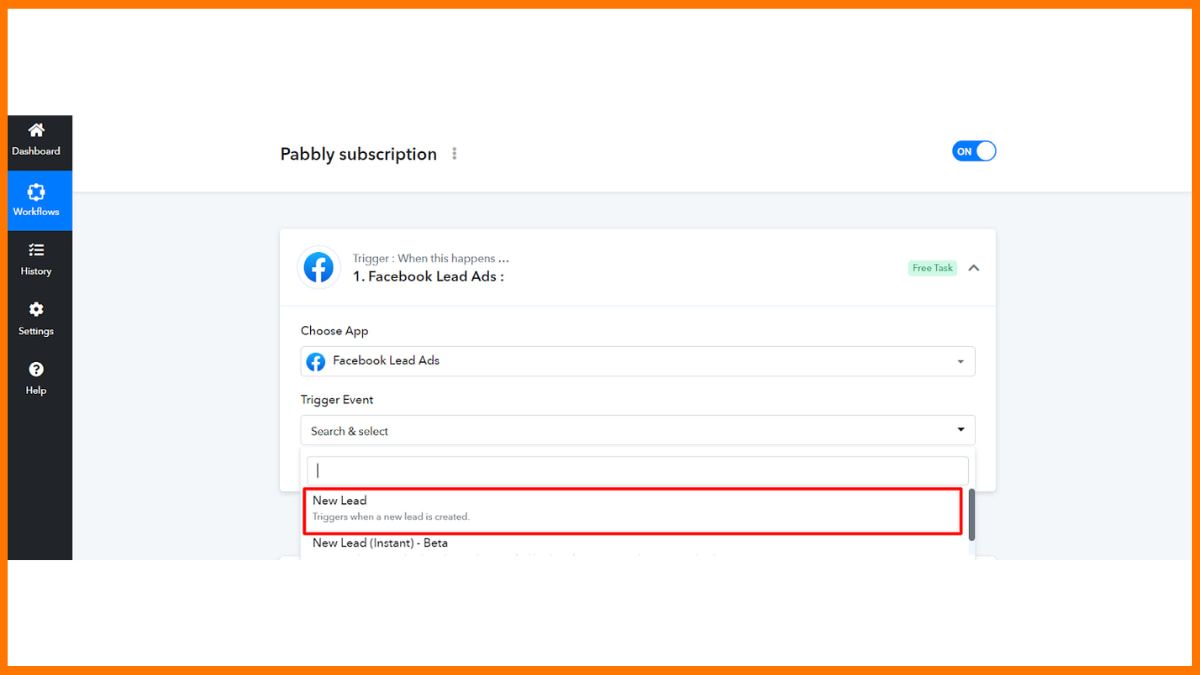
Choose the app that you want to set up as a triggering app. Add the filter ‘Triggering event’ when you want Pabbly to perform the action.
For example, if you wish to perform the action only when a new Facebook lead is generated, you can choose the trigger app as ‘Facebook’ and the Trigger event as ‘new lead’.
Adding Facebook Lead
While some apps may require you to perform a few steps through the external apps to capture the webhook response, some triggering conditions or apps do not require any steps to capture the response.
Here are some examples of Triggers:
When a customer purchases something from PayPal.
When someone submits a form on Pabbly form builder of another form builder that you chose.
When a new user books an appointment.
Actions
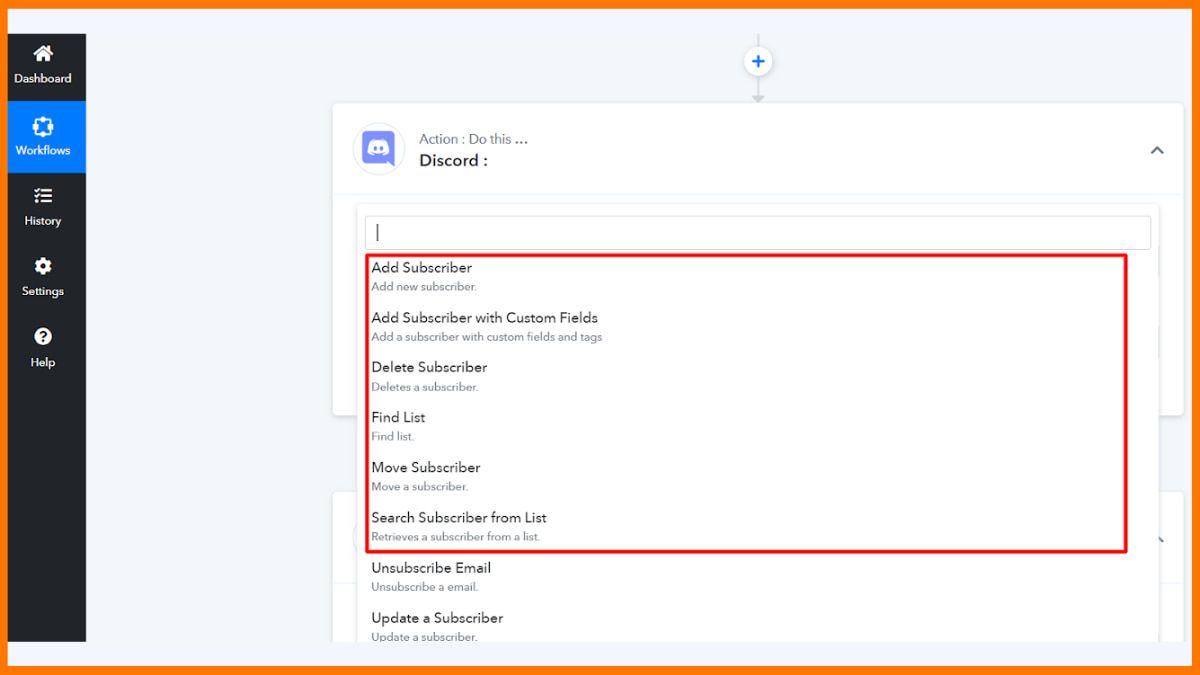
An action is performed when the required event occurs inside the trigger app. By choosing the application and what action you want this app to perform, you can integrate these two apps together.
Adding a subscriber using Discord
A filter tells the data that type of data you wish to send.
Here are a few examples of actions inside the Pabbly Connect workflow:
Add the new lead to the email list inside MailChimp
Share files through Dropbox
Set up welcome SMS through Twilio
You can also set the conditional filters to perform the task only when a specific action occurs.
Let’s consider an example where a user wants to add a new contact to the email list when a new charge occurs through Stripe.
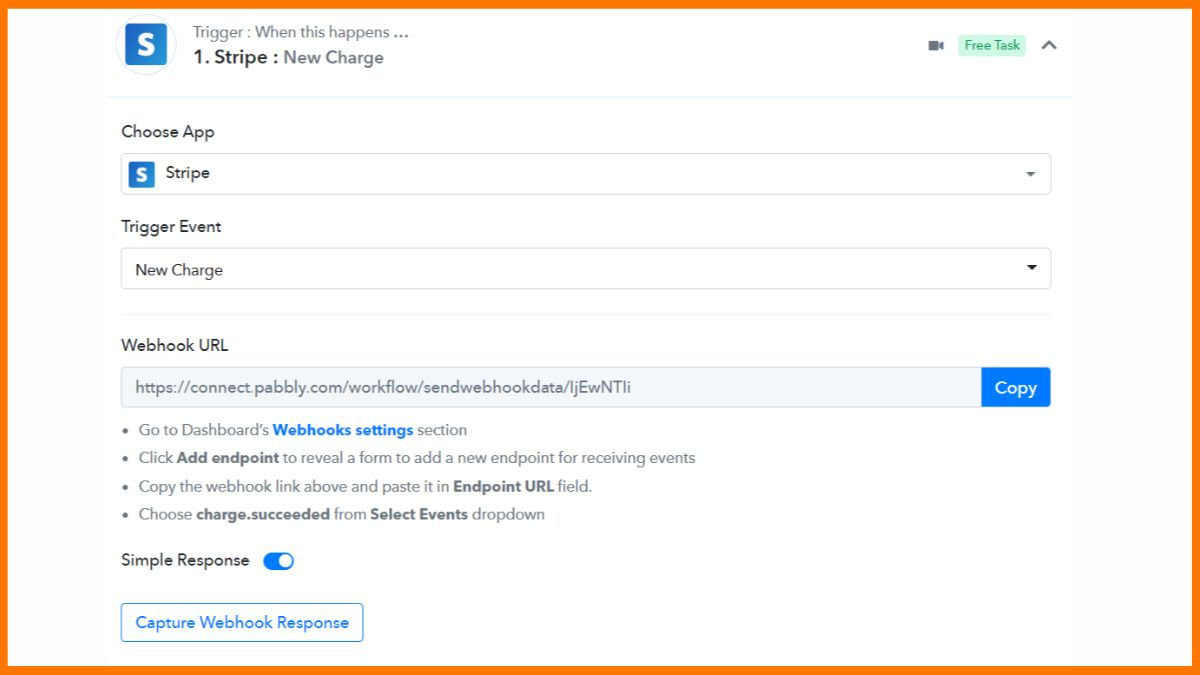
Step 1: Choose the trigger app ‘Stripe’ and select the trigger event as ‘New Charge.
Creating trigger event using Stripe
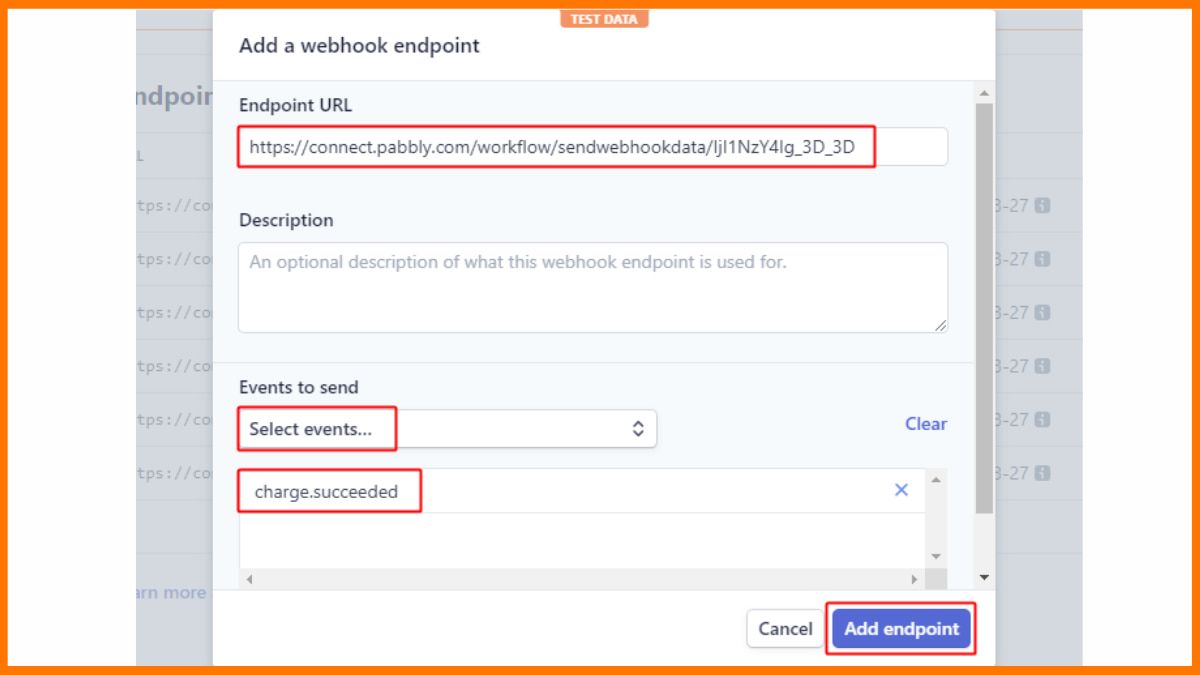
Step 2: Go to Stripe’s webhook settings section and add the new endpoint by clicking on ‘Add endpoints’.
Step 3: Copy the webhook URL and paste it into the endpoint box. Also, choose the ‘charge. succeeded’ as the events to send responses.
Adding Webhook
Step 4: After adding the endpoint, click on the ‘Capture Webhook Response’ button to connect Stripe with Pabbly Connect.
For this, you need to make a test payment.
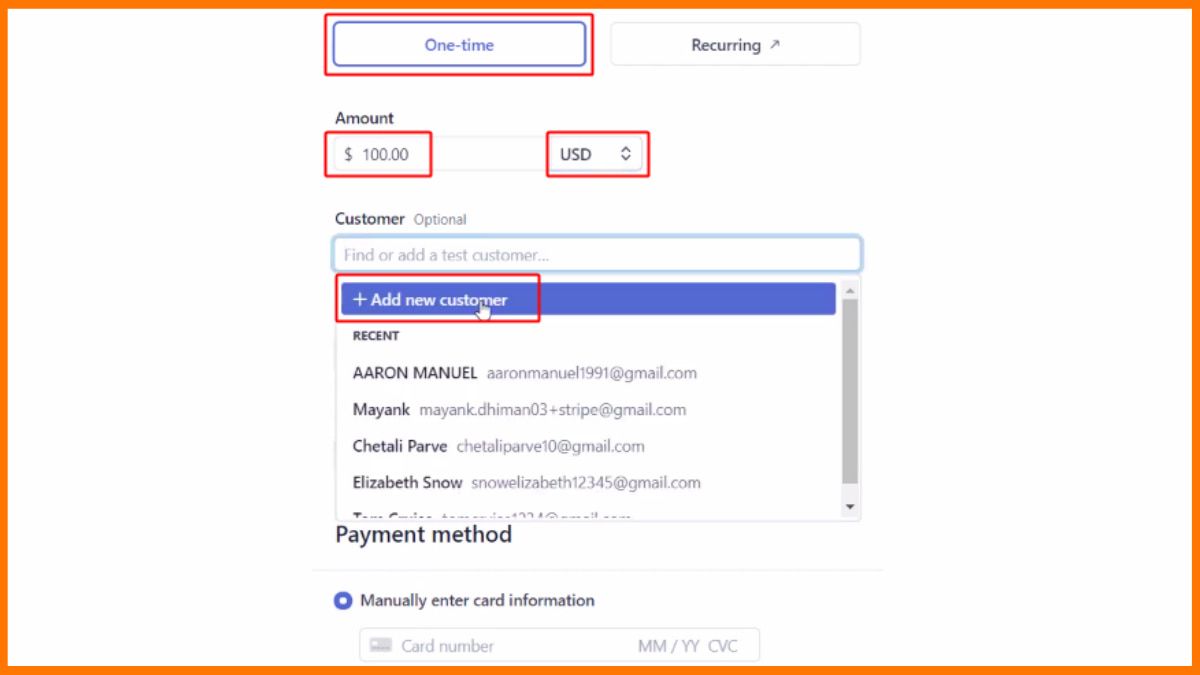
Step 5: Make a test payment through Stripe by selecting the email, name, currency and adding a new customer.
Adding a new payment and customer
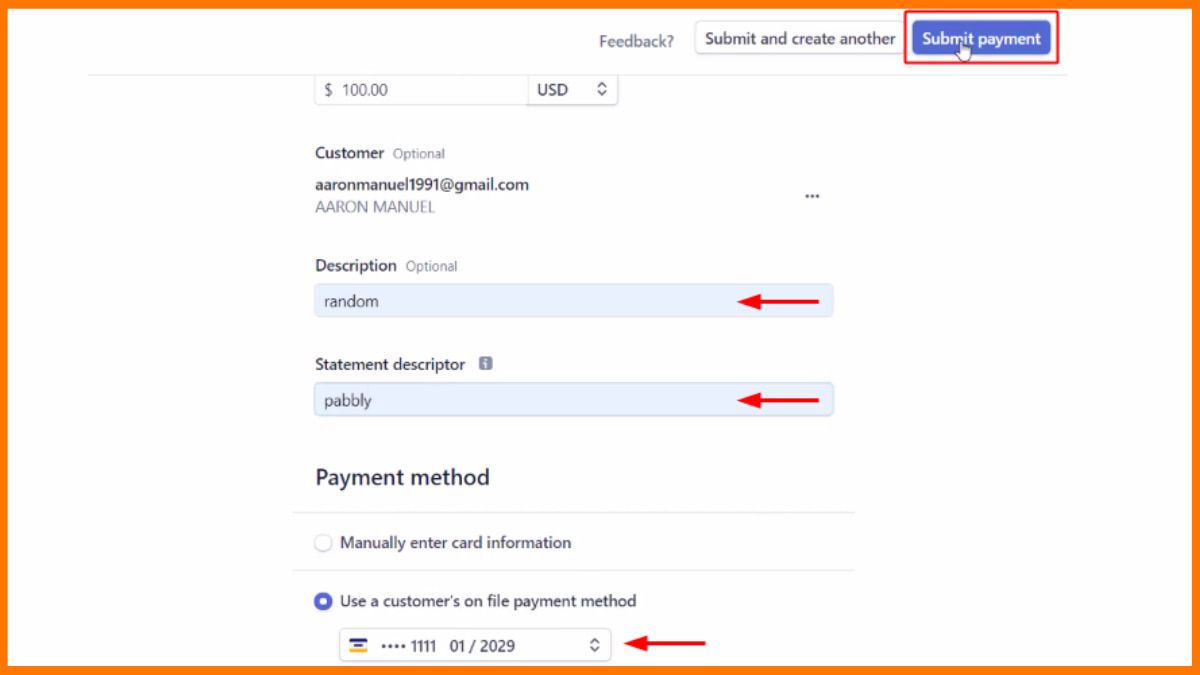
Step 6: After adding all the required information, click on Submit payment to perform a test payment.
Submitting Payment
Step 7: Once you have made the payment, your trigger app will be connected to Pabbly Connect.
Step 8: Next, connect the action app with your Pabbly Connect account by choosing the app that you wish to integrate.
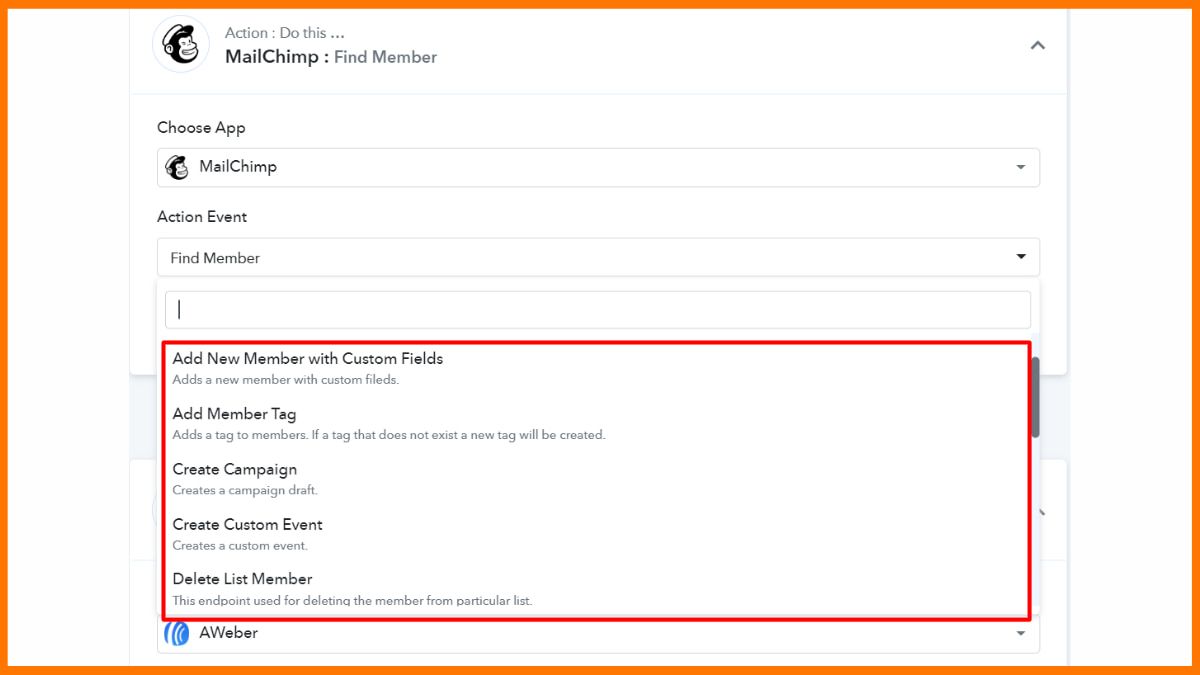
For instance, select MailChimp as the action app and choose the action to perform.
Selecting the action app – MailChimp
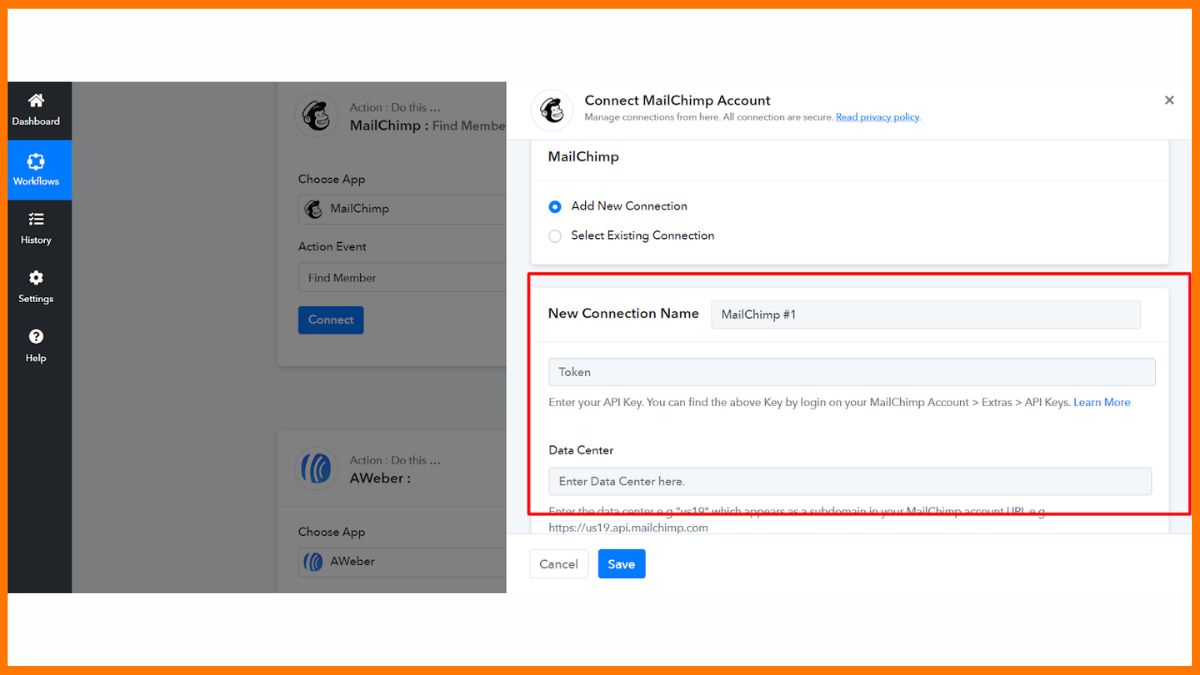
Step 9: Once you click on Connect, you will be asked to integrate the API keys from the action apps to Pabbly Connect. Follow the steps as mentioned.
Adding a new connection in MailChimp
On clicking ‘Save’, your action app will be integrated with the trigger app. Thus, a new workflow will be created between these two apps.
You can further add more action steps if you wish to transfer data from this second platform to the third one.
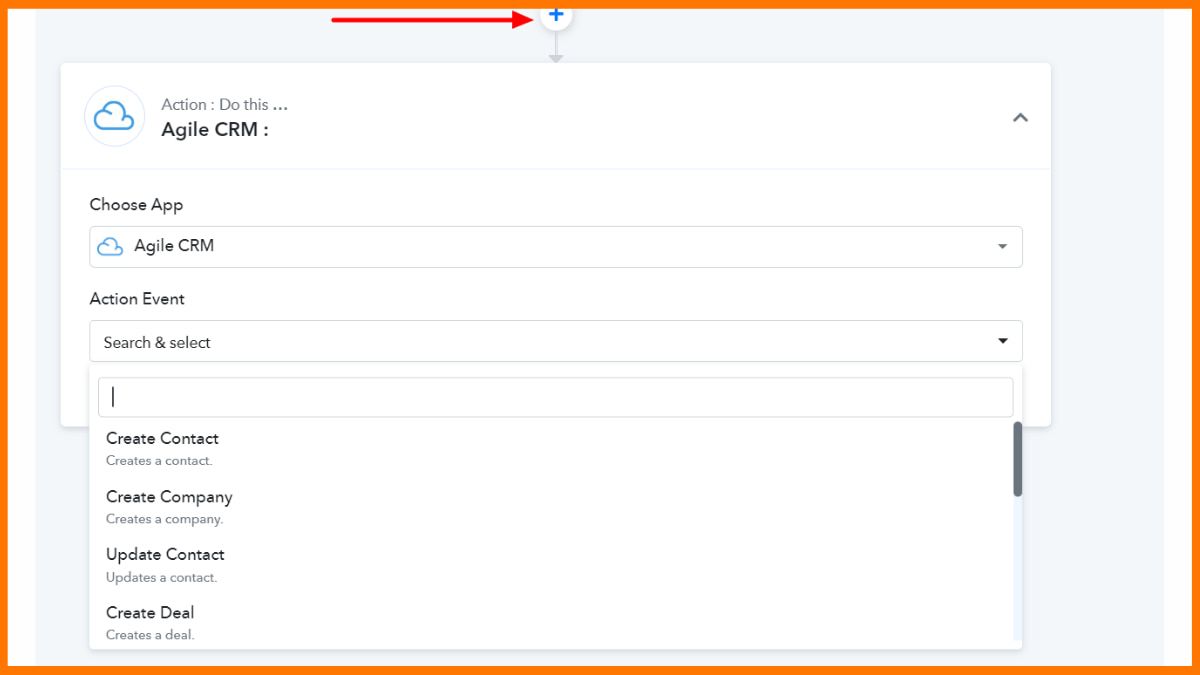
You can add as many action steps by clicking the ‘+’ button. Choose the application to connect and the event for which you want to perform the action.
Selecting the action app – Agile CRM
What makes Pabbly Connect easy to use is that it gives a step by step guide on how to connect the specific apps to the workflow.
Different actions and events may require different steps to perform and connect these apps. But, the basic idea behind the workflow creation is to smoothly transfer the data between these apps and reduce the time and effort.
Another method of integrating these apps is via the API module.
Filters can be used in the action step to perform an action only if a specific field in the platform is selected.
Let’s say, you wish to gather data from a specific gender using your form. Once you’ve selected the trigger app as any form builder, connect it to the Pabbly Connect and then add action as ‘Filter’.
Select the Filter field as ‘Gender’ and choose ‘equal to’ from the drop-down. Enter the value as ‘female’ or ‘male’ whichever you want to capture.
You can connect the trigger app like form builder with an action app such as Google sheet to collect only the responses from a specified gender. Thus, Pabbly Connect can also streamline your task of filtering the conditions.
What Apps Does Pabbly Connect Integrate With?
Pabbly Connect offers integrations with over 800 different apps. Pabbly Connect seamlessly integrates with apps including:
Marketing
CRM
E-Commerce
Helpdesk
Payments
Web forms
Collaboration
These include apps such as 123 form builder, Agile CRM, HubSpot, Zendesk, Stripe, PayPal, Slack, Ninja Forms and many others. Check out the full list of integrations here.
Conclusion
Pabbly Connect is an amazing workflow creation software that helps you integrate various apps together and enable you to perform actions. In fact, it is one of the best Zapier alternatives at present.
What makes it better than Zapier is that it allows unlimited operations and allows actions as a task. This makes it more affordable than Zapier. Plus, setting up the trigger and action is fairly easy since you get the step by step guidance on how to set up the action.
Above all, Pabbly Connect offers 100s of helpful guides and video tutorials to help you understand how the integration works. You can sign up and start with Pabbly for free and perform 3x workflows as compared to other similar apps!
FAQs
What does Pabbly Connect do?
Pbbly connect lets you integrate 800 plus tools and helps you streamline your workflow.
How much does Pabbly cost?
The basic plan of Pabbly Connect starts at $10/month and goes upto $40/month
Is Pabbly Connect Free?
No, but Pabbly Connect provides unlimited workflows, operations and 100 tasks per month for free.
Software as a service, commonly abbreviated as SaaS, is a type of software that is hosted by a software company or single provider. It permits its customers to connect to and use apps based on the exclusive cloud-based feature over the internet.
The customer need not need to worry about the storage. The software is backed up by the product engineers of the providers. The customer success team looks after the management of the software.
SaaS sales can be understood as the process of selling web-based software that is accessible by the customers through an online portal. SaaS sales products help solve business-related issues.
SaaS sales are regulated by the following sales representatives- Sales Development Representatives (SDRs) and Business Development Managers (BDMs). The former focuses on the outbound sales and qualifying leads, and the latter works on conducting product demos and closing deals respectively. Here is a list of a few most common challenges faced by SaaS founders that they face when selling SaaS, along with suggestions on how to overcome them.
Like all B2B sales, the prime objective of the SaaS sales team is to generate qualified leads and revenue for the company.
Planning gives an idea about what we are up to and paves the direction for us. Therefore, a strategized sales technique must be adopted. The decision of the SaaS sales strategy depends on the company’s SaaS adoption and development.
The SaaS sales strategy includes various sales techniques to fulfil two-fold objectives i.e., upselling clients and closing deals.
A SaaS Sales strategy plays a vital role in the success of the company as it focuses on the growth of the company and its position in the market, in the longer run. The SaaS sales strategy most commonly uses the subscription-based pricing model. While creating the strategy the team must focus on the following points:
Lead generation to turn interested into sales.
Focus on the target group of the market and convert prospects into consumers by introducing them to the company and its offerings.
The final stage of the transaction includes the agreements signed between the company and the customers thereby, resulting in sales.
This simple 3-step transaction has to face a lot during the implementation phase.
1. Qualified and Unqualified Leads
Lead Generation
Lead generation gives happiness. But the same end up in tears if it does not give you a sale in return. Therefore, it is necessary to make sure that you do not waste time on unqualified leads.
Categorization of your leads into qualified and unqualified must be followed after lead generation as not all leads require an equal amount of attention. Contacting all leads will result in a waste of time and leave you exhausted.
Here, the team needs to come up with a strategy so that more time and focus can be given to the most important leads. This distinction could be made by a little survey through an interesting and engaging questionnaire in a Google form or measuring their quality through a lead scoring formula.
Preparing a lead scoring model that fits your business model is a good idea. It helps to focus and save time on the most important inbound leads. It can also prepare you for future dealings with bigger opportunities yet to come in the future. The lead scoring formula gives amazing results when comes to filtering the potential customers from the free trial users who are never planning to convert.
2. Stressful SaaS Sales Cycle
SaaS Sales Cycle
SaaS sales cycles vary from product to product. Each sales cycle depends on various factors such as the target market, the pricing model, or even the target audience.
It might involve dealing with unrealistic expectations at times, which creates pressure on the sales team. The only solution to this problem is- Benchmarking. It helps you get started as you have a goal set to achieve. Once the benchmark is reached, it’s no more an issue. The next step is to align the results with the expectations.
The team should set a benchmark to predict the average sales cycle based on industry, pricing, and customers’ needs.
3. Choosing the Right SaaS Sales Model
Sales models play a vital role in the success journey. However, picking one isn’t as simple as it may seem. Your decision directly impacts the growth and revenue. Therefore, all the SaaS sales model options available must be reviewed thoroughly. Further, there should be a test to find the most suitable one in a limited time.
Finally, it can be rolled out if successful. Otherwise, there should be a re-test if your sales model lacks at any point for your SaaS product.
4. Conversion from Freemium to Premium
This one can be regarded as the biggest challenge for every SaaS business that wants to grow.
Many of the generated leads are of the view that they would enjoy the free trial and switch to the other SaaS product’s free trial once the previous one gets over, without paying for the product in the end.
It’s good to know that all the free trial users cannot be convinced to pay. But at the same time, you need to pay attention to those who are showing interest in your SaaS product in a different way as compared to others. They could be the ones who would like to continue.
That is the point where you need to create an engagement and keep those warmest leads engaged throughout the trial period. You need to set up a strategy for how you approach them.
You need to make them well versed with the benefits and further exclusive features eagerly waiting for your customers once their free trial ends. You should let them know how that your product is important to them as they are to you.
You must try to find out more about them and try not to overwhelm them. Take them into trust with your pocket-friendly policy and other benefits by the time they get ready to retain with you.
5. Too Many Options to Choose From
Too Many Options
New SaaS products pop up like crazy. Having competition is good – it increases the value of the market.
When a customer is looking for that one product that satisfies exactly what he wants, he faces too many options. The customer gets confused about which SaaS product to choose from when several options are presented before them.
To make your product the most obvious and preferable choice out of many alternatives, you must think like a customer. You need to figure out the ways to stand out in the heavily crowded market.
You need to highlight the most exclusive feature that compels your customer to opt for your offering, over the other options available to them at the same time.
While presenting your product, you need to explain its value, how is it different from the other offerings, and how it benefits your customer.
Your website must be customer-friendly. It must be a little more informative than your competitors; fill it with the past experiences of you and your present and current customers. The content must be such that it helps customers make more informed decisions.
Every SaaS business faces sales challenges. Sales is not an easy task, we need to earn it. There is a solution to all the challenges. Whether it’s the lack of time to qualify all the leads, a longer sales cycle, or dealing with a saturated market. The only thing we need to do is to figure out the right strategy and find the best possible solution to get the SaaS product in front of customers.
FAQs
What are sales biggest challenges in selling SaaS?
The customer is faced with too many options, converting a customer from a free trial to a paid customer, choosing the right sales model, and qualified and unqualified leads.
Is it hard to sell SaaS?
Yes, selling a SaaS product is not easy as there are already other companies trying to convert customers into paid customers so it is important to make your product stand out and provide the best customer service.
Why is SaaS so profitable?
SaaS businesses are profitable as it is a recurring model where you are already earning revenue from recurring customers as well as from new customers.
An entrepreneur should identify a need in the market before starting a product or service. When entrepreneurs build a solution that customers are satisfied with, the success of their product is quite obvious. Your value proposition should hold true for being in a good market with a product that can satisfy that market demand.
On finding the Product-market fit for SaaS products, entrepreneurs from SaaS industry shared their ideas. Get an insight into the Product-market fit for SaaS startups.
Shayak Mazumder – Co-founder, Eunimart
Shayak Mazumder, Eunimart Co-founder
In 2017, before we started building the product, we did roadshows across many cities and towns of India, speaking personally to thousands of merchants to understand the kind of software they use, the network issues they face, their staffing issues, etc. We identified the biggest challenges facing these merchants both from the merchants as well as the subject matter experts who came to speak in our roadshows. This helped us to build a very robust plan for the product because we knew exactly what were the biggest challenges facing these merchants and what the impact of solving them would be.
Most external folks who didn’t have this insight initially advised that we were doing too much. However, we were certain that unless we solved the entire problem, chipping away at the minor problem statements would only help a minuscule segment of the merchants who could figure out things for themselves. This resulted in rapid growth once we launched the platform in 2020, with hundreds of merchants signing up organically. We continue to take feedback from the industry in building our platform.
Robin Das – CEO, Brandintelle
Robin Das, CEO of Brandintelle
Finding PMF is never easy. A product can improve their PMF by –
Talking to potential/current customers and understanding their day-to-day life. Sometimes getting a larger context is more important than just focusing on what your idea is addressing.
Analyzing if the problem your product is solving is big enough so that your customer will be willing to change his habit & pay for the service.
Read up on the competition. If there is no competition yet, there could be a 10% chance you’re onto something really big and a 90% chance that the problem you’re solving is either too small or does not exist.
Once you hit PMF you’ll know, as your email inbox or phones won’t stop ringing and you won’t have the resources to meet the demand.
Pramod Gummaraj – CEO, Aprecomm
Pramod Gummaraj – CEO of Aprecomm
Product Market Fit does not stop with generating MVP (Minimum Viable Product) and traction in the industry. Product Market Fit is a continuous process, particularly in the case of SaaS (Software as a Service) models. There should be a visible increase in the value addition Year on Year to keep the customers motivated and interested in continuing the engagement. So, it is particularly important to keep interacting with customers, to keep driving the innovations. Always, look for ways to upsell.
Product market fit is one of the first and most fundamental activities for any company to nail as early as possible. It can evolve to some extent over time, but getting it right as early as possible is key. Courseplay launched at a time when formal learning platforms were virtually non-existent in companies in India, especially the small and mid-sized companies. I remember spending a lot of time researching the market and speaking with real companies about challenges that they are facing when deploying skill development solutions for their companies. I remember getting a lot of clarity the more I would talk to different people because they would share real-world problems and help me focus on practical solutions rather than develop something that might sound good on paper but be impractical to deploy. I particularly remember one client that talked about the importance of measuring impact in learning, and we have been obsessed with delivering that answer ever since.
Shreyan Gandhi – Director and Co-founder, Comket Solutions
Shreyan Gandhi – Director and Co-founder, Comket Solutions
Our product market fit was identified by the problems we faced ourselves. We found a whole bag full of business cards in office and we had no idea which card we got from whom, we had no recollection of the vendor or anything that stood out. That’s when we decided to make networking impactful, a way in which the consumer can share their details in a seamless way and also to make a lasting impression on the person receiving the information. During our beta phase we realised we weren’t the only ones facing this problem. A lot of people had a stack of business cards that they eventually threw away or forgot about.
Not only the Indian market but even the global market and businesses are facing the challenge of maintaining constant communication with their customers daily. The overall call centre industry is worth $339.4 Billion, but still, businesses are losing ~10-15% of their potential revenue just because of lack of timely communication.
Considering the above stats, it is evident that the Product is a market fit that can cater to all the calling needs of businesses at a 10X faster pace by placing 1M+ calls a day.
Traditionally, software was distributed in different forms such as through CDs and DVDs. These practices are used to cost the user and distributor the additional responsibility of installation and maintenance of the software.
The new alternative to this practice is to directly download a subscribed service by the means of the internet. They are termed SaaS. SaaS is a software distribution method that allows the end-users to directly purchase and download their needed software by the means of the internet.
SaaS has gained much hype in the last few years. Many different startups and companies are investing in SaaS for vivid reasons. Some sell their products by SaaS, or others use SaaS for improving their business. Irrespective of the need, creating a SaaS is a hectic job.
Imagine creating a SaaS product with such dedication. However, in the end, you are left with an almost negligible amount of customers acknowledging your efforts. The biggest fall for any product is through its customers. Customers are the biggest resources for success. Creating the best user experience for any SaaS developer is surely one of the major tasks.
There are a few tricks and tips one can try to implement for a better SaaS user experience. Some of them are:
Work Towards Creating a Good Impression
We all have heard and believed the proverb “First impression is the last impression”. Creating better impactful landing pages can attract the attention of customers. On average, a visitor roughly spends about 10-20 sec on each webpage. These initial seconds are the time when a judgment is passed towards it. Creating an attractive and thoughtful landing page can surpass this period. Surpassing can increase the chance of converting a visitor into a customer.
Begin With Ease
The beginning is the first and most crucial step of any journey. Providing customers with an easy start can be more beneficial. There can be times when a SaaS product loses out their customers at the start only. This can be because of a complex starting procedure. It’s best to keep the start simple and clear.
Starting with complex or time-consuming steps can irritate the customers. Even to sign in, it is best recommended to ask for needed information only at the start. As an alternative one can also add up the option of skipping unrequited formalities at the start.
Be Clear About Your SaaS Product
SaaS is a product brought by some amount. Before buying the product, no user has the proper acknowledgement of its services and tools. Not all products of the same field offer the same services. Customers buy the SaaS depending upon their requirements. Without actually having the idea of detailed work, a customer can’t make a call. Giving out clear information on the subscription given by the amount and the tools made available will be a plus point for both sides.
Provide Clear Guidelines
New users might get stuck in some steps. Keeping clear and detailed guidelines for customers can make them grateful for the team. Guidelines can be in the form of a small tour of the service, it can be a video explaining any error, a pdf full of basic working, or a graph showing the next steps. Guiding users makes them feel valued. This is a great tactic for avoiding any negative comments about service.
Have an Open Communication System
There can be times when clients might feel stuck. And no possible solution is made available to them through any guide. At such times, they might feel the need to have direct contact. For such occasions, keeping one or two methods as a part of communication is recommended. It can be in the form of an email or any other similar service.
As much as it is important to provide clients with an immediate contacting option, it is also an essential part to answer them. For one to have better control over their customers, they should constantly reply and communicate with customers on all of their needed issues.
Follow Real Advice
Each service has a comment section below it. This is the place where one can easily track the accuracy of their made products. Be it grocery products or a SaaS product. It is best to keep track of given comments for a better understanding of the target audience and their needs. This can also avail the developers with the knowledge of their competitor’s strategies.
Provide Improved Services Constantly
The purchased users are the ones who can attract more customers by their comments and feedback. It is important to provide them with satisfactory service. New implementations are required to be made now and then.
Developers should avail their SaaS users with new implementation as a part of the update. This update should also be explained and notified to the users by any possible means such as a message box or notification to their registered email.
Be Grateful
Showing gratitude to the SaaS users can alleviate their experience. Along with that, it can also make them a trusted client of your SaaS product. There are different options for making your users feel special.
Giving out any free service as an addition or providing them with a free trial of service for a limited period. All these can create a good impact on clients.
There are many practices one can implement for improving the user experience. The above-given examples are some of the most simple and needed implementations by markers.
Conclusion
SaaS (Software as a System) is the distribution of software by the means of the internet. Software as a service (SaaS) is one type of cloud computing along with Infrastructure as a service (IaaS) and Platform as a service (PaaS). SaaS works to deliver software to the client directly without the need for additional instalment and management of any software or hardware.
SaaS startups and products are gaining much hype recently. There are many factors affecting the success rate of SaaS products. One of them is their user experience.
FAQs
How do you improve SaaS UX?
Provide Clear Guidelines, Provide Improved Services Constantly, and Be Clear About Your SaaS Product.
What are SaaS best practices?
Provide a better user experience, focus on personalization and compatibility with all devices.
What are the examples of SaaS?
Some of the most common examples of SaaS are Microsoft Azure, Dropbox, Google Docs, etc.
What are some of the failed SaaS startups?
Some of the failed SaaS startups are Teamometer, RingDaddy, Habitual, etc.
 Nitin Konde