To improve its coverage of deliveries that take less than 30 minutes throughout its vast network, Reliance Retail has opened more than 600 dark stores around India and intends to open more. After the quarterly results, Reliance Retail CFO Dinesh Taluja responded to an analyst question by stating that JioMart is in a better position because of its vast network of physical shops and the establishment of dark stores in specific areas. JioMart had a 42% Q-o-Q growth and a 200%+ Y-o-Y rise in average daily orders, while Reliance Retail has already operationalised 600 or so dark stores and is investing further to increase its play in speedy hyper-local delivery.
JioMart Ramping its Quick Commerce Services
With operations spanning 5,000 pin codes and served by over 3,000 outlets in more than 1,000 locations, JioMart continues to be the fastest-growing quick hyper-local commerce platform, according to Reliance Industries’ parent company’s results statement.
With its extensive network and well-placed hidden shopfronts, JioMart’s e-commerce platform—which competes with rapid commerce competitors like Swiggy Instamart, BigBasket, and Blinkit, owned by Zomato—has likely grown to be the biggest in the nation. Six months prior, during the March quarter, Reliance Retail claimed that 4,000 pin codes nationwide were served by its hyper-local delivery. Additionally, Reliance Retail has promised 30-minute delivery in ten cities for its fast hyper-local deliveries to the electronics and accessory categories.
The Recent Growth of JioMart
The business noted that JioMart attracted 5.8 million new consumers, marking a notable increase in client acquisition. This indicated a 120% Q-o-Q growth rate. The platform’s seller base increased by 20% year over year, and in order to increase customer choice, the live catalogue variety was further enlarged.
With plans to construct dark stores to increase the coverage area, Reliance Retail, which formerly had retail operations in 77.8 million square feet across India with 19,821 outlets, is drastically scaling up. Reliance Retail had previously stated that the JioMart app uses its network of Reliance Retail stores to deliver within a three-kilometre radius as part of the goal.
Quick Shots
•Reliance
Retail activates 600+ dark stores across India to strengthen its hyperlocal
delivery network.
•Goal:
Deliver orders within 30 minutes using strategically placed dark stores.
•JioMart
sees massive growth – 42% quarter-on-quarter and 200%+ year-on-year rise in
daily orders.
•Coverage
expanded to over 5,000 pin codes and 1,000+ cities, served by 3,000+ outlets.
•Competing
with Blinkit, Swiggy Instamart, and BigBasket in India’s quick commerce race.
•Customer
growth: 5.8 million new users, up 120% Q-o-Q; seller base up 20% Y-o-Y.
•Reliance
Retail footprint: 19,821 stores covering 77.8 million sq. ft nationwide.
•Focus
on electronics, grocery, and accessories under the 30-minute delivery
promise.
•Expansion
of dark store network planned to further enhance speed and reach.
The House of Abhinandan Lodha has partnered with Zepto, a quick commerce platform, to reportedly provide land plots in ten minutes. In a recent advertising campaign, the real estate player revealed the partnership.
The commercial, which was released during the Janamasthami festival, features expansive land plots and concludes with a delivery partner holding a picture of the plots.
Partnership With The House of Abhinandan Lodha
“This Janmashtami, reimagine land investments with India’s largest branded land developer, The House of Abhinandan Lodha and Zepto,” is the tagline of the promotional video. Whether Zepto will merely serve as a showcase for The House of Abhinandan Lodha or sell property plots on its behalf, akin to real estate websites like 99acres and MagicBricks, was not made clear.
Zepto’s Growing Brand Collaborations: From Skoda to Realty
In February, Zepto teamed up with Czech automaker Skoda to provide test drives for the Kylaq, the company’s small SUV, in India. Aadit Palicha, a co-founder of Zepto, later denied that the partnership was interpreted as Zepto promising to deliver the car in ten minutes.
IPO Preparations and New Fundraising
Zepto has been working to get ready for its IPO in India. Before going public, it obtained an INR 400-crore investment from Motilal Oswal Financial Services to increase its Indian stake. According to various media reports, Zepto was valued at approximately $5.4 billion, or INR 47,298 crore, as part of a larger INR 1,000 crore sale, ET said.
At the same time, Zepto is wrapping up a primary round that is being led by current investors Avenir Growth and General Catalyst. Additionally, the founders of Zepto are funding INR 1,500 crore from domestic family offices, Edelweiss Alternative Asset, and smaller credit firms.
The most recent investments come after Motilal Oswal’s wealth management division helped listed non-banking finance business Elcid Investments and domestic mapping solutions startup MapmyIndia acquire modest stakes in Zepto. Prior to the IPO, the company rebranded itself and moved its headquarters to India.
India’s Booming Quick Commerce Market
According to research, the gross order value of the Indian rapid commerce (Q-commerce) market is expected to develop exponentially, nearly tripling from an anticipated INR 64,000 crore in FY25 to about INR 2 lakh crore by FY28.
According to a report by CareEdge Advisory, a subsidiary of CareEdge Ratings, the Q-commerce market in India is expected to have grown at a startling CAGR of 142% between FY22 and FY25, reaching approximately INR 64,000 crore in FY25.
This growth was fuelled by a lower base, hyperlocal infrastructure, and changing consumer preferences. Compared to the government, the Q-commerce market’s fee-based revenue has increased at a far quicker rate. With a noteworthy compound annual growth rate (CAGR) of 26–27% from FY25 to FY28, the fee-based revenue, which was INR 450 crore in FY22, increased to an estimated INR 10,500 crore in FY25 and is expected to reach INR 34,500 crore by FY28.
Quick
Shots
•Zepto partners with The House of
Abhinandan Lodha to promote land plots under a campaign launched during
Janmashtami festival.
•Ad shows expansive plots, ending with
a delivery partner holding a plot picture.
•Unclear if Zepto will act as a
showcase platform or directly sell land like 99acres / MagicBricks.
•Earlier this year, Zepto teamed with
Škoda to offer Kylaq SUV test drives
Due to fierce competition in the market, BigBasket, a fast commerce platform supported by Tata Digital, witnessed a decline in yearly income in the fiscal year that ended in March 2025. BigBasket’s B2C division, Innovative Retail Concepts, had a 3% decline in turnover from INR 7,885 Cr in FY24 to INR 7,673 Cr in FY25, according to Tata Sons’ annual report.
Revenue and Losses: BigBasket’s FY25 Financial Snapshot
Additionally, their net loss rose 46% from INR 1,267 Cr to INR 1,851 Cr the year before. Supermarket Grocery Supplies, BigBasket’s B2B division, had a more dramatic 7% decline in revenue from INR 2,391.8 Cr in FY24 to INR 2,227 Cr in the year under review. Its net loss, however, decreased by 20.2% from INR 128.1 Cr in the prior fiscal year to INR 102.2 Cr in FY25.
BigBasket was first established in 2011 as an Indian online grocery delivery service. Through its digital division, Tata Digital, the Tata Group purchased the majority of BigBasket in 2021. In order to meet the growing demand for quicker deliveries, BigBasket later changed its focus to quick commerce by developing BBNow, which aims to deliver groceries in urban areas in a matter of minutes.
BB Now Faces Off Against Blinkit, Zepto, and Instamart
In the rapid commerce market, it is currently up against severe competition from companies like Blinkit, Zepto, and Swiggy Instamart. The network of dark stores is being rapidly expanded by the three fast commerce majors.
Anish Srivastava, SVP of Blinkit, stated last week that he anticipates the number of rapid commerce dark establishments in the nation to increase to between 15,000 and 20,000 within the next two years. Older businesses, though, are vying for market share in this expanding industry.
Even though Reliance hasn’t had much success in the market thus far, it still uses Reliance Retail locations and opens dark stores. Amazon and Flipkart, two of the biggest online retailers, are also testing their fast commerce services across the nation.
Bigbasket’s wide range of private label products may provide it a competitive advantage over the rapid commerce heavyweights. With over 40% of sales coming from private label products like Fresho, BB Royal, and Tasties, BigBasket has made these brands the cornerstone of its business.
Essentials including staples, produce, meats, snacks, and even seasonal gifts are included in this line of in-house goods. Even with slotted delivery models, the platform has maintained a high client retention rate of over 50% thanks to this focus.
With the belief that quality and brand recognition may outperform speed alone in India’s changing grocery battles, the company is also extending private labels into occasion-based and impulse-led items in an effort to open up new revenue streams.
Following its initial debut in Bengaluru, Amazon has expanded its 10-minute delivery service, Amazon Now, to a few parts of Delhi. The business was excited about the favourable comments made by clients.
This action demonstrates Amazon’s dedication to the quickly expanding quick-commerce market in India, where rivals Zepto and Blinkit have already seen notable success. Amazon Now offers a carefully curated selection of everyday necessities that are quickly delivered to satisfy customers’ urgent needs.
According to an Amazon’ spokesperson, the company has always prioritised providing customers with a large selection together with quick and easy shipping.
Amazon is thrilled with the first customer response and favourable feedback, especially from Prime members, as it launches its 10-minute delivery service, Amazon Now, in a few pin codes in Bengaluru and Delhi.
Strategic Expansion to Explore New Markets
In the upcoming months, the business intends to significantly develop this service. While attending to urgent customer requirements, Amazon Now upholds the company’s standards for safety, quality, and dependability, the spokesman continued.
In December 2024, this service made its debut in Bengaluru, and in June, it was brought to Delhi. India’s quick-commerce industry is expanding quickly.
Recent estimates indicate that during the Financial Year 2024–2025, Indians spent INR 64,000 crore on websites such as Blinkit and Instamart. Compared to INR 30,000 crore in the prior fiscal year, this amount more than doubled.
Growing Nexus of India’s Rapid Commerce Sector
According to research, the gross order value of the Indian rapid commerce (Q-commerce) market is expected to develop exponentially, nearly tripling from an anticipated INR 64,000 crore in FY25 to about INR 2 lakh crore by FY28.
According to a report by CareEdge Advisory, a subsidiary of CareEdge Ratings, the Q-commerce market in India is expected to have grown at a startling CAGR of 142% between FY22 and FY25, reaching approximately INR 64,000 crore in FY25.
This growth was fuelled by a lower base, hyperlocal infrastructure, and changing consumer preferences. Compared to the government, the Q-commerce market’s fee-based revenue has increased at a far quicker rate. With a noteworthy compound annual growth rate (CAGR) of 26–27% from FY25 to FY28, the fee-based revenue, which was INR 450 crore in FY22, increased to an estimated INR 10,500 crore in FY25 and is expected to reach INR 34,500 crore by FY28.
According to the research, this dramatic rise is the result of major companies raising platform fees, which raises revenue realisation and significantly raises GOV overall. Even if the Q-commerce sector only accounts for about 1% of India’s enormous grocery market, it is precisely what makes it so fascinating.
With its quick delivery service, Amazon entered this market, demonstrating its calculated attempts to take a piece of this growing industry. The company’s emphasis on offering dependable and speedy service is in line with Indian customers’ growing need for quick-commerce solutions.
Putting in an order for groceries was once considered the most difficult task. Shopping for groceries is becoming more pleasurable because of the development of “smart grocery stores” like Nature’s Basket, Dmart, Reliance Mart, and others. But now that technology is driving more solutions, online grocery shopping is becoming increasingly popular. Blinkit is one of the players that has risen to the top in this field. An Indian grocery delivery business that operates on demand. Blinkit (formerly Grofers) has simplified people’s lives by bringing a vast array of products right to our front doors. Subsequently, the company changed its name to Blinkit and adopted the slogan “Let’s Blink It.” This includes food, baked goods, baby necessities, and more.
Launched in December 2013, Blinkit is spearheading the use of innovative technologies to revolutionize India’s massive unorganized grocery market. The Blinkit platform, which is based on a proprietary stack of technologies, brings together shoppers in need of common necessities, retailers who can meet those requirements, and manufacturers seeking a way to reach shoppers throughout the country. The technology developed by Blinkit, co-founded by Albinder Dhindsa and Saurabh Kumar, is well suited to meet the needs of India’s rapidly expanding urban population and the additional 100 million or so people who have not yet shopped online.
The foundation of Blinkit is the marketplace model. It lacks any autonomous marketplaces or storage facilities. Instead, delivery people are sent by the corporation to collect the necessary supplies from several nearby shops and grocery stores. The customers’ orders are subsequently fulfilled by the delivery boys.
Through its tie-up mechanism, Blinkit can swiftly transport consumers’ orders submitted through its app or website to neighboring supermarkets. Blinkit makes money from these orders since the company charges a commission. The core elements of Blinkit’s business model are regional suppliers, regional clients, and delivery personnel.
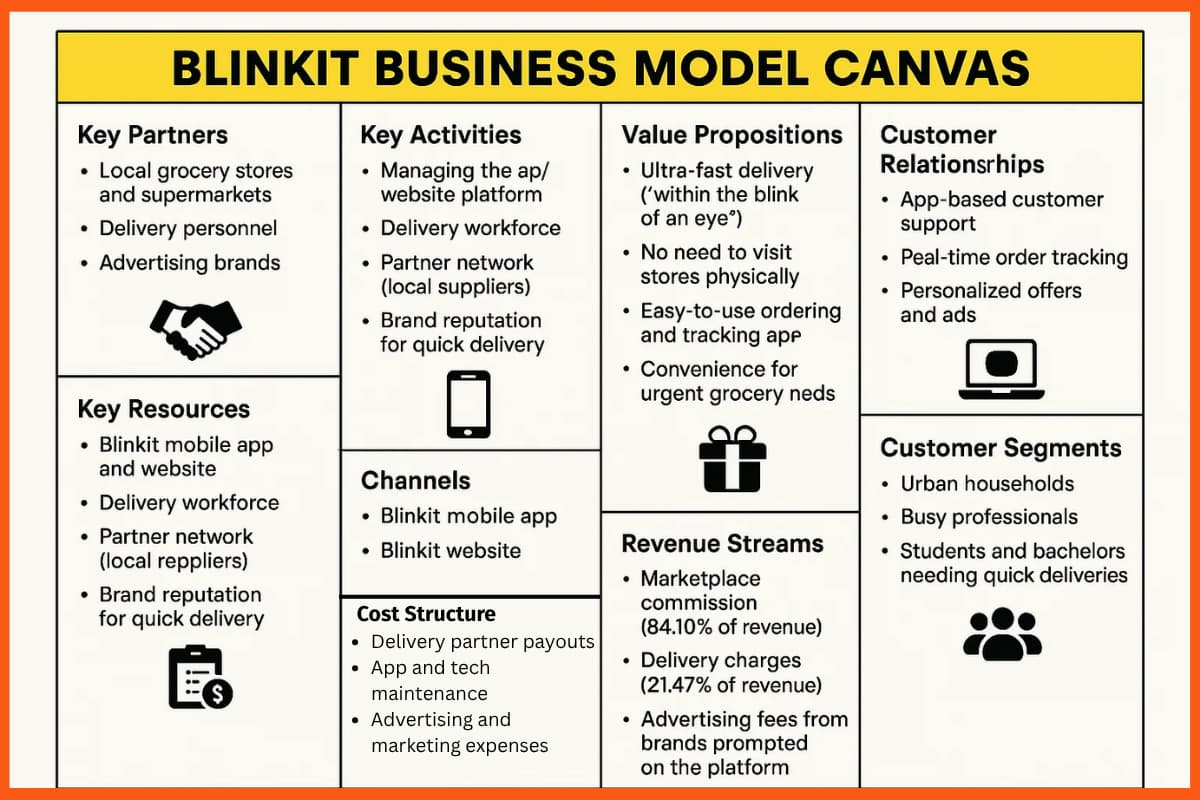
Blinkit Business Model Canvas
Blinkit operates on a marketplace-based business model that connects local stores with nearby customers through its app and website. It earns primarily through commissions on orders, delivery fees, and advertisements. Below is the Blinkit Business Model Canvas summarized:
Blinkit Business Model Canvas
1. Key Partners of Blinkit
Local grocery stores and supermarkets
Delivery personnel
Advertising brands
2. Key Activities of Blinkit
Managing the app/website platform
Order processing and logistics coordination
Partner onboarding and support
Running targeted ad campaigns
3. Key Resources of Blinkit
Blinkit mobile app and website
Delivery workforce
Partner network (local suppliers)
Brand reputation for quick delivery
4. Value Propositions of Blinkit
Ultra-fast delivery (“within the blink of an eye”)
No need to visit stores physically
Easy-to-use ordering and tracking app
Convenience for urgent grocery needs
5. Customer Relationships of Blinkit
App-based customer support
Real-time order tracking
Personalized offers and ads
6. Channels of Blinkit
Blinkit mobile app
Blinkit website
7. Customer Segments of Blinkit
Urban households
Busy professionals
Students and bachelors needing quick deliveries
8. Cost Structure of Blinkit
Delivery partner payouts
App and tech maintenance
Advertising and marketing expenses
Partner management and operations
9. Revenue Streams of Blinkit
Marketplace commission (54.10% of revenue)
Delivery charges (21.47% of revenue)
Advertising fees from brands promoted on the platform
How Blinkit Makes Money | Blinkit Revenue Model
As stated earlier, the company earns heavily through its online orders, there are other earning sources as well from where now company has started minting money. Following are the revenue streams that encompass Blinkit’s revenue model:
Marketplace Commission from Online Platforms: Online orders make up the bulk of Blinkit’s sales, accounting for 54.10% of the company’s total revenue.
Delivery Services: The company charges certain commissions or delivery charges on each customer’s delivery. The delivery partner receives a portion of the commission while the company retains the remaining portion. The yearly income of the company is around 21.47 percent generated by this model.
Advertisement Services: Blinkit has quickly become one of the most popular online grocery shopping platforms, and it continues to rank among the industry’s leaders. The company has also taken advantage of this potential by implementing a business strategy in which it promotes specific companies on its website in exchange for payment.
Blinkit Revenue
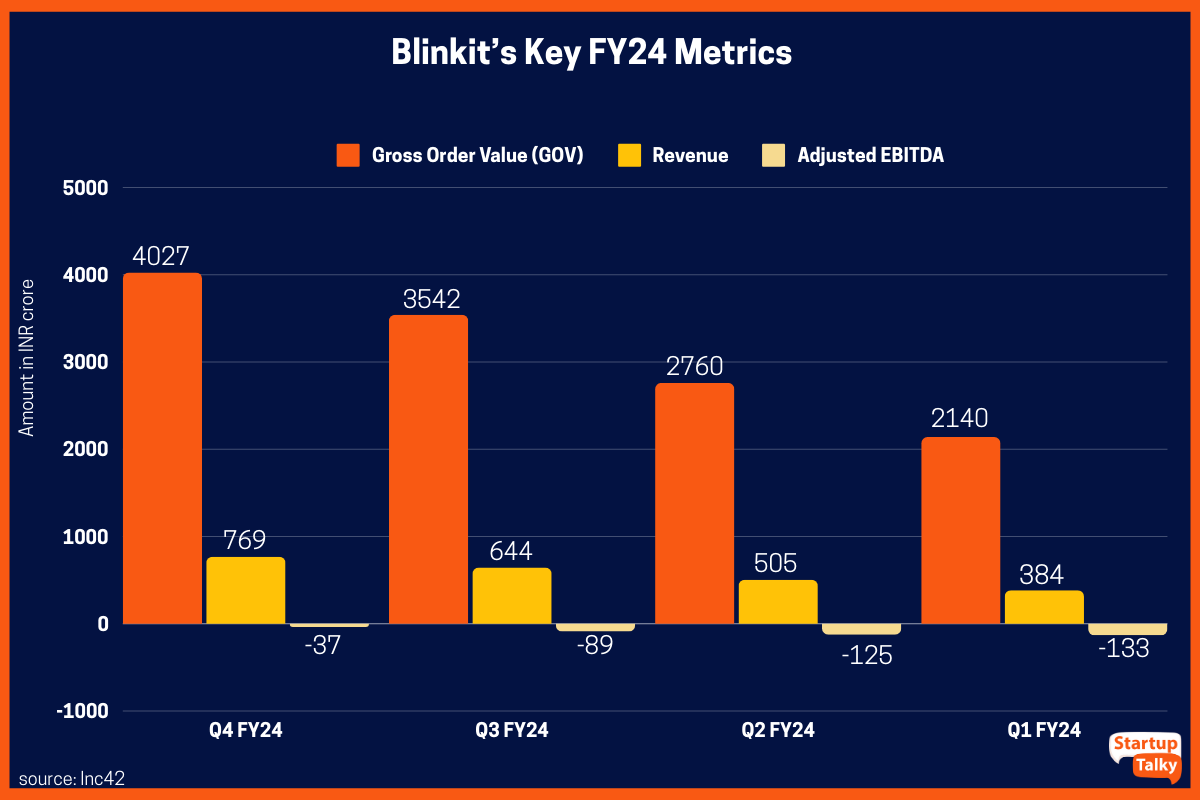
In Q2 FY25, Blinkit reported a revenue of INR 1,156 crore, more than doubling from INR 505 crore in the same period last year. However, its adjusted EBITDA loss increased to INR 8 crore, up from an INR 3 crore loss in the June quarter. Additionally, Blinkit’s gross order value (GOV) surged by 122% year-on-year to INR 6,132 crore.
Blinkit’s revenue grew significantly from INR 747 crore in FY23 to INR 1,934 crore in FY24, driven by strong growth in operations.
USP of Blinkit
Delivery Within the Blink of an Eye: With this incredibly quick service, customers won’t even need to plan their grocery list. Did you forget to include a component in your dinner? Do you require a snack on the go? Blinkit responds lightning-fast to these urgent demands. This makes it a very handy option to go to.
Accessibility at Your Seated Pleasure: With the Blinkit app, customers can quickly browse inventory, place orders, and monitor their deliveries. The need to physically go to a store and wait in checkout lines has become irrelevant by this.
Analysing the Future
Blinkit may have been the investor favorite for a long time, but it is far from alone. Internet sales are becoming more important to many large enterprises and grocery stores. Because of this, competition among eCommerce platforms is increasing. Zopnow, Dunzo, Zepto, and many more delivery partners are preparing to dominate the industry. Therefore, for Blinkit to maintain its lead, it must perform exceptionally well.
FAQs
What is Blinkit?
Blinkit is an on-demand online grocery delivery service that was founded in the year 2013. This eCommerce startup platform provides a variety of daily needs products ranging from groceries, bakery items, baby care items, and many more to its customers. Blinkit is a Gurugram-based company that is currently present in 26 cities across the country.
How does Blinkit make money or what is revenue model of Blinkit?
The main revenue streams of Blinkit include Marketplace Commission from Online Platforms, Advertisement Services, and Delivery services.
Is Blinkit acquired by Zomato?
Yes, in 2022, Zomato acquired Blinkit for $569 million.
Who is the CEO of Blinkit?
Albinder Dhindsa is the co-founder and CEO of Blinkit.
What is the business model of Blinkit?
Blinkit follows a marketplace model, connecting local grocery stores with customers through its app. It earns mainly from commissions on orders, delivery charges, and brand advertisements.
How Blinkit works?
Blinkit works by receiving customer orders via its app or website, then assigns delivery partners to pick up items from nearby stores and deliver them quickly, often within minutes.
This article has been contributed by Griffith David, Founder and CEO, of Habanero Foods.
The rapid quick commerce industry in India is undergoing a remarkable transformation, soaring from $300 million in 2022 to an astounding $7.1 billion by the fiscal year 2025, as per a report released by Cornell University. Additionally, the report forecasts a 24-fold increase in gross order value, with estimates suggesting it will hit $35 billion by 2030. This sector is showing impressive growth, and it has outpaced conventional e-commerce.
At its heart, quick commerce is all about a vast network of cleverly positioned “dark stores”—those nifty little warehouses that cater to online orders—to ensure hyper-local fulfillment and lightning-fast delivery, often wrapped up in just 10-30 minutes. Initially, all about groceries, this sector has rapidly expanded to cover personal care goodies, household must-haves, electronics, mobile gadgets, and even a variety of fashion items, pulling in a colorful mix of businesses, including fresh direct-to-consumer (D2C) brands. India’s quick commerce market is booming like never before, completely changing the shopping game for consumers.
Thanks to rising urbanization, higher disposable incomes, and an insatiable desire for instant gratification, this growth is nothing short of remarkable. For businesses, this rapid expansion is a golden opportunity. But thriving in this cutthroat environment demands a solid grasp of operational frameworks, pricing strategies, contractual commitments, and the must-know best practices of these platforms.
Starting a quick-commerce business in India is all about following some key steps. First off, businesses have to get officially registered in India, typically picking from options like sole proprietorship, partnership, limited liability partnership (LLP), or a corporation. Additionally, it’s crucial to secure the right licenses for certain product categories. For example, online food businesses need to get an FSSAI license, regardless of their earnings. A valid GSTIN and PAN card are also essential since GST registration is a must for all e-commerce ventures in India. Second, choosing the right platform is crucial. Although major rapid commerce providers share similar core features, they vary in focus areas, geographic coverage, and commission structures.
It is advisable to thoroughly research each platform’s features, target audiences, and selected product categories, considering factors like operational cities and logistical challenges. According to a report from Cornell University, in the initial quarter of 2025, a dominant platform holds about 47% of the market share, whereas the others represent 29% and 24%, respectively.
Product Preparation and Documentation
Preparing products for the fast-paced commerce environment is essential, as this model relies on quick consumption and attractive packaging. Businesses should tailor their product offerings to increase sales, focusing on fast-moving consumer goods (FMCG), everyday essentials, and those irresistible impulse buys. Dark stores usually carry a wide range of stock-keeping units (SKUs), with a large share dedicated to items that fly off the shelves.
Packaging should be designed for smaller, often single-use formats, making sure they are durable for swift handling and delivery. Maintaining product quality and freshness is crucial, especially for perishable goods, to ensure customer satisfaction and encourage repeat purchases. The documentation and registration process is mostly uniform across different platforms, necessitating detailed information about the business and personal details, along with key documents. Typically, this includes email verification, submission of business details, GSTIN, bank information, and high-quality images and descriptions of products.
Licensing, Onboarding, and Crucial Criteria
Obtaining an FSSAI license is essential for food products, and some platforms may require that these products be sent to their warehouses, necessitating an APOB (Additional Place of Business) license for that particular site. Furthermore, some platforms might impose a product activation fee, which could be deducted from an advertising account.
While a few platforms can complete initial verification within 30 to 45 business days with varying onboarding fees based on revenue and product type, others require businesses to complete a registration form and submit business registration certificates, GST details, PAN, proof of address, and bank account information, followed by a partnership agreement and training for the seller platform. Essential requirements for all platforms consist of GSTIN, PAN Card, bank account information, business registration certificates, proof of business or warehouse address, FSSAI license, medicine license (if relevant), trademark certificates or authorization letters, and a digital signature.
Listing Products and Inventory Management
Once the approval process receives the go-ahead, sellers must meticulously list their products and monitor inventory closely via the seller dashboard. A customer’s trust always leans upon accurate detail. So, it is of utmost importance that product names, descriptions, MRP, and selling prices are perfectly visible to the customers. Managing inventory in real-time is vital; regular updates that show current stock levels are necessary to prevent stockouts and order cancellations, which can negatively impact seller ratings. Platforms often provide tools or APIs for smooth inventory synchronization, and it is important to develop strong internal inventory management systems that incorporate smart distribution (placing products closer to customers).
Pricing and Advertising Strategies
Pricing and advertising strategies need thorough research. Analyzing the prices set by competitors is crucial for determining the pricing of your products. Additionally, understanding how the platform’s commission operates is essential, as it varies based on the product type and is becoming more flexible. For example, a platform may implement a commission structure that changes according to the selling price, beginning with a smaller percentage for less expensive items and increasing to a larger percentage for more expensive ones.
Hence, it is crucial to factor in these commissions, along with possible warehousing and advertising costs, when developing a pricing strategy, since total platform fees can sometimes surpass 30-45%, as reported by a reputed news platform. Utilizing in-app advertising, special promotions, discounts, and bundled offers from the platforms can significantly boost visibility and sales. Furthermore, some platforms may even provide support for initial marketing investments, as ad revenue is becoming increasingly important for their sustainability.
Order Fulfillment and Financial Considerations
While quick commerce platforms manage last-mile delivery, the seller plays a vital role in effective order fulfillment. This involves promptly processing orders as they come in through the seller app, securely packaging items according to platform standards, and quickly handing over packed orders to delivery partners. Real-time notifications, like marking orders as ready for pickup, are also important. It’s crucial to grasp how the payment cycle of the platform operates, usually on a weekly schedule, and how funds are funneled into the seller’s bank account. Keeping a close eye on settlement records is a surefire way to monitor your earnings with precision.
For businesses aiming to hit the ground running in commerce, understanding the ins and outs of financial and contract details is essential. Commission structures aren’t set in stone; they can shift depending on the type of product, pricing tiers, and the brand’s standing, often providing heftier commissions for sought-after or high-end items. Besides commissions, companies might also encounter additional costs tied to warehousing, which encompasses receiving, storage, fulfillment, and inventory removal, along with marketing expenses and potentially fees for onboarding or activating products.
Mastering Partnership Contracts
When bringing new partners on board, companies have to sign a standard partnership agreement with the quick commerce platform. It’s crucial to take a close look at these agreements. The reason these agreements are so vital is that they contain specific details about commission rates, payment terms, return policies, and how to deal with damaged or returned items (including potential customer return fees for seller-related issues). They also include information about inventory management responsibilities (like stock reconciliation and losses) and order fulfillment Service Level Agreements (SLAs), which should be thoroughly assessed. SLAs detail the expected preparation and handover times, along with penalties for non-compliance. The terms for data sharing and usage are particularly critical, as they outline how the platform can manage sales data and customer information, especially considering regulations like the Digital Personal Data Protection Act of 2023.
Clauses about marketing and promotion responsibilities, including who pays for the related costs, are also important. Additionally, it’s essential to pay attention to methods for resolving disputes and arbitration clauses. Termination clauses, which cover notice periods and conditions for ending the partnership, as well as product liability and quality assurance measures that clarify responsibilities for defects, round out the key areas that need review. While larger, established brands might have significant negotiating power, newer or smaller sellers are more inclined to accept the platform’s standard terms.
Driving Success Through Data and Strategy
Overall, making choices rooted in data is crucial. Keeping an eye on platform performance metrics (like sales trends, customer habits, delivery times, popular products, and return rates) sets the stage for continuous improvements in product choices, pricing strategies, and marketing plans. The rapid evolution of commerce in India offers a fantastic chance for businesses eager to grow quickly and serve a tech-savvy audience.
By carefully analyzing what the platform requires, monitoring expenses and agreements, and prioritizing key operational efficiencies while ensuring excellent customer satisfaction, sellers can carve out a successful niche in this dynamic and ever-changing market. Although starting out might seem overwhelming, the immense potential for growth and brand visibility in today’s fast-paced business environment makes it a highly rewarding opportunity for contemporary Indian companies.
According to reports, Flipkart, the massive e-commerce company owned by Walmart, intends to restrict the growth of its Flipkart Minutes rapid commerce division to the top six to eight cities in order to minimise capital burn.
The top eight cities account for over 90% of quick commerce volumes, with Bengaluru, Mumbai, and Delhi NCR accounting for the majority of this, where Flipkart is expanding with Minutes.” Flipkart Minutes operates a network of over 300 dark stores, or micro warehouses, and is now available in 14 locations.
It is a competitor to Amazon Now, Swiggy Instamart, Zepto, BigBasket’s BB Now, and Eternal-owned Blinkit. According to a media report, the goal is to grow this up to about 500–550 by October.
Flipkart Carefully Spreading its Wings
As a result of this action, Flipkart is now approaching growth more cautiously, similar to Swiggy, whereas Eternal is growing rapidly regardless of immediate financial gain. In the meantime, Flipkart wants to reach 500–550 customers through its dark shop channel before this year’s “Big Billion Days” promotions.
However, analysts at broking firm HSBC Securities noted in a research note on May 12 that it is also under pressure to cut its continuous cash burn of about $40 million per month in half over the next few quarters in an effort to launch its IPO.
The company’s intention to move its headquarters from Singapore to India in preparation for an IPO in 2026 was approved by Flipkart’s board last month. Nearly a year after Flipkart got $350 million from Google as part of a $1 billion fundraising round headed by Walmart, the domicile shift procedure was started.
More recently, Flipkart invested INR 3,248.9 Cr in Flipkart Internet, its marketplace division, through its Singapore holding company. Flipkart has established new alliances despite limiting its goals for rapid commerce expansion.
In order to introduce its smartphone line on Flipkart’s e-commerce platform and its Minutes rapid commerce sector, French smartphone manufacturer Alcatel formed a “retail” agreement with the company in April. Flipkart’s collaboration with Alcatel coincides with the Competition Commission of India’s scrutiny of the company’s exclusive product releases with OEMs such as Xiaomi and Samsung.
Flipkart’s Financial Outlook
The internet giant and competitor Amazon were found guilty by the watchdog’s internal investigation last year of breaking antitrust laws by favouring specific vendors on its platforms and engaging in aggressive pricing practices.
Flipkart is concentrating on enhancing its financial performance as it gets ready for its public launch. Flipkart Internet’s losses decreased 41% to INR 2,358 Cr in FY24, while its sales increased 21% year over year to INR 17,907.3 Cr.
According to its financial report, the company’s advertising earnings in FY24 exceeded its marketplace fees. The industry is one of the fastest-growing in India, with a 37% compound annual growth rate (CAGR) predicted to reach $40 billion or more by 2030, according to a report published by a media house. In 2024, more than two-thirds of all online grocery orders were placed through quick commerce.
Realiance Retail, the nation’s foremost retailer, is investing in the expansion of its coverage area by opening dark stores. In the March quarter, the company experienced a 2.4x increase in the number of orders from its rapid commerce/hyperlocal delivery service.
During the earnings call earlier this week, Reliance Retail’s CFO Dinesh Taluja stated that the company saw a tremendous scale-up in the March quarter, with orders growing by more than 2.4 times. According to Taluja, Reliance Retail is now experiencing very significant traction, as evidenced by a 2.4x increase in daily exit orders from quarter to quarter.
Additionally, this figure will increase significantly during the next 12 months. Customers continue to respond favourably to the company’s offer of no hidden fees, fast delivery, and no delivery charges; thus, the company is also beginning to aggressively market this offering, as per Taluja.
Reliance Retail Operates Quick Commerce Through JioMart App
Reliance’s network of existing stores provides hyper-local deliveries, which are sub-30-minute deliveries, to 4,000 pin codes throughout the country. This network has a significantly greater reach than any other quick commerce participant in the country.
Reliance Retail offers three different sorts of services, including scheduled and expedited deliveries, through its JioMart app. There is a rapid service that takes less than 30 minutes, a scheduled delivery service with a considerably larger selection, and a subscription service where customers can sign up to have daily items brought to their doorsteps in the early hours of the morning. All three of them are picking up quite nicely, Taluja said.
He added that, on a year-over-year basis, the average daily orders had increased by 62%. In particular, the brand’s 30-minute or less offering, which has the broadest network coverage. More than 4,000 PIN codes are covered by the company’s nearly 2,000+ networked stores.
Therefore, compared to other rapid commerce players, this has a far greater reach. JioMart has essentially changed its business strategy to deliver goods in less than 30 minutes.
New Business Strategy to Expand Network
Taluja claims that Reliance Retail is utilising its network of stores to deliver within a three-kilometre radius as part of the goal. JioMart will open dark shopfronts in a few niche markets.
JioMart will also open some dark stores in areas where there is a real need, a sufficient volume, and the company is unable to fulfil it in 30 minutes.
That’s the rapid commerce aspect of it, then. On a stand-alone basis, the company’s stores have experienced double-digit growth over the past few quarters. Thus, stores are expanding quite quickly as well.
“We are not seeing that impact either in metro or in any other city,” he stated. In a same vein, Reliance Retail has introduced same-day and next-day delivery in 26 locations for its online fashion firm Ajio.
“So, we are increasing the speed at which we are able to deliver the products,” he stated. Reliance Retail reported gross revenue of INR 3.30 trillion for the 2024–25 fiscal year, up 7.85%, and profit after tax of INR 12,388 crore, up 11.33%.
The convenience of Internet food delivery services was greatly enhanced during the pandemic. The dominant player in the online grocery delivery app and company market is influencing users’ habits.
Online shopping is becoming increasingly common among consumers. As a result, more and more delivery services, like Zepto, have launched their services to meet the ever-increasing demands of their clients for lightning-fast delivery. You should be familiar with the Zepto business model if you are looking to enter the market.
The supermarket delivery industry is booming, thank goodness, because it requires less time, effort, and money than other industries. In 2020, the projected value of the online grocery business was $2.9 billion. Through this article, we will go over the basics of Zepto, including its business model and how it generates revenue.
About Zepto
Zepto, founded in 2021 by Aadit Palicha and Kaivalya Vohra, two former Stanford University students, is a platform for quick commerce that provides a grocery delivery service within 10 minutes. Fast grocery delivery was the driving force for the founding of the firm. Zepto boasts delivery to major cities like Bengaluru, Lucknow, Delhi, Chennai, etc., from its Mumbai headquarters. The original company, Kiranakart Technologies Private Limited, was turned off into Zepto by its founders.
The “dark store model” serves as the foundation for Zepto’s business model. This involves setting up delivery-only warehouse-style stores in residential regions. The shops sell a variety of products, and the sole way for buyers to place orders is through the Zepto India website or app. Across multiple regions, Zepto now has more than eighty-six dark storefronts. Dark businesses are great for quick shipping, but they may crash under heavy traffic. However, Zepto created an AI-driven system to assist with selecting, packing, and shipping to avoid sacrificing quality or service. Zepto can provide an extensive product line at rock-bottom prices because of this technology, which guarantees a seamless transition from choosing to packaging to delivery.
Zepto India can provide a fast delivery service thanks to the convenience of having outlets close to customers’ homes, which is an advantage of the Zepto business model. The elimination of the necessity for employees to utilize the store also allows the company to run with a reduced headcount.
How Zepto Makes Money | Zepto Revenue Model
A little commission is charged for each order placed using the Zepto Grocery app in India. Helping to pay the costs of running the app and ensuring that consumers have a great experience, this commission is usually 2-3% of the total order amount.
With almost $1.3 billion raised across eight rounds, Zepto is certainly a no-money lightweight, making it the first unicorn startup of 2023.
In recent times, the Zepto business model has experienced tremendous expansion. Their incomes increased by 800% while their burn rate per order reduced by 5%. The reason for this rise is that Zepto boasts a 50% growth rate per month.
Here’s an easy-to-understand version of Zepto’s revenue model:
Sales of Products: Zepto makes money by selling groceries, home goods, and personal care items on its website. They buy products from local suppliers and brands, keeping prices low. Sometimes, they charge a little more for certain items compared to regular stores, which helps boost revenue.
Delivery Charges: Zepto charges a delivery fee based on factors like how far the delivery is, the order size, or any special deals. This fee helps cover the cost of fast delivery and brings in extra money.
Subscription Models: Zepto offers membership plans for regular customers, giving benefits like free delivery or special discounts. This makes it easier for frequent buyers to make purchases.
Advertisement and Promotions: Zepto partners with brands for advertisements on their platform. Brands pay to get more visibility. They also create special offers or coupons in the app to attract more customers.
Data Monetization: Zepto collects useful data from customers. They can sell insights from this data to brands and suppliers to help them understand customer behavior and improve their products.
Fulfillment and Logistics: Zepto could offer its delivery and logistics services to other businesses, creating another source of income.
New Category Expansion: Zepto may expand beyond groceries to sell other items like electronics, health products, or prepared meals, increasing their revenue streams.
Challenges and Considerations
Pricing Pressure: Zepto must balance keeping prices low and offering fast delivery while making a profit.
Customer Retention: Zepto needs to keep customers loyal with great service and rewards programs.
Operational Efficiency: Zepto must keep its delivery and logistics system efficient to control costs and maximize profits.
Zepto Financials
Zepto Financials
FY22
FY23
FY24
Operating Revenue
INR 142.3 crore
INR 2,026 crore
INR 4,454 crore
Expenses
INR 532.7 crore
INR 3,350 crore
INR 5,754 crore
Profit/Loss
INR 390.3 crore (loss)
INR 1,272 crore (loss)
INR 1,248 crore (loss)
Zepto Financials FY24
In FY23, the quick-commerce startup’s operating revenue stood at INR 2,026 crore. In FY24, Zepto’s operating revenue saw a growth of about 120%, reaching INR 4,454 crore.
Zepto’s losses saw a slight decrease of 2%in FY24, to INR 1,248.6 crore from INR 1,272 crore in FY23.
Customers in a rush will be enticed by Zepto’s promise of ultra-fast delivery—a mere 10 minutes—since the company dominates this segment.
Zepto has been aggressively growing its presence in key Indian cities, particularly in metro and big urban areas, to guarantee the quickest delivery times imaginable.
Zepto SWOT Analysis
SWOT Analysis of Zepto
Zepto Strength
Zepto can process orders more quickly and efficiently thanks to its dark store and speedy packaging. Several distribution options are made available by micro and cold warehouses, which physically deliver groceries closer to a certain market group.
To maintain an up-to-date procedure and an app that is easy to use, Zepto makes use of a broad variety of software. Put together a crack team of professionals who are well-versed in all things related, such as data analytics, software development, and artificial intelligence. As a result, the market delivery system is more within the company’s control.
Zepto Weakness
Customers are less likely to purchase due to the lack of high-quality product images.
Delivery is only offered in a limited number of areas. There is a limit on their ability to invest in marketing or expand operations due to limited human, or infrastructure resources.
Zepto Opportunities
Zepto may explore opportunities to extend its business operations internationally by entering new markets and expanding its clientele on a global scale.
When new technology or industry trends emerge, Zepto may have opportunities to expand its product and service offerings or create innovative solutions.
Zepto Threats
Rules and regulations or the need for regulations and developments pertinent to Zepto’s sector can complicate compliance and increase operational expenses.
To retain customers over the long term, Zepto must fulfill its word and deliver on time every time. Failing on this line means a massive loss of business.
Zepto’s founders assert that the additional acquisitions will strengthen the company’s ability to connect with customers and improve its level of service. As of this very moment, Zepto is operational in the metros of India. In any case, the company has not disclosed its consumer calculation; however, several sources claim that Zepto is growing at a rate of 200% per month.
For a company to achieve success, it takes a lot of things, and Zepto has everything. They have a fantastic team, are quick to act, and are focused on their goals. In addition to this, they planned their entrance into the supermarket delivery market with great precision. Even though they have only been in operation for a few years, they have already raised the expectations of their customers and are heading towards a company strategy that is more focused on the client.
FAQs
What is Zepto?
Zepto is a startup based in Mumbai that offers a 10-minute grocery delivery service. To fulfill orders promptly, Zepto employs its network of ‘cloud shops’ or micro-warehouses.
What is business model of Zepto?
The “dark store model” serves as the foundation for Zepto’s business model. This involves setting up delivery-only warehouse-style stores in residential regions.
What is the valuation of Zepto?
The valuation of Zepto is $3.6 billion as of June 2024.
What is Zepto seller commission?
Zepto currently does not use a seller commission model. It profits from direct product sales, delivery charges, and other revenue streams like ads and data.
What is Zepto USP?
Zepto’s USP is ultra-fast delivery of groceries and essentials, often within 10-15 minutes, through its network of dark stores located near customers.
What is Zepto dark store model?
Zepto’s dark store model involves setting up delivery-only warehouse-style stores in residential areas. These stores are not open to the public, and customers can only order through Zepto’s website or app. This model allows for faster delivery and reduced overhead costs, as the stores are optimized for picking, packing, and shipping products efficiently.
The craze of joining the quick commerce bandwagon is as real as it gets, as is the sprint to reach a netizen’s doorway with a platter full of goodies at unprecedented speeds. With its 15-minute meal delivery service, QuickiES, IPO-bound cloud kitchen unicorn Rebel Foods has also entered the ultra-fast food delivery market. However, Rebel Foods’ list of competitors may be overwhelming to many at a time when smaller competitors like Swish and Zing have already begun to attract attention with their 10- to 15-minute food delivery endeavours. The cloud kitchen startup intends to compete with Zepto, Swiggy, and Zomato in their home market by offering speedy delivery. In addition, the three delivery giants have repeatedly invested millions of dollars to expand their delivery business, sifting through minutes to service clients at their beacon call.
Logistics Vs Quality of Food
Rebel Foods, on the other hand, appears unconcerned, and CEO Sagar Kocchar believes that while Swiggy and Zomato excel at logistics regardless of what they provide, Rebel Foods’ unique selling point is food. This faith appears to be further bolstered by the company’s previously unheard-of promise of a free delivery or one in 15 minutes. Dominos was an early adopter with a similar offer; they also guaranteed 30 min or free delivery, and the entire market knows how sustainable that was in the long run.
Has Rebel Foods Really Cracked the Code?
Given that the quick meal delivery model is still in its infancy and many things need to be worked out, the market believes that Rebel Foods has truly mastered the ultra-fast food delivery code because of the brand’s confidence. Would it be sufficient to defeat Swiggy and Zomato, who have a stronger brand recall?
When consumers experience hunger pangs, they immediately seek food, Sagar Kochhar, co-founder and CEO of EatSure at Rebel Foods, stated to a media outlet, asserting that the decision was not prompted by competition or investor pressure. Why shouldn’t food be delivered in 15 minutes? The only thing left to do is to close the gap between the underlying demand and the consumer requirement. The brand was fully supported by consumer insights, but it is undoubtedly monitoring the competition.
He went on to say that consumers’ initial preference for light snack meals will push them to order quick food, but if the cuisine is good, they will eventually switch to it for all meal occasions. Apart from its own proprietary app EatSure, Rebel Foods has all of its brands listed on the meal delivery apps Swiggy and Zomato. However, EatSure will be the sole way to fulfil all consumer orders for the 15-minute service. Through its EatSure app, the company already has access to user data, which it can use to forecast client demand and properly design its menu—a capability that traditional restaurant brands frequently lack.