According to reports, tech titan Apple and Reliance Jio have teamed up to provide Jio customers Rich Communication Services (RCS) texting on iPhones.
According to ET’s story, which cited sources, this partnership will enable Jio customers on iPhones to send iMessage-style “blue tick” RCS texts with interactive features, read receipts, and high-resolution photos and videos over WiFi or mobile data without incurring additional costs.
What is RCS Messaging and How It Works on iPhones?
The worldwide telecom industry organisation GSMA launched RCS in 2007 as a messaging standard to improve and update SMS. RCS, which is integrated into a phone’s default messaging software, provides functions including read receipts, group conversations, file sharing, and interactive communications that resemble WhatsApp or iMessage.
Compared to SMS, it allows for authenticated and secure corporate communication, lowering the danger of spam or phishing. Additionally, it enables telecom providers to remain competitive in the expanding messaging market.
Why RCS Matters: Secure, Spam-Free Alternative to SMS?
Due to the country’s continued heavy reliance on SMS for transactions, banking alerts, and OTPs, RCS use is increasing in India. RCS provides a safer option for communication and modernises this channel.
RCS Adoption in India and Global Trends
RCS has been adopted by ten nations worldwide, and India views it as a digital upgrade to its communication environment as well as a security measure. With a robust subscriber base of more than 49 Cr, Jio will assist Apple in promoting the use of RCS services. Jio and Apple have been contacted by Inc42 for their thoughts on the development.
Airtel’s Opposition to RCS and Industry Response
As soon as an answer is received, the story will be updated. Notably, according to ET, Bharti Airtel previously refused to collaborate with Google or Apple to enable RCS, claiming that the encrypted channel may expose consumers to spam. This development coincides with Apple’s rapid expansion in India.
Due to double-digit increases in iPhones, Macs, and services, the business recorded record revenue from India in the June quarter. According to Tim Cook, CEO of Apple, the iPhone has grown in every region and in growing countries like Brazil, South Asia, the Middle East, and India, where it has double-digit growth.
Apple Expanding its Nexus in India
The iPhone manufacturer is growing its retail presence in India, bolstered by the strong demand. The company announced on 26 August that it will establish a new store in Pune the following week, following the announcement of the opening of its third official store in Bengaluru last week.
In addition, the tech giant is increasingly making India a major location for manufacturing. According to a rumour earlier this month, Apple intends to increase manufacturing of the iPhone 17 at all five of its Indian factories. Last year, the company began producing 30 million to 40 million iPhone 15s a year in India.
Up until this year, Tata Electronics, Foxconn, and Pegatron, Apple’s contract manufacturers, accounted for 25% of the company’s manufacturing in India. Apple made the decision to outsource the majority of iPhone production from China in late April of this year. Apple revealed that by 2026, all iPhones sold in the US will be assembled in India.
Quick
Shots
•iMessage-Style Features: Blue tick
chats, read receipts, group texting, file sharing, HD media sharing.
•RCS-A GSMA standard (since 2007)
upgrading SMS with interactive, secure messaging.
•Safer, spam-free, modern alternative
to SMS—important for banking alerts, OTPs, and business communication.
•Airtel refused to support RCS citing
spam risks; industry divided.
The story of BlackBerry is a cautionary tale of a once-dominant player in the smartphone industry who ultimately fell from grace. At its peak, BlackBerry was a trailblazer, pioneering on-the-go communication and email with its iconic keyboard-enabled phones. However, the company’s slow adaptation to changing market trends, lack of consumer focus, and missed opportunities ultimately led to its downfall. In this article, we shall shed light on the key factors that contributed to BlackBerry’s decline and examine the lessons that can be learned from its spectacular failure.
BlackBerry, initially known as Research in Motion (RIM), emerged in the late 1990s and quickly gained traction in the smartphone market. The company’s early success was fueled by its innovative products, such as the Interactive Pager 950, which introduced on-the-go communication and email capabilities. With its signature keyboard and secure messaging system, BlackBerry became synonymous with professionalism and efficiency.
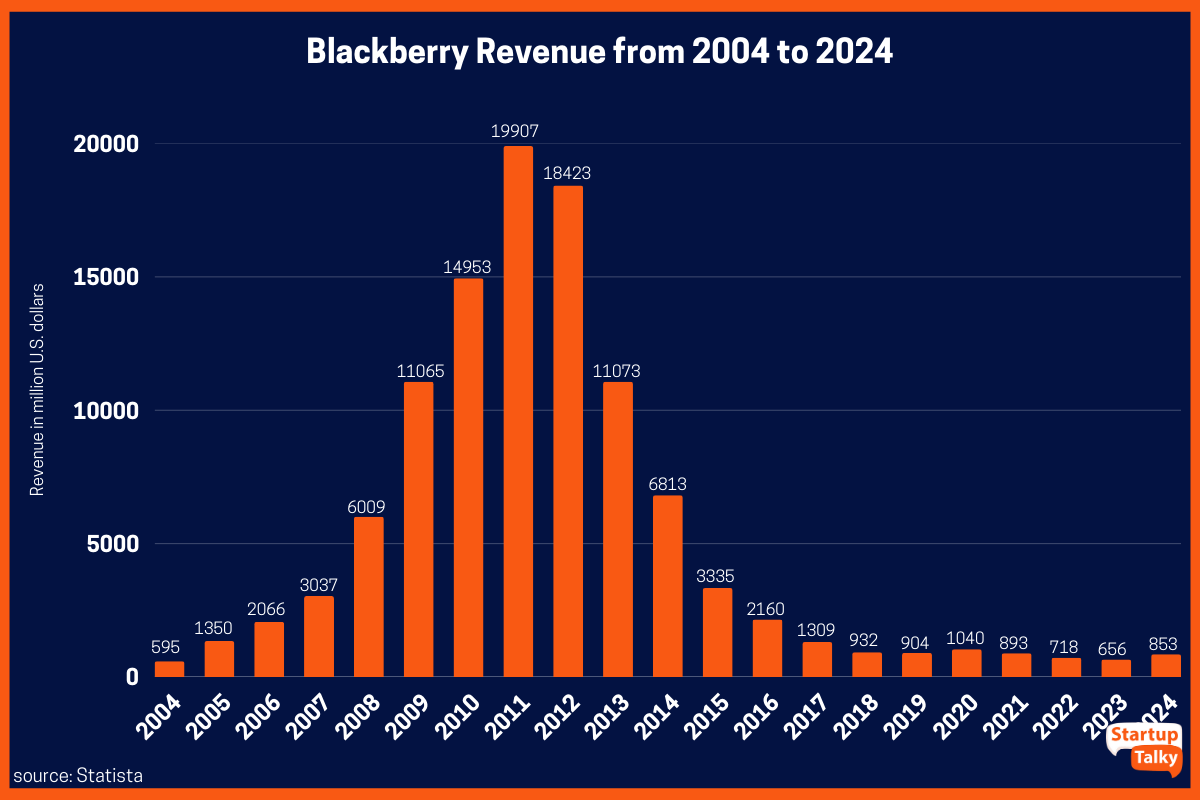
Throughout the early 2000s, BlackBerry continued to expand its product portfolio and solidify its position in the market. The introduction of the BlackBerry Pearl series, Curve, and Bold product lines further cemented the company’s success. BlackBerry’s user base grew rapidly, and by 2011, it boasted more than 50 million units sold worldwide.
Missed Opportunities and Lack of Adaptation
Despite its initial success, BlackBerry failed to anticipate and adapt to key market shifts, leading to its downfall. One of the critical mistakes made by the company was its slow response to the touch-screen revolution. While competitors like Apple were going for touch-screen technology, BlackBerry remained loyal to its keyboard-enabled devices. This decision proved to be a significant misstep, as consumers increasingly gravitated towards touch-screen devices.
Furthermore, BlackBerry’s lack of consumer focus played a significant role in its decline. The company primarily catered to corporate and government customers, neglecting the broader consumer market. While BlackBerry’s devices offered robust security and email capabilities, they lacked the intuitive user experience and app ecosystem that consumers were seeking.
The introduction of the iPhone in 2007 marked a turning point in the smartphone industry. With its sleek design, touch-screen interface, and extensive app store, the iPhone changed the way people interacted with their mobile devices. BlackBerry, however, failed to recognize the iPhone as a direct competitor and continued to focus on its core business customers.
At the same time, Android smartphones began to gain traction, offering consumers a wide range of device options and customization capabilities. BlackBerry, with its limited device selection and lacklustre app store, struggled to compete with the growing popularity of iPhones and Android devices.
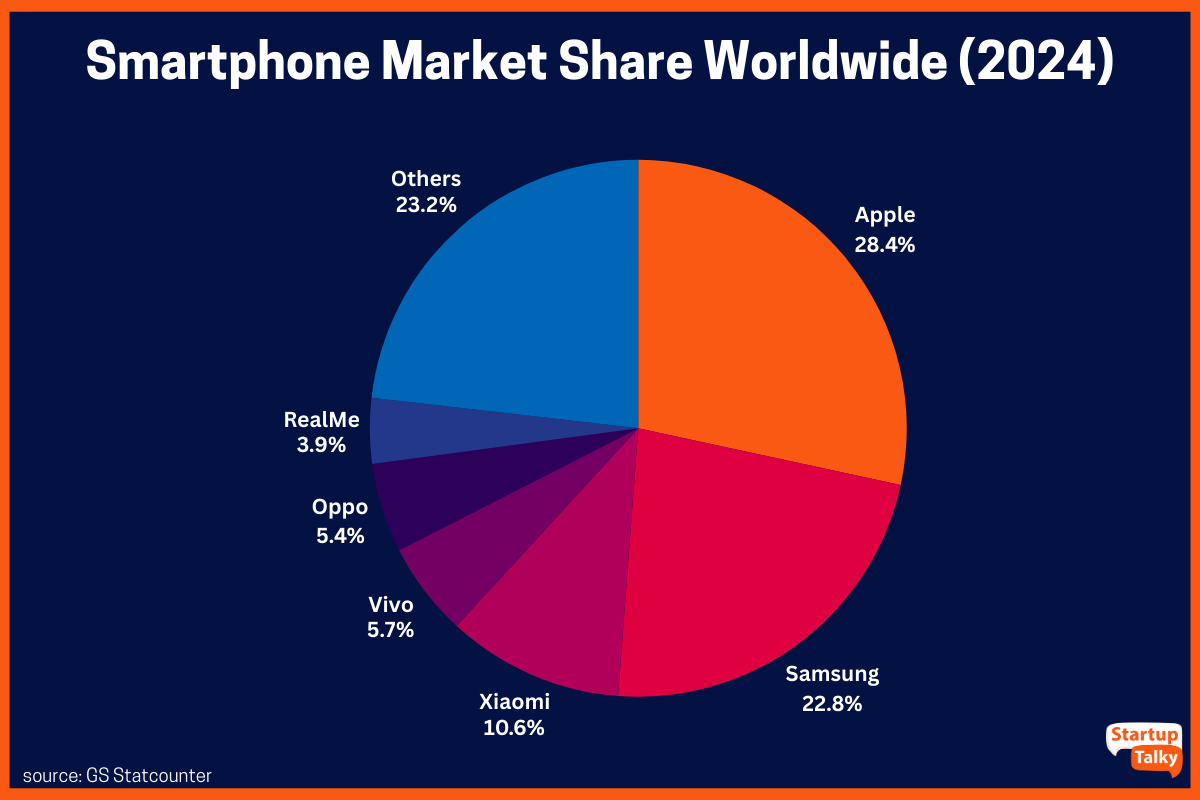
Smartphone Market Share 2024
The Failure to Innovate
Another critical factor in BlackBerry’s decline was its failure to innovate and keep up with evolving consumer demands. While BlackBerry Messenger (BBM) gained popularity as a messaging platform, the company missed the opportunity to expand its user base by locking the service exclusively to BlackBerry devices. Competitors like WhatsApp, which offered cross-platform messaging, quickly surpassed BBM in popularity and user adoption.
Additionally, BlackBerry’s operating system (OS) faced significant limitations in terms of app availability and user experience. While competitors like Apple and Android devices offered a vast array of applications, BlackBerry struggled to attract developers and provide an appealing app ecosystem for its users. As a result, BlackBerry devices became increasingly outdated and less desirable to consumers.
Recognising the need for a strategic pivot, BlackBerry decided to shift its focus from hardware to software and cybersecurity. In 2016, the company ceased smartphone manufacturing and transitioned into a software firm. Today, BlackBerry specializes in providing cybersecurity solutions and software services to businesses and governments.
The shift to software has allowed BlackBerry to leverage its expertise in security and build a new business model. The company offers a range of products and services, including endpoint security, threat intelligence, and secure communication solutions. BlackBerry’s cybersecurity offerings have gained traction in the market, positioning the company as a key player in the industry.
Blackberry Revenue from 2004 to 2024
Lessons Learned from BlackBerry’s Downfall
The rise and fall of BlackBerry offers valuable lessons for companies operating in the fast-paced and ever-evolving technology industry.
Adaptability: First and foremost, adaptability is crucial. Companies must be willing to embrace change and respond to shifting market dynamics. BlackBerry’s failure to recognise the significance of touch-screen technology and adapt its devices accordingly proved to be a fatal mistake.
Consumer Focus: Consumer focus is essential for long-term success. While BlackBerry initially targeted corporate and government customers, it failed to recognise the growing importance of the consumer market. Companies must understand the needs and preferences of their target audience and prioritise delivering a compelling user experience.
Innovation: Furthermore, innovation is key to staying competitive. BlackBerry’s reluctance to innovate and introduce new features and functionalities limited its ability to attract and retain customers. In today’s fast-paced technology landscape, companies must continuously innovate and evolve to meet the ever-changing demands of consumers.
Strategic Pivots: Strategic pivots can be necessary for survival. BlackBerry’s decision to shift its focus from hardware to software and cybersecurity allowed the company to capitalize on its strengths and remain relevant in the industry. Companies must be willing to reassess their business models and make bold decisions to adapt to changing market conditions.
Leadership and Vision: Strong leadership is crucial during times of disruption. Leaders must not only have a clear vision but also the foresight to anticipate market trends and the agility to pivot quickly. Without strategic leadership, even well-established companies can lose their edge.
The rise and fall of BlackBerry serve as a powerful reminder of the importance of adaptability, consumer focus, innovation, and strategic pivots in the technology industry. While BlackBerry’s dominance in the smartphone market may be a thing of the past, the company’s transformation into a software and cybersecurity provider demonstrates its resilience and ability to evolve.
The lessons learned from BlackBerry failure can guide other companies in overcoming the challenges and opportunities presented by technological advancements. By inculcating change, understanding customer needs, pushing for innovation, and making strategic shifts when necessary, companies can position themselves for long-term success in an ever-changing market.
FAQs
Why Blackberry failed?
BlackBerry failed because its leaders were slow to adopt touchscreen phones and app-based innovation, falling behind as the smartphone industry rapidly evolved. They underestimated the impact of competitors like Apple and Android. Their reluctance to change cost them market share and relevance.
What is the main reason for Blackberry phone failure?
The main reason for BlackBerry’s phone failure was its delay in adopting touchscreen technology and app ecosystems. While the market shifted toward full-screen smartphones and rich app experiences, BlackBerry stuck to physical keyboards and outdated software, losing relevance to faster-moving competitors like Apple and Android.
What went wrong with Blackberry?
BlackBerry went wrong by failing to adapt to major shifts in the smartphone industry. It:
Ignored the rising demand for touchscreen phones
Underestimated the importance of app ecosystems
Continued focusing on physical keyboards and enterprise users while the market moved toward consumers
Reacted too slowly to competition from Apple and Android
This lack of innovation and poor timing led to its sharp decline.
In a thought-provoking session with StartupTalky, Mr. Rajarshi Bhattacharyya, Chairman and Managing Director of ProcessIT Global, engaged in an in-depth discussion covering a wide range of topics. Throughout the conversation, he provided valuable insights into the competitive tech industry and what sets ProcessIT Global apart from its peers. He emphasized the company’s focus on cyber resilience, which involves building strategies, processes, and technology solutions to help organizations become resilient in the face of cyber threats.
StartupTalky: Good morning, everyone. My name is Sayantan, and today we have with us Mr. Rajarshi Bhattacharyya, the Chairman and Managing Director of ProcessIT Global. So, Mr. Bhattacharyya, how are you?
Mr. Bhattacharyya: Great, good to see you, Sayantan. And it is very nice to be at your show.
StartupTalky: Thank you so much, Mr. Bhattacharyya. It has been a pleasure for us to host you today. I am sure that this will be a very thought-provoking session. And definitely, your insights will enlighten our audience. So, Mr Bhattacharyya, can you share some insights into ProcessIT Global’s unique strategy in the competitive tech industry and what sets it apart from other players in the market?
Mr. Bhattacharyya: It is a deep tech services and solutions startup. We operate in the field of Enterprise. Specifically, I use the word “resilience” because “security” is widely misused. Resilience is where organizations start building up strategies and processes, implement product technology solutions, and make them work as one to become a resilient organization.
Resilience is a key factor term, where we enable organizations to become cyber resilient. In the ever-changing landscape, the paradigm of business is also changing these days. So, what we do is we also help organizations to secure themselves. Our tagline at Process It Global is “Securing the Modern Enterprise.” This encompasses the advisory piece, implementation, operations, and maintenance, functioning as a managed cybersecurity service provider.
That is in a nutshell what we are involved in. We operate in a very niche technology space, focusing on identity and access management, which forms the fundamental pillar of the zero-trust security policies that you keep hearing about. We also work on SIM, Soar, and UBR, which are essential for managing cybersecurity. Application security is another area where we work on securing applications. Additionally, we provide data security, which covers data at rest as well as data in motion.
Furthermore, we are partners with different organizations, particularly large global UEMS (Unified Endpoint Management Systems), and we build on top of their products to create a unique customer experience. Every organization’s demand is different because every industry vertical is unique, and their challenges vary.
For example, consider small-scale exporters who manufacture products for larger manufacturers globally. They may sign GDPR contracts without fully understanding the implications. We assist them in developing a strategy to become compliant and confidently sign GDPR contracts. That is what we bring to the table.
StartupTalky: Thank you Mr. Bhattacharyya for sharing your views. Since you mentioned the GDPR policy in Europe, with the new Digital Personal and Data Protection Act of 2023, I would like to know how your company, ProcessIT Global, is ensuring data security for your clients.
Mr. Bhattacharyya: So, we have an air gap environment when it comes to customer data, so it is never exposed to the internet. Whatever is there remains within our system. Additionally, we have implemented various security policy measures. We are also an ISO 27001-certified organization. This speaks volumes about how well our processes are defined. This ensures that we are compliant. Furthermore, if you look at the current policy of the government of India, it is a fantastic one. It is on par or even better than many others. It is more advanced because GDPR came out some time ago. This policy is more advanced and comprehensive, which will further India’s progress.
StartupTalky: All right. Since you mentioned government policies, I would like to continue with the next question on the same note. How do government policies support the growth of Indian startups, including yours?
Mr. Bhattacharyya: To encourage a startup ecosystem, the government must be open to ideas and entrepreneurship. The government has indeed taken steps in this direction. They initially launched the Skill India program, followed by the Startup India program. It is a process. If you examine the flow, it begins with skill development, followed by idea generation, and then the Startup India program comes into play. Startups, whether they offer services, products, or commodities, often require substantial funding. The government has introduced schemes that offer funding without requiring collateral, such as the Mudra scheme.
There is a significant emphasis on supporting women-led startups. India is now one of the world’s largest startup hubs. If you look at the top 15 cities globally for startups, three of them are Indian: Bangalore, Mumbai, and Delhi NCR. This is a testament to the encouragement the government provides for individuals to become entrepreneurs, break free from mundane jobs, and pursue innovative ideas. Access to funding is available, and Indians are known for their brilliant minds. Additionally, policies have been established to enable startup companies to participate in large government tenders without needing to provide Earnest Money Deposits (EMDs). Membership in the Startup India scheme takes care of your credentials, eliminating the need for Pre-Qualification (PQ) criteria.
Moreover, an essential aspect is that if your startup is performing well for three years, you become eligible for tax exemptions. It can hardly get better than this. The ecosystem is designed to support your growth. The government, in collaboration with organizations like NASSCOM, organizes various mentorship programs under the Startup India initiative, providing people with invaluable guidance and support.
StartupTalky: How do you see the G20’s Startup20 initiative helping Indian startups go global? Are there concerns about foreign players posing competition to Indian sectors?
Mr. Bhattacharyya: In terms of the Indian startup sector, we do not fear anybody these days. We have become a fearless India. So that is the spirit. Only the exchange of ideas and collaboration can make things better. If you are collaborating with somebody in California, they can learn a lot from us.
Most of the large-scale successful startups are founded by Indians. If you look at large-scale global companies, many of them are run by Indians. So, it is India’s time to shine. All these developments are happening for the better. Collaboration will only improve our situation. There will be an influx of money, an exchange of ideas, and technology exchanges. It is going to be great, and there is nothing to fear.
StartupTalky: India has transitioned from being a BPO hub to a center of innovation. Given this shift and your mention of data, here is a hypothetical question: Is it possible for startups to use their data as collateral for securing loans? If so, how can the security and assurance of this data be ensured?
Mr. Bhattacharyya: I think the government of India is working on data insurance. The moment you have insurance against data, as well as hybrid insurance, once that is formalized, it will lead to a massive explosion in having data that is bankable. So, it all depends upon the financial policies as well.
The government of India is working towards it, and hopefully, we will find a solution soon. Right at this moment, it does not seem like data could be mortgaged, and that is not the right approach.
If you look at it, you are getting financial benefits out of the data that you have. The data you are collecting is for servicing individuals better. It is for compliance requirements. Your data cannot be used for generating money. Data is a very secure thing. It cannot be bankable.
StartupTalky: I will get to my final question without taking much of your time. What are Process IT Global’s future plans and industry outlook?
Mr. Bhattacharyya: See, we would love to become the largest cybersecurity player in India when it comes to services and solutions. And that is what we intend to become in the next five to six years. We are currently experiencing triple-digit growth every year, a trend that can likely be sustained for another couple of years. However, there will come a stage where the growth may slow down a bit but eventually stabilize. Startups typically experience rapid hockey stick growth initially and then reach a stabilization phase. So that is the trajectory.
When I look at this industry, it will always experience double-digit growth. The reason is that hacking and cyber threats will always be present. If you look at the World Economic Forum 2021 Report, it identified cyber risk as the third most significant risk factor that can harm a nation. Today, the focus is on defending against an army of hackers who are becoming increasingly organized. In the realm of cybersecurity, it is a continuous process of improving weaknesses against threat actors.
Considering the pace of digital transformation happening right now, there are numerous applications getting modernized, adopting microservices, and becoming cloud native. There’s also significant usage of containers. However, the usage of containers introduces additional attack surfaces, opening opportunities for threat vectors. This trend is only going to increase.
As of now, the cybersecurity market stands at close to around $180 billion, and approximately 50% of this revenue comes from services. What is noteworthy about this market is that there is not a single product that can fulfill all your cybersecurity requirements. It requires a collection of tightly integrated products to provide a cyber resilience platform. Therefore, this market is poised for continued growth and will likely maintain double-digit growth rates.
StrartupTalky: Definitely, as rightly said, Mr. Bhattacharya. It was really an insightful conversation, and I also gained a lot of knowledge. Definitely, I can assure you that our audience will gain more knowledge from our interaction. It has been a pleasure hosting you Mr Bhattaharyya, and I wish all the success for you and your company.
Company Profile is an initiative by StartupTalky to publish verified information on different startups and organizations.
In today’s world, technology has been a significant catalyst for a lot of change that we are experiencing daily. The world is now completely digital. Modern mornings begin with us having a check on our notification tab on our phones, and the day is wrapped up by finishing off all our tasks on our devices followed up by setting the alarm for the next day. The ability to “Work from home” is made feasible by electronic devices and technology, which we were bound to follow as per the covid circumstances, but now is a choice of most working professionals. All of it, at our fingertips, so comfortably, is possible because of technology that keeps updating itself every day.
Accenture is a multinational management consultancy and professional services firm that provides consulting, marketing, technology, digital and operational services. It was founded on September 1, 2009, in Dublin, Ireland, and is a Fortune Global 500 business.
Accenture provides Strategy and Consulting, Technology and Operations services, and Accenture Song, combining unrivaled knowledge and specialized capabilities across more than 40 sectors. These services are all supported by the greatest global network of Advanced Technology and Intelligent Operations centers. Every day, its 721,000 employees fulfill their promises of both human and technological inventiveness, providing services for clients in more than 120 countries. To generate value and shared outstanding customer experiences, employees, shareholders, partnerships, and communities, the organization embraces the power of change.
Production and Services provided by Accenture are as follows:
The IT services sector offers a range of products and services that assist businesses in managing and improving their information and operational operations. Managed services, security services, data management, and cloud computing are all part of the larger IT services business.
In 2022, the market for IT services is anticipated to generate US$1,114.00 billion in revenue.
The IT Outsourcing market category is expected to have a market value of US$395.00 billion in 2022.
By 2027, the market volume is anticipated to reach US$1,570.00 billion, representing an annual growth rate of revenue of 7.10% (CAGR 2022-2027).
In the market for IT services, the average Spend per Employee is anticipated to reach US$322.30 in 2022.
In comparison to other countries, the United States will produce the highest revenue (411.80 billion US dollars in 2022).
Accenture-Founders & Team
Arthur E. Anderson, Clarence DeLany & Steve Wick
In 1989, Arthur E. Andersen, Clarence DeLany, and Steve Wick established Accenture.
Arthur E. Andersen
Arthur Edward Andersen (May 30, 1885 – January 10, 1947) was a Scandinavian-American accountant who founded Arthur Andersen LLP (now Accenture).
Clarence DeLany
Accenture was also co-founded by Clarence DeLany.
Steve Wick
Steve Wick is Accenture’s Founder and CEO of Content Aggregation and Content Analytics Platform (IT Agility).
More team members of Accenture include :
Ammy Anderson – CEO
Alex Pachetti – Chief of Staff to the Chief Executive Officer
Alexis Morel – Chief Executive Officer
Alix Hetteling – ANZ SAP CFO & EV Practice Lead
Amandeep Chhina – Team Lead (Management Consultant Level C)
Amrita Waingankar – Chief Medical Officer
Andrew Vo – Chief Human Resources Officer – Growth Markets
Annette Rippert – Group Chief Executive – Strategy & Consulting
Arlin Pedrick – Chief Security Officer
Arturo Pasarn – Chief Agile Scrum Master
Accenture-Startup Story
The history of the firm spans more than 60 years, starting with its early years as a pioneer in the emerging field of information technology in the 1950s and ending with its current status as a Fortune Global 500 industry leader. Initially, Arthur Anderson’s business and technology division was Accenture. The company is credited for installing the system UNIVAC I computer and printer in 1953, which is said to have been the country’s first usage of a computer for business purposes.\
The Andersen Worldwide Society Cooperative split up Arthur Andersen and Andersen Consulting in 1989. After the arbitration with the International Chamber of Commerce was resolved in august 2000, Andersen Consulting severed all contractual links with AWSC and Arthur Andersen and paid the sum of $1.2 billion to Arthur Andersen. Andersen Consulting changed its name to “Accenture” on January 1, 2001, which is said to imply “Accent on the future.” As the winner of an internal contest, Kim Petersen, a Danish employee from the business’s Oslo, Norway, branch, proposes the name “Accenture.”
Accenture’s initial public offering (IPO) was conducted in July 2001 for $14.20 per share on the NYSE, with Goldman Sachs and Morgan Stanley serving as the primary underwriters. The price of Accenture shares at the day’s end was $15.17; the day’s high was $15.25. Accenture raised over $1.7 billion on the first day of the IPO.
Accenture-Name, Logo, and Tagline
Accent on the future is where the word “Accenture” comes from. Kim Petersen, a Danish worker from the business’ Oslo, Norway, office, won the internal contest and came up with the name “Accenture.”
Accenture’s tagline says, “We make change work for you.”
Accenture-Mission, and Vision
Accenture’s mission statement says, “helping our clients create their future.”
Accenture’s vision statement says, “To become one of the world’s leading companies, bringing innovations to improve the way the world works and lives.”
Accenture-Business Model
Customer Segment – Accenture’s business strategy is mass market, with no distinction made between different types of clients. The business targets all categories of businesses, including mid-sized businesses, major corporations, and governmental entities, with its solutions.
Value Proposition – Accenture provides four main value propositions: brand/status, innovation, personalization, and accessibility. The business fosters accessibility by providing a variety of alternatives. It has up to $2.5 billion invested in new technologies and acquisitions, allowing it to expand its service offerings with a wide range of new capabilities. Through its expertise and focus on certain services, the organization provides personalization.
It offers local execution and market relevance in every country where it has operations, which total over 120. Additionally, it works in more than 40 different industries, and more than 50% of its employees are either connected with a particular market or have industry certifications. This enables it to offer counsel that is very individualized.
The business prioritizes innovation highly. It has an entity for research and development called Accenture Technology Labs that seeks and creates new technologies. Additionally, it runs the Accenture Institute for High Performance, a program aimed at giving clients access to cutting-edge, commercially viable insights and solutions. Due to its success, the business has built a strong brand.
With more than 375,000 people servicing clients in more than 200 locations across 120 countries, it is the largest consulting business in the world in terms of sales. It describes itself as the largest independent provider of technology services and counts Microsoft, HP, Oracle, and SAP among its illustrious clientele.
Accenture’s business plan includes creating and delivering services that help clients solve problems.
Accenture-Revenue Model
Accenture has two sources of revenue :
Outsourcing – Revenues from company functions or client systems that are transitioned or managed through the use of services and resources are known as outsourcing revenue.
Consulting revenues – Profits from services such as management consulting and systems integration.
Accenture-Funding, and Investors
Date
Round
Amount
Lead Investor
Oct 1, 2018
Grant
$6M
Youth Business International
Accenture-Investments
Date
Organization Name
Round
Amount
Dec 16, 2021
HomeAssist.ph
Grant
$11.2K
Feb 2, 2021
InvestCloud
Private Equity Round
–
Nov 2, 2020
SkyHive
Series A
$8M
Sep 24, 2020
Ripjar
Series B
$36.8
Jan 9, 2020
ACCES Employment
Grant
CA$1.1M
Dec 17, 2019
TradeIX
Series B
–
Dec 11, 2019
Digital Asset
Series C
$35M
Oct 30, 2019
Upskill
Venture Round
$7.6M
Mar 26, 2019
Vlocity
Series C
$60M
Feb 28, 2019
P97 Networks
Series B
$5M
Accenture-Acquisitions
Acquiree Name
About Acquiree
Date
Amount
ALBERT
ALBERT offers businesses analytics and consulting services to assist them in their business decision-making.
Nov 15, 2022
–
Blackcomb Consultants
Blackcomb Consultants develops enterprise system & cloud-managed solutions as well as offers production support services to insurance firms.
Oct 4, 2022
–
Inspirage
Inspirage is a company that provides supply chain solutions for businesses.
Sep 6, 2022
–
Carbon Intelligence
Carbon Intelligence provides a strategic roadmap, programs, and services to help organizations move towards a zero-carbon economy.
Sep 1, 2022
–
MacGregor Partners
MacGregor is a supply chain software and consulting firm that leverages technology to ensure our client’s products keep the world in motion.
Strategy & Consulting, Interactive, Technology, and Operations will be the four services into which Accenture will divide its industry-leading capabilities. Instead of using operational groups, the corporation will manage its operations via three geographical markets: North America, Europe, and Growth Markets. Accenture will keep targeting certain industries and grow its international industry programs. Accenture will alter its leadership at the same time and broaden the composition of its Global Management Committee to include more executives from its service and regional markets.
Accenture is undertaking these improvements at a time when its clients are experiencing unheard-of change. Technology and digital are increasingly essential to business success, driving the demand for constant innovation and enterprise-wide change. Due to the dissolving of conventional industrial boundaries caused by digital disruption, cross-industry competence is essential. The convergence of location, industry, and technology is where this disruption and other developments are taking place.
Given these trends, Accenture is becoming more agile in order to offer its clients a distinctive variety of services, from strategy to operations, with a strong emphasis on digital capabilities. Applied intelligence, extensive industry, cross-industry, and functional knowledge are all present in these services. Accenture will also quicken innovation by fusing the local and the global in a seamless manner, utilizing its unrivaled network of more than 100 innovation centers, and collaborating even more closely with its ecosystem partners to develop quick-value solutions. These adjustments will strengthen the company’s position as a top partner for innovation and transformation.
Accenture’s shift to the new strategy during the past six years, including digital, cloud, and security, has shown an unequaled capacity to spot and seize fresh possibilities in the most important, fastest-growing segments of the industry. The goal of these adjustments is to improve the company’s capacity to foresee customer requirements and market shifts.