A business that sells its products and services to other businesses is called B2B, or Business-to-Business. So, B2B writing simply means writing for businesses that sell products and services to other businesses. A few examples of B2B business models are:
A SaaS company selling budgeting tools to other companies.
An industrial machine manufacturing company selling industrial machines to other companies.
An insurance company selling commercial insurance to other companies.
Just as with a consumer-facing business, a B2B business needs marketing content to reach its target audience. Since the target audience is comprised of other businesses, their marketing techniques differ from the established commercial marketing gimmicks. This is where B2B content writing plays an important role, and so does a B2B writer.
Within the scope of freelance writing, B2B writing is a type of content writing. The only specific and important difference between B2B writing and other forms of content writing is the target audience. Depending on their products or services, brands engage in different formats of B2B content writing. Some common forms of B2B Content Writing are:
Newsletters
Info products or Infomercials
Social Media Advertisements
E-Books
Copywriting
Case Studies
Press Releases
Blog Posts
Email Campaigns
Video Scripts
Web Design
Infographics
Skill Set Required to Become a B2B Writer
Leading Goals of B2B Content Marketing Worldwide (2021)
There are many work opportunities for a B2B writer. The big question is – Are the required skills present to become a successful B2B writer? A successful B2B writer needs certain specific skills, including word articulation.
Copywriting
Meaningful content that is easy to read, engaging, and leaves the reader yearning for more is what makes successful copywriting. The writer must be able to reveal facts within the framework of the article that adds value to the reader. It is one of the most important skills for a B2B writer.
Research
One word, but it is the backbone of a successful write-up. Research helps with understanding the nuances of a business, the target client, the buyer persona, and the business marketing strategy. This, in turn, helps to shape content that is sharp, focused, and specific in its address. Some questions to ask before creating content would be:
Who is the target audience?
What are the pain points that are being addressed?
What is currently resonating with target clients?
Business & Industry Knowledge
It is, of course, necessary for a B2B writer to know the business and its inner workings to create great content. It is important to know about the company’s vision and market, as well as understand how their marketing, leadership, and sales work. However, a working knowledge of the industry to which the business belongs adds another layer of effectiveness to the created content. Industry knowledge allows for a deeper understanding of the issues that need to be addressed.
Detail-Oriented Writing Process
When it comes to creating B2B content, it is mandatory to know that companies value statistics, facts, and useful information, usually backed by case studies. These are vastly different from B2C content writing, which is usually driven by emotional and impulse buying. B2B writing process is detail-oriented, factual, and showcases a real value add in terms of return on investment.
Adaptability
While working with businesses and brands, adaptability is a skill that is a must-have. In a field like content writing, businesses are always looking for new ideas and innovative approaches to reach their target audience. This need is more prominent with a B2B content writer. A result-driven content is one that hits the target audience with relevant content material at various stages of the buying journey. This calls for adapting quickly to situations and creating relevant content.
Business-to-Business writing is specialized and laser-focused. So, while it requires skills that answer to this form of writing, there are various benefits attached to B2B writing. These are:
It is a financially rewarding work due to its specialisation.
It provides an excellent opportunity to work with globally recognised brand names.
It allows a writer to explore new areas of expertise.
It helps in building new relationships within the industry.
Almost all industries require B2B writers. While it is impossible to comprise a comprehensive list that covers all industries, there are a few prominent industries and brands in these spaces that provide B2B work opportunities.
B2B writing opportunities can be found on sites like LinkedIn, Monster, etc., where companies and brands often list their requirements. A B2B content writer can apply with a portfolio of previous write-ups and a resume that highlights their skill sets. As a profession, B2B writing is in high demand and a skilful writer can build a successful career with this specialisation.
FAQs
What is B2B writing?
In simple terms, B2B writing means writing for businesses that sell products and services to other businesses. This can be in the form of blog posts, case studies, sales copy, emails, white papers, and more.
What skills do I need to become a B2B writer?
The following skills are required to become a successful B2B writer:
Copywriting
Research
Business and Industry Knowledge
Detail-Oriented Writing Process
Adaptability
What are the benefits of B2B writing?
There are various benefits of B2B writing, like:
It is Financially rewarding.
Provides an opportunity to work with global brands.
Helps writers to explore new areas of expertise.
Helps in building new relationships in the industry.
Provides an opportunity to experiment with different forms of writing.
We are living in an era where fintech is taking over the world. Technology has always given us a revolutionary form in every sector, now it is the turn for fintech. India has become a hub for startups. More and more people are showing their interest in being an entrepreneur. Fintech startups are showing immense growth in the country and as of now, India has over 2,100 Fintech companies. As per reports, by 2025 the fintech market in India is expected to reach $150-160 billion.
Now, any kind of business needs funds to function, without funds, the survival of a business is not possible. The fintech industry is booming with new business ideas and opportunities alike. Now Fintech startups are experiencing growth and one of the prime reasons is the investors. They are providing these startups with the required funds that their business needs. In this article, we will talk about the different investors in India that invest in fintech startups. So, without any further ado, let’s get started.
“FinTech is not only an enabler but the driving engine” -Pierre Gramegna
How Fintech Founders are Planning to Dominate the Indian Bond Market?
Elevation Capital which is formerly known as SAIF Partners is a venture capital firm known for investing in some of the most popular startups and is one of the biggest investors in India. The company was founded in the year 2002 by Ravi Adusumalli and since then it has never looked back and provided support to some of the biggest fintech startups in India. Some of the popular Indian fintech startups that have received funding from this venture capital firm are PayTm, FamPay, Uni, Jodo Anthem, Aye Finance, Acko, and more.
This Mumbai-based investment firm, founded in 2010 has been showing its grasp by investing in some of the seed-stage and early-seed-stage startups from all sectors of business. The venture capital firm has participated in more than 175 funding deals. Some of the Indian fintech companies it has invested in areInstamojo, Turtlemint, Slice, Zopper, Kaleidofin, Unicoin, smallcase, and more. Blume Ventures is one of the most popular venture capital firms in India that has generously invested in some of the most popular fintechs in India.
Better Capital is founded by Vaibhav Domkundwar and the firm is focused on building and investing in promising businesses. This India-based, venture capital firm has been showing its interest in fintech startups from the very beginning. Better Capital’s investment portfolio includes more than 200 companies among which 40 are related to fintech. The venture capital firm has invested in some of the popular fintech startups like Rupeek, Open, Slice, M2P, Jupiter, Rupify and others.
Kalaari Capital is a popular Indian Venture Capital firm that is founded by a woman, Vani Kola. The headquarters of the Kalaari Capital is situated in Bengaluru. The investment firm founded in 2006 mainly looks for promising and early seed-stage startups from multiple sectors to invest in. Kalaari Capital has invested in the likes of Threedots, Upstox, Toffee Insurance, AffordPlan, WeRize and other fintech startups.
Get Actionable Tips to Successfully Raise Funds for Your Start-up
A 5-Day Crash Course for individuals wishing to find investment for their start-up dream
The venture capital firm mainly focuses on early-stage businesses and invests in them. The company focuses on multiple sectors including Fintech, Edtech, b2b sectors dealing with fintech, Health-tech, SaaS, consumer brands and others. The headquarters of the company is situated in Mumbai. The company has invested in more than 70 deals and among them, 9 are related to fintech startups. Some of the popular fintech startups that the venture has invested in areLendingkart, LoanTap, Upwards, Propelld, and more.
Prime Venture Partners
Founder – Amit Somani, Sanjay Swamy and Shripati Acharya
Prime Venture Partners – Fintech Investors in India
Prime Venture Partners was founded in the year 2011 and since then it has funded many fintech startups. The company was founded by Amit Somani, Sanjay Swamy and Shripati Acharya and the headquarters is situated in Bengaluru. The company has also invested in the sectors of Edtech, SaaS, and health care. Some of the major fintech startups that Prime Venture Partners have invested inareNiyo, AffordPlan, KredX, Knight FinTech, and more.
Pravega Ventures
Founder – Mukul Singhal, Rohit Jain and Vinay Menon
Another prominent fintech investor in India on the list is Pravega Ventures, founded by Mukul Singhal, Rohit Jain and Vinay Menon. The headquarters of the company is situated in Delhi. Pravega Ventures has contributed to more than 26 funding deals till now. The venture capital firm focuses on tech-related startups which include fintech as well. It has invested in fintech startups like ePayLater, Flexmoney, Mintoak, MyShubhLife, and more.
Titan Capital
Founder – Kunal Bahl and Rohit Bansal Founded – 2015 Investment Portfolio – LogiPe, Jupiter, Credgencies, Razorpay, Tinkerr, Astu Credit
Titan Capital – Fintech Investors in India
Titan Capital is a venture capital firm whose headquarters is situated in Gurugram. The most interesting thing is that the firm is founded by Kunal Bahl and Rohit Bansal who are the founders of Snapdeal. The firm focuses on funding seed-stage and pre-seed-stage startups. It was founded in the year 2015 and since then Titan Capital has participated in many funding deals related to different sectors of startups. Titan Capital has invested in fintech startups like LogiPe, Jupiter, Credgencies, Razorpay, Tinkerr, Astu Credit, and more.
For any kind of business, investment is necessary. Investors willingly provide businesses that they deem to be potential with the needed funds. Fintech startups are growing in numbers in India, and it seems like it’s just the start of the real game. Naturally, investors are also looking to invest in fintech startups as financial services have become an important need and the market is growing quite fast. With time, many other venture capital firms will also start investing generously in fintech startups.
FAQs
What is Fintech?
Financial technology is abbreviated to FinTech and it comprises companies that use technology to offer financial services.
How many fintech startups are there in India?
There are more than 2100 fintech startups in India as of 2022.
Farhan Akhtar is an Indian director, actor, producer, singer, screenwriter, and television host. He is primarily known for his work in Bollywood. He hails from a family of veterans and is the son of film actress and screenwriter Honey Irani and poet and lyricist Javed Akhtar. He has an elder sister, renowned filmmaker Zoya Akhtar.
He made his directorial debut in 2001 with the critically acclaimed Dil Chahta Hai, which received the National Award for Best Hindi Film in 2002. His sophomore movie, a war drama, Lakshya, was released in 2004 and is regarded as a cult film. He garnered significant commercial success with Don in 2006, starring Shah Rukh Khan. He made his debut on the big screen with the musical drama Rock On!! In 2008. He launched a social campaign called M.A.R.D. (Men Against Rape and Discrimination) to spread awareness about the rape and discrimination faced by women.
He has earned success and respect on his own accord, despite coming from a family of people with connections in Bollywood. He has been on the checklist of many brands, especially after having established himself as a leading actor in the industry. He is the face of several brands and continues to be sought after by many more.
An Indian luxury products company, the Titan, is the manufacturer of fashion accessory products like watches, fragrances, eyewear, jewelry, etc. It is a part of the Tata Group and has its headquarters in Bangalore. Xylys is an exclusive brand of Swiss-made watches by Titan. It brings the precision of Swiss watchmakers.
The brand signed Farhan Akhtar as its brand ambassador in 2011. On their association together, the Vice President, Ajoy Chawla, said, “Farhan is a new age, multi-talented individual admired for his unconventional work. He embodies the Xylys brand’s core values of sophistication, individualism, and authenticity, yet unconventional. We believe he will enable Xylys to connect deeply with the new age, global Indian seeking to express their own identity uniquely.”
Farhan also added, “A great deal of design thought is required in the making of a film or bringing a character to life. Only when the design is in place, you can infuse it with passion, and I feel that the ideation behind creating every timepiece from Xylys has followed a similar process. It is great to be associated with a Swiss watch brand that exemplifies precision for detail, uncompromising functionality, and design excellence. I am all the more excited to represent a Swiss watch brand from House of Titan, and I look forward to the days to come with Xylys.”
O.M.R.O.N.
Based in Kyoto, Japan, Omron is an electronics-based company founded in 1933 by Kazuma Tateishi. It is particularly known for manufacturing its medical equipment like blood pressure monitors, thermometers, etc. It is also known to be one of the world’s first manufacturers of Automated Teller Machines (A.T.M.).
In 2013, Farhan Akhtar was signed on to promote the company’s new age blood glucose monitors, also known as glucometers. India is known to be the diabetes capital of the world, and so there is a massive demand for blood sugar level measuring machines here.
Farhan Akhtar, on their association, commented, “Keeping fit and staying healthy is essential for everyone in this fast-paced age. I am delighted to partner with O.M.R.O.N. in its mission toward the realization of a healthy life and the prevention and treatment of lifestyle-related diseases. Strict adherence to international quality and safety standards makes O.M.R.O.N. the right choice for you and your loved ones.”
They signed on Farhan Akhtar in 2015 to be the face of the deodorants at Park Avenue through a televised advertisement.
The advertisement was aimed at promoting the deodorant through ways other than the generic attracting the opposite sex plot line and revamping the marketing strategy based on the lifestyle and the true meaning of male grooming and masculinity, and sparking a fresh conversation around it.
Ford Figo Aspire
Ford Motor Company is a multinational automaker with its headquarters in Dearborn, Michigan. It is through this company that the concept of Fordism (a type of industrial work management) and assembly lines were introduced in the industrial world.
In 2015, Farhan Akhtar was appointed to be the brand ambassador of the new Ford Figo Aspire, a compact sedan.
Commenting on the car he is promoting, he said, “I love the way it looks, I mean look at it, it’s fabulously contemporary and it is great driving it around in city conditions. It’s also got some nice features like the SYNC technology with the Ford Applink and Emergency assistance and then there are the airbags, which make it a safe car.”
IndusInd Bank
A first among the new generation banks in India, IndusIndBank was inaugurated in 1994 by the then Finance Minister, Manmohan Singh.
The bank signed Farhan Akhtar to be the face of their brand and represent a new feature called Video Branch in 2014. Video Branch is an extension of the feature ‘Responsive Innovation’, which aims at providing customers with a convenient and hassle-free experience. As banking is becoming more and more digitalized, features like these are extremely useful for customers.
About the tie-up, Farhan Akhtar said, “I am happy to be associated with a young and fast-growing brand which has responsive innovation as an integrated theme. I have seen the earlier brand campaigns by the bank, and I am sure my association with the brand will complement the brand growth and take it to new heights.”
Yepme
Based in Gurugram, India, Yepme is an online shopping brand that specializes in the retail of men’s and women’s clothing and accessories. It was launched in 2011 by Vivek Gaur, Sandeep Sharma, and Anand Jadhav.
Yepme signed on Farhan Akhtar as their brand ambassador in 2014, with him featuring in a music video for the company.
On their association, Farhan Akhtar commented, “We are incredibly eager to release this music video. Regarding the usage of special effects and transitions, the video is unique and reflects the everyday life of today’s youngsters in a unique and entertaining way. Since Farhan is an iconic figure among Indian youth and is a class apart from others as a singer-songwriter, actor, director, and multi-talented artist, we are confident that the song and visuals will find their way to everyone’s hearts and minds. Farhan is also someone who is liked, respected, and also highly relatable to our audience. The video is one of its kind in terms of the use of special effects and transitions – and captures the slice of life of today’s youth in a fun and unusual way. This is a completely fresh approach to building a connection with today’s youth, and we are confident that the song and visuals will make way to the heart and minds of everyone – especially since Farhan is an iconic figure amongst Indian youth and is a class apart from others, being a singer-songwriter, actor, director, a multi-talented artist – he is someone who is liked, respected and also highly relatable for our audience.”
Code by Lifestyle
Code by Lifestyle is a formal and casual clothing retail brand for men and women. Farhan Akhtar was signed on to endorse the company as their brand ambassador in 2015.
Code by Lifestyle has emerged to be one of the most preferred brands by men who have an eye for the new age and a sharp sense of style. Farhan, with a versatile range of achievements and an effortless and confident style, perfectly embodies everything the brand wants to deliver and more.
Farhan also commented, “I really like the collection Code has. The apparels are both trendy and stylish. It’s great to be representing the brand.”
Farhan Akhtar is one of the most skilful Bollywood celebrities, having expertise in not only his acting skills but also in direction, writing, singing, and production. His witty and charming personality and huge fan following make him a popular choice among brands for their endorsements. Be it fashion and lifestyle, automobiles, or banks, this man has played a role in almost every kind of brand endorsement.
FAQs
What is Farhan Akhtar’s Net worth?
Farhan Akhtar’s net worth is 2.5 million USD.
Who are Farhan Akhtar’s parents?
Farhan Akhtar’s parents are Javed Akhtar and Honey Irani.
What is Farhan Akhtar’s age?
Farhan Akhtar is 48 years of age.
What was Farhan Akhtar’s first film?
Farhan Akhtar’s first film as a director was Dil Chahta Hai, and as an actor was Rock on!!
When it comes to a product management tool, we look for those with flexibility, and easy functioning, and should include all the required software, right? Yes, with the right product management tool, the job becomes a lot easy than it is.
Usually, such tools include development tracking, product analytics, and road mapping software. However, the work of product managers goes way beyond just tracking the backlog, reviewing the product roadmap, and obtaining product insight.
That’s why the preferences that both the fresher as well as seasoned product managers go with is such a tool that does not leave any key component which is significant to their job.
And if you’re also confused with so many product management tool options available in the market, then you’ve come to the right place. This article contains a brief evaluation of the best product management tools in the market. So, go through this list of tools and pick out the best option for you. Let’s get started!
If you’re looking for the best tool for scalability, then monday.com is the best choice for you. It manages and tracks the daily work of teams of all sizes. Whether it’s a roadmap for a large-scope product or just a weekly iteration, with monday.com, you can easily analyze and track your employee’s work and progress.
And the plus point here is that with such a platform, collaborating with teammates becomes a lot easier. The operating system of monday.com is built with tons of visual as well as flexible features that fit perfectly for any kind of workflow required by your team. It is created with a simple and intuitive UI that makes enrolling pretty quick and effective.
You can also customize your account here to fit all your requirements in it. Plus, you get various customized templates for all the stages of product management. Moreover, this product management tool has integration with more than 40 tools that proceed with a 2-way data sync.
Price: monday.com offers a 14-day free trial period, after which the prices start at $17/2 users/month.
2. Walling
Founded: 2019
Ratings: 4.7
Walling Website
If you’re looking for a visual product management tool with an absolutely clean interface that organizes and handles the workflow, then Walling is the perfect fit for you. It visually organizes all those work ideas and projects in a single place so they can have clarity on the overall task and important points.
Along with this, Walling comes with a distinct feature of collecting ideas and organizing them in a particular visual place for everyone. The key selling point of Walling is that it organizes all the key components, ideas, tasks, and projects in a broad visual format.
Some of its key features are assisting tasks, adding comments, due dates, database tables, kanban views, and many more. Apart from this, it is integrated with Google Drive so you get a list of several third-party integrations scheduled for future purposes.
Price: Walling starts with the price of $5/user per month along with a free place of 100 bricks.
3. Trello
Founded: 2011
Ratings: 5
Trello Website
Another amazing product management tool is Trello, famous for collaborating, project management, and achieving new productivity grounds. It creates a colorful board that contains various sticky notes, each representing different tasks for the team members.
For product managers, Trello helps in organizing their ideas and thoughts in a collective format. It has great accountability tracking and keeps conversations, documents, and all the important things in one place.
Price: Trello comes free of cost for the first 10 boards, after that it charges $5/month for unlimited boards and $10/month for a premium subscription.
4. ProdPad
Founded: 2012
Ratings: 4.7
ProdPad Website
Being counted among the top product management platforms, ProdPad comes with a wide range of amazing features with an amazing interface. This tool is mainly famous for three key components which are idea discovery and management, Lean road mapping, and customer feedback management.
Let’s begin with its idea discovery and management feature which helps in determining what the company needs at the utmost priority and offer efficient tools like customer data integration and impact vs. effort charts.
The next is lean road mapping which provides an alternative solution to the timeline-based roadmaps to gain a clear and broad picture of a team’s progress and make it easy to track its success.
And its customer feedback management tool leverages artificial intelligence to provide organized user feedback. ProdPad is known for its versatility and is a comprehensive road mapping tool.
Price: ProdPad offers various pricing models as the roadmap feature comes at the price of $20/editor per month while all three combined modules are $60/editor per month.
5. Notion
Founded: 2013
Ratings: 4.2
Notion Website
When it comes to note-taking capabilities for product management, Notion is the best to consider. Product managers prefer Notion to note down the key points during the meetings, label them and collect them in a particular place. This makes it very easy to search for what you need and obtain all the required information from it.
Now being a product manager, you very well know how important it is to take notes of all kinds from different stakeholders, such as business development, leadership design, team meetings, engineering, and user interviews.
And with this note-making only, you can come up with tons of properties like set deadlines, create drop-down menu items, checklists, team notes & people, add formulas and create various templates through the existing note blocks. And with such versatility, Notion works amazingly for both team and personal accounts.
Price: Notion is initially free to share with 5 guests only, after that it charges $4/month for unlimited guests, and for premium features, it is $8/month.
6. ProductPlan
Founded: 2013
Ratings: 4.7
ProductPlan Website
Built with the combined feature of road mapping and collaboration, ProductPlan works to align the team for a product manager to come up with something brilliant.
This product management platform is very easy to function and helps you build and share as many roadmaps as you prefer along with pivoting between timeline and table views. Plus, with its customizing feature, the drag-and-drop editor helps you browse through extensive templates and pick out the right one for you.
Moreover, ProductPlan also offers features such as “comment and mention” that allow you to post status updates, tag teammates, and ask queries directly. And if you find any trouble using this tool, you can check out the product management blog that they have.
Price: ProductPlan pricing starts at $39/editor per month in a basic plan.
7. Aha!
Founded: 2013
Ratings: 4.0
Aha! Website
Topping the list of best road mapping tools is Aha! which is a web-based product strategy that gives you a proper and complete understanding of all the requirements and functioning of your product and how it can be improved for future purposes. Aha! plays a very important role in making the job of product manager easy.
Here, you get tons of product roadmap templates, and portals to manage and gather ideas along with feedback. It is integrated with Asana, Azure DevOps, Google Analytics, Github, Salesforce, and many more. With Aha! you can smoothly share roadmap options for collaboration.
Price: The pricing of Aha! starts with $59/ month for each user.
8. airfocus
Founded: 2017
Ratings: 5
airfocus Website
Another widely preferred product management tool is Airfocus which offers both modern as well as modular product road mapping. Here, you can find the complete product solution for your team and smoothly manage the strategies, work prioritization, build roadmaps and efficiently connect the feedback to the right solution.
This platform helps you customize the features as per your requirements and does not disrupt the usual team proceedings. Airfocus comes with several amazing features such as road mapping which is mainly to align your team and work towards a fixed goal and have insights from teammates to highlight the core issues and work on them.
It is the first ever modular product platform that works to discover, plan and provide promising solutions.
Price: Airfocus offers paid plans that start with $15/editor per month and provide numerous integrations.
9. Jira
Founded: 2002
Ratings: 4.4
Jira Software Website
Being an amazing project management tool, Jira is the first choice for everyone with agile and scrum software development teams. It comes with issue and bug tracking features. This Atlassian product tool works pretty well with over-the-top tasks and customers’ feature tickets.
It is built with features such as scrum and kanban boards, and built-in workflow automation, to create a roadmap for better communication of product strategy and a detailed analysis of the overall team performance.
Price: Jira offers a free plan for a maximum of 10 users after that, it charges $7/user per month.
10. Typeform
Founded: 2012
Ratings: 4.0
Typeform Website
When it comes to gathering user feedback for your product, whether it’s an employee-facing initiative or gathering external customers, Typeform is a great survey tool to prefer. This tool is famous for its human-centricity and conducts quick, cost-effective, and on-board scale customer feedback.
The question that Typeform asks in its surveys is always designed conversationally so users can connect with it. And users get time to respond with thoughtful answers as they receive one question at a time.
In addition to this, Typeform comes with a great product category and an extensive template library. It provides easy guides for its customers to properly understand and function.
Price: Typeform offers three price plans which are a basic plan which costs $25/month, plus a plan of $50/month, and a business plan of $83/month.
11. Slack
Founded: 2013
Ratings: 4.7
Slack Website
Along with a good project management feature, Slack provides a great solution for better communication flow and day-to-day coordination among teammates. This tool is pretty handy and comes up with the facilities like private instant messaging, group chats and channels, and voice and video calls.
Moreover, using the Slack Clip feature, you can show your work, share instructions as well as tutorials, and give product demos. Plus, it enables file sharing and is integrated with tons of apps and tools. Slack is considered the perfect platform for communication among teammates.
Price: Slack pricing starts at $6.67 per month and goes up to $12.50 per month.
The above graph shows the amount of time spent by a product manager on different tasks in percentage as per the data shared by Mckinsey product management index
In conclusion, we can say that using a good and effective product management tool makes it very easy for teammates to easily collaborate, ensure optimal workflows, and have a data-driven approach to building products.
And finding the right one could be difficult but starting with this article, you can pick out the right product management tool that fulfills all your requirements.
FAQs
What are the three major areas of product management?
The three main are of product management are product vision, product development, and product marketing.
Does Google have a product management tool?
Google does not have a single dedicated product management tool, instead, few of its tools can be used as a part of a product management system. Google apps like Google Docs, Google Sheets, etc can be used in product management.
What tools should a product manager use?
There are many tools that are needed by the product manager. Some of them are user tracking and analyzing tools, road mapping software, customer survey tools, production management software, etc.
Can Jira be used for product management?
Yes, Jira is completely made to be used as a product management tool. It is counted in the list of best product management tools.
Nowadays, everyone is a social media freak, spending half of their day scrolling social media posts and watching videos, which has gained an advantage for brands, where they see a way to easily promote their product. The majority of us would do some research before making any kind of purchase, wouldn’t we? It’s such a basic human trait to review, question, and expect high-quality and consistent content from our favorite brands. It could be easily accomplished through content marketing, which is just as important as digital marketing to promote your business. As a result, effective content marketing contributes to building relationships & trust with your audience.
Additionally, marketers generate leads using content marketing more than 60% of the time, according to sources. As the business world is rapidly changing, we are having difficulty coming up with new content ideas. In spite of this, we can improve the quality as well as the ideas for content by using these 14 top content generation tools.
On top of the list, Hubspot Blog Idea Generator is considered one of the best Content generation tools. In general, before clicking on any blog, we read the ‘Blog post title’, the more it gets relevant to keywords, the more we consider it worth giving it to read. This tool helps you to generate ideas for your post in an easy and quick way, all you have to do is fill 5 nouns in the required field. Thereby, the software comes up with 5 weeks’ worth of blog title ideas, which automatically enables readers to click in.
BuzzSumo
BuzzSumo
Being the world’s first content marketing platform, we expect no less from Buzzsumo. The process of generating content ideas from Buzzsumo is much more effortless plus easy-to-use for beginners. Whereby, you can generate the content ideas either by searching by topics, brands, domains, or site URLs. With the help of this tool, you get to analyze more engaging articles & blogs, which keeps you updated on the trends and also helps you in writing blogs according to your audience’s demographic profile.
It’s better to be attentive rather than an absent-minded person in these happening events of the world. AllTop is a platform, that helps you in knowing what’s happening around the world, from focusing on hot-cake news to tech, lifestyle, and sports, literally covering all nooks & corners of the world’s events. This tool can be benefitted in other ways too, by searching for a specific topic, the tool sums up a plethora of news blogs, depending on your niche.
AnswerThePublic
AnswerThePublic
You could have heard of the AnswerThePublic tool, which is popular among online generators. Just enter a keyword and you’ll receive a list of content ideas. People often use those keywords when researching basic research questions. In this way, you could create content that is relevant to the basic keyword. This tool is one of the straightforward and simple-to-use content generation tools.
Quora
Quora
If you are looking for general public opinion on any matter, then Quora is the best spot. Quora is a social question-and-answer website, for instance, if you are searching or posting for a seafood restaurant with a nice ambiance on quora, then you will get the results in answers, blogs, reviews, or posts about it in one place i.e, Quora.
Knowing what people are talking about online will help you stay on trend, especially in marketing strategies. Simply sign up for Google alerts, and you’ll receive email notifications whenever new content with any of your selected keywords is published online. Furthermore, you can use this tool to see what people think of your brand and how your competitors are doing.
Impact’s Blog Title Generator
Impact’s Blog Title Generator
In addition to giving you the chance to create a topic using keywords, Impact’s Blog Title Generator also lets you browse through a large selection of the most well-liked topics that are already created and in high demand between some users and people. Additionally, if the title format that the generator offers you does not suit your tastes, you can click on the icon to rapidly access additional formatting possibilities.
ContentIdeator
ContentIdeator
Another tool that generates blog subject ideas is called ContentIdeator, and it makes suggestions depending on the term you provide. The fact that ContentIdeator generates pages and pages of ideas makes it unique. In order to receive any results, you must enter a broad keyword.
Portent’s Content Idea Generator
Portent’s Content Idea Generator
The simplest thing there is Portent’s Content Idea Generator. Just throw in a keyword and start searching. Along with the topic recommendations, this generator also includes brief asides and gags in speech bars. As is typical with these steam generator programs, some blog topic recommendations will be quite stupid, but if you give this one enough time, you’ll come across some genuine rare gems.
Inbound Now’s Blog Title Idea Generator
Inbound Now’s Blog Title Idea Generator will be useful if you believe that tools that give you hundreds of title alternatives are too confusing for you since you find it difficult to focus when you have too many options. One title is offered to you at a time by this generator, but if you don’t like it, you can keep clicking until you find what you want. The easiest way to operate efficiently and avoid becoming lost in the limitless possibilities that are provided by such technologies is to follow this method.
Fatjoe’s Blog Post Title Generator
Fatjoe’s Blog Post Title Generator
For every keyword you enter on this page, Fatjoe’s Blog Post Title Generator provides ten title choices. If you believe that you struggle with this many titles, you can subscribe to have this tool give you a list of 100 potential titles. There is little doubt that among these choices, you will find something intriguing for your blog
Content Row’s Title Generator
Content Row’s Title Generator
With the help of Content Row’s Title Generator, you may generate seven title ideas for a new blog after entering your keyword. You can utilize these names to create additional material if you feel that this tool does not give you enough alternatives. This tool is simple to use because you won’t get sidetracked by a tonne of possibilities and will instead concentrate on the results, allowing you to choose the topic that best suits your blog.
Content Strategy Helper
Content Strategy Helper
The Built Visible tool, called the Content Strategy Helper, creates blog subject suggestions directly in your Google Spreadsheet using Google Docs. To display the stories that everyone is talking about, the tool compiles data from Google News, Google Insights, Reddit, YouTube, Topsy, and other sources. Additionally, and this is usually helpful, it provides outreach connections for related themes. By offering information on already-published stories, this tool stands out from the crowd. However, taking a close look at these trending subjects might affect your decision-making regarding your content strategy and make it simpler to locate newsworthy tales for which you might wish to join the bandwagon. The Content Strategy Helper is a useful tool to have in your toolbox for creating content, while not being a traditional blog topic generator. However, adopting Content Strategy Helper is generally not going to yield many benefits if you already have a favorite tool for keeping track of trending news stories.
There are numerous tools available on the market that may assist you in coming up with quality content ideas, but it can occasionally be challenging to pick the right one for you. We have therefore listed some of the best tools available in the hopes that you will find them useful in order to assist with that.
FAQs
What is Content creation?
Content creation refers to the combination of information with media, especially digital media to form a specific context on any subject.
What is Content marketing?
Content marketing is a type of marketing based on creating, modifying, publishing, and distributing content online for a specific audience group.
What are some of the best content-generating tools?
It is 2022 and nearly every single commodity or service that exists is up for sale on the internet. It is indeed the age of online shopping. From groceries to jewelry, you can shop for everything online. One just needs to search for it, a thousand options and hundreds of sellers are available right in front of your phone screen.
It’s just a matter of clicks and items in your wish list are delivered within the span of 10 minutes to 2-3 days. All this is rightly termed e-commerce and we can’t emphasize enough the fact that the world has gone completely online and there is no stopping buy.
More and more people are joining the world of daily online e-commerce transactions thanks to the rising cases of the COVID-19 pandemic which brought the whole world under a single web internet. A truly astonishing number of people each year connect to online e-commerce websites and we can’t believe the numbers we see.
In the years 2020 and 2021, more than two billion individuals made purchases online, and if we go on to add up all the data together, we’ll find that more than one-fourth of the world’s population has access to a minimum of one or more e-commerce shopping sites and platforms.
But have you ever wondered what people buy on these platforms? No, it is not only limited to electronics or clothing, the list is long. It is evident that online apps deliver very basic needs such as groceries and toiletries at doorsteps, and offline purchases have tremendously decreased.
But what is the proportion? Since a lot of the public still believes in shopping for their stuff offline, we cannot conclude that the online market is the real boss. We are here to decode the data with the help of reliable sources and surveys available on the internet let us see. Online shopping saves money, saves time, is exciting, and is revolutionizing the way a consumer’s psychology acts.
So, E-commerce companies have always been a great option for online purchasing since the introduction of digitization. Many consumers never even consider a day without purchasing from an online retailer of goods. Surveys and researches say that by the end of 2050, more than half the population of the world would be buying and selling online. So we are heading towards the ultimate digitization.
Both owners and consumers may take advantage of online transaction facilities due to the transformative effects of digitization and widespread public access to the internet. People can select whatever daily-use item they want, including kitchen and household appliances. Let us see what is sold the most and least, online.
1. Clothing & Apparel
Different Clothing and E-commerce Sites
Among the majority of people shopping online, most of them prefer buying clothes. The reason being they get access to a vast variety of clothing and apparel options from which they can choose. This is way more than the limited stock shown to them in a physical shop or store.
They get to choose the color, range, fabric, design, brand, occasion, etc. easily. Plus most of the online shopping sites provide free shipping and exchange too which might not be possible in the marketplace.
The above graph shows the global apparel market size revenue in billion US dollar
2. Footwear & Shoes
Various Footwear and Shoes E-commerce Sites
Regarding shopping for footwear online, surveys say that around 58-60% of people choose to buy their shoes online. Earlier due to size issues people chose to stay limited to physical stores for their footwear.
But with companies introducing standard footwear sizes online, most of them have shifted to online shopping. Needless to mention, they get access to a lot more options in the online mode, and easy exchanges and returns add to the facility hence adding to the no. of online shoppers.
The above graph shows the global e-commerce shoe segment with its revenue in billion US dollars as per the data published by Statista
3. Electronics & Gadgets
Various E-commerce Sites for Electronics and Gadgets
Almost 90% of the people who use online shopping have once in a lifetime bought an electronic appliance, gadget or device, or device online, according to recent surveys. Great offers, discounts, and deals are mostly available online which might be absent in a physical store.
Because electronics are quite expensive, people always want to save on them. Hence they prefer buying it online. From phones to laptops and TV to fridges, online shopping sites are a hot market for electronics.
4. Games & Toys
Different Toys and Games E-commerce Sites
With the popularity of Disney, Star Wars Dora, etc., games and toys have become one of the most sold items on the online market. Hamleys, Shumee, Toy Cart, Toy Champs, etc. are some of the most famous brands selling toys online.
With the increase in the no of millennial parents, the no of parents who buy games and toys online has drastically increased. Not to forget the PlayStations such as Xbox, PS 5, Oculus, etc. are always trending online and more and more people buy them.
The above graph shows the reasons why customers prefer online shopping in place of offline shopping as per the data shared by community2business.com
5. Veterinary & Pet Items
Pet products are in great demand online. Be it pedigree, dog harness, dog belt, or dog healthcare items, people prefer buying them online to avoid the hassles of the offline market. Often the product they are looking for might not be available offline, so people are more interested in buying them online where they have great options and varieties. Around 35% of the online sales account for veterinary and pet items.
6. Stationery
Stationery items rule the world of online shopping sites. From books to pens to crayons to planners, everything stationery is sold in huge quantities every day, on online shopping sites. While you may not find the one book that you’re looking for in the city’s biggest library, you will surely find it online.
There are many unique pieces available online. From students to office-going people, everyone likes to shop their stationery online because they also get to save a big deal on it.
7. Hand & Power Tools
Gone are the days when power tools were only found to be with plumbers or mechanics. Today, the skill of repairing a leaking tap or joining a circuit box is mandatory for us all as they come under basic skills. Be it a wrench, a screwdriver, a hammer, or a drill, you may end up needing them anytime.
Hence the market for hand and power tools has grown considerably. Around 25% of online shoppers shop for them online as they come with a warranty and guarantee as well which is not common in the physical tools market.
8. Tupperware
Tupperware sales are rising day by day as offices, workplaces and schools have fully resumed post the pandemic period. People prefer buying Tupperware online because of the durability and lifetime warranty that comes with it.
Lunch boxes, bottles, containers, etc. are the favorite choices of people when it comes to buying Tupperware online. Every day thousands of Tupperware are sold in huge quantities online.
9. Furniture
Various E-commerce Sites for Furniture
The hassle of buying furniture from a physical store is way too much. There are concerns about the wood quality, durability of the furniture, etc. To avoid all this, around 30 to 40 percent of people prefer buying them online.
Furniture sales have risen drastically post the pandemic. People buy all sorts of furniture starting from rugs, recliners, and beds to sofas, etc. Sometimes there are offers of free mattresses etc. along with beds, sofas, etc. which makes it a lucrative deal for the customer.
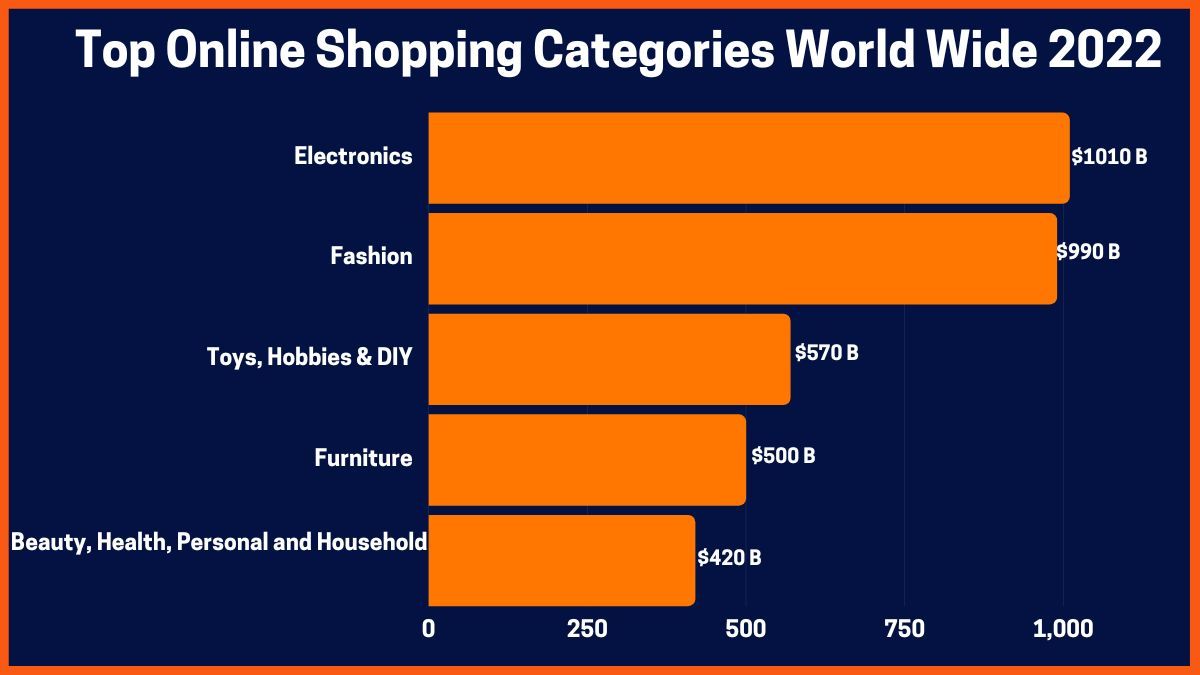
The above graph shows the online shopping categories worldwide for 2022 in US billion dollars as per the data shared by Statista
10. Sports Products
Lately, the online sports market has been in great profit as people search for sets used by popular players which is not generally available in the market. Not only does online shopping save time but some of the people who shop online for sports products say that they typically get it at cheaper prices as compared to the market. And added benefits include certified products, free repair, etc.
The world of e-commerce or online shopping is booming! We are quite sure you too shop online. Have you shopped from the above-mentioned products offline? Every day we come across products that might not be easily found in the market. So, online shopping sites are our resort.
The above-mentioned products which dominate the online market are mostly daily-use products and it is a delight to have all of them under the same platform over the internet.
FAQs
What is the largest retail category?
The largest retail category can have a debatable answer. Currently, the largest retail category is apparel.
What categories are most frequently bought through e-commerce?
The most frequently bought e-commerce categories are toys and hobbies, food and beverages, equipment and supplies, etc.
What are product categories in marketing?
The product categories in marketing stand for a group of products all sharing similar properties.
What do people purchases most online?
People mostly purchase casual and daily usable items online. These items can widely be divided into multiple categories such as fashion, electronics, books, sports, etc.
With the evolving time of technology, the healthcare industry is growing at a large scale. And being one of the most crucial fields for the application of artificial intelligence, there have been some remarkable innovations through this.
For instance, we can learn from the recent pandemic example where AI made the prevention method of Covid-19 quick and possible. Similarly, AI is used in almost every sector of the healthcare industry.
Speaking of AI in healthcare, India valued it at Rs 431, 97 billion, which is growing by the rate of 40 percent. India has always lagged when it comes to health care as the doctor-patient ratio here is 1:1456 which is significantly low. That’s why WHO has recommended the ratio to be 1:1000.
This brings us to the current situation of AI in the healthcare industry in India. And to discuss this, we have presented this article where we’ll be discussing the top Healthcare Analytics startups in India. So, let’s get started!
When it comes to healthcare analytics, Niramai Health Analytics has never been off-list. The company was founded in the year 2016 by Nidhi Mathur and Geetha Manjunath, having its headquarters in Bengaluru, India.
Using the advanced technology of high-resolution thermal sensing devices and artificial intelligence, this healthcare analytics company has developed Thermalytix which is based on ML algorithms. This is used for detecting breast cancer at an early stage so the chances of successful treatment procedures are enhanced.
Plus, with this device, using traditional methods and self-examinations has a high success rate in treating breast cancer. And the best thing about the company and this amazing device is that it is a low-cost, automated portable that makes cancer screening possible for all patients.
2. HealthifyMe
Founded: 2012
Headquartered: Bangalore, Karnataka, India
HealthifyMe Website
Another Bengaluru-based health care analytics company is HealthifyMe which was established in 2012. It is formed as a digital health and wellness platform, founded by Sachin Shenoy, Mathew Cherain, and Tushar Vashisht. These three saw a vision of introducing digital healthcare, especially in India where it is much needed.
They enable an AI-based virtual assistant called by the name of Ria, which helps the users in listening and solving all their queries regarding nutrition, fitness, and health in different languages. Plus, you also get notifications whether you are following your diet or not. And by using the AI, you can easily track calorie intake at home.
3. Innovaccer
Founded: 2014
Headquartered: San Francisco, California
Innovaccer Website
Innovaccer is an amazing cloud and AI-based telehealth solution that is highly used in healthcare centers for managing population health. It was founded in the year 2014 and offers various features such as collecting, analyzing, and then providing insights on the health condition of the patient.
The company Innovaccer is backed by prominent investors like B Capital Group, M12, and many more. Its top features include AI-based patient engagement and decision support tools. Through this platform, the healthcare industry enjoys the benefits of remote patient monitoring, virtual care networks, and SDOH management. Plus, they also get CRM, surgery optimization, and referral management as well.
4. IndoHealth Software Solutions Pvt. Ltd.
Founded: 2016
Headquartered: Pune, Maharashtra, India
IndoHealth Software Solutions Pvt. Ltd. Website
Being a Pune-based company, IndoHealth Software Solutions Pvt. Ltd. has a partnership with Government Health Departments, Research institutions, and hospitals to improve the health program. It has created a National Award-winning digital Public Health Platform, iHealWell.
IndoHealth Software Solutions Pvt. Ltd. is a well-established health-tech company that has recognition under the DPIIT Startup India Program. The company has compiled the health care experience of the US and India to introduce and promote patient monitoring through technology and public health platforms to bring better outcomes.
5. BioAssistant
Founded: 2016
Headquartered: Navi Mumbai, Maharashtra, India
BioAssistant Website
Built with super advanced technology that would make healthcare more accessible, smarter, and quicker, BioAssistant has made a great contribution to the medical field.
With the help of AI, the company has powered innovative remote clinical monitoring solutions and devices for automatic medical diagnosis. With the proper use of the R&D approach in the medical field, they have worked on some of the biggest medical field issues.
The company has an amazing team of experienced healthcare entrepreneurs who have worked enormously with leading medical institutions all across the world. BioAssistant’s operational areas include preventive healthcare, clinical IT, non-invasive diagnostics, and medical monitoring.
6. Tricog
Founded: 2014
Headquartered: Bengaluru, India
Tricog Website
Tricog is a Bengaluru-based healthcare analytics company that was founded in the year 2014 by Udayan Dasputa, Chirat Bhograj, Abhinav Gujjar, and Zainul Charbiwala.
They have created a flagship product, InstaECG, that is used to interpret and analyze ECG reports within just 10 minutes by being cloud-connected. Another successful product by them is InstaEcho which is a cardiac product used to assist doctors in accurate echocardiogram diagnosis.
With these two successful products, Tricog has served more than 12 countries across the world and has an employee count of over 2,600+. And the company has been awarded the honorable NASSCOM Artificial Intelligence Game changer Award of 2018.
7. BlueSemi
Founded: 2017
Headquartered: Hyderabad, Andhra Pradesh, India
BlueSemi Website
When it comes to healthcare analytics, BlueSemi has contributed a lot by providing IoT solutions to manage it and climate changes. They have worked a long way to provide solutions for anti-counterfeiting, energy harvesting, and temperature measurement.
And in the medical field, the company has delivered a wireless temperature scanner that helps in fever screening. The company was founded in the year 2017 and is established in Hyderabad, India.
Moreover, BlueSemi is enormously appropriated for developing the energy harvesting device that enables complete power for autonomous and wearable vehicles. It includes features like customized access, identification coding, data analytics, marketing, and many more. The company is backed by prominent investors such as Softbricks Private Limited, Global Emerging Market solutions, and others.
8. SigTuple
Founded: 2015
Headquartered: Bengaluru, Karnataka, India
SigTuple Website
SigTuple is a healthcare analytic company that provides AI-based healthcare diagnostic solutions. And Manthan, a machine learning platform that SigTuple developed can provide insights from data, as claimed by the company.
SigTuple was founded in the year 2015 in Bangalore, India. They use the technology of deep learning to detect and foresee any changes that the patient of any particular disease might have from medical diagnostic images.
Plus, the peripheral blood smear analyzer solution provides image processing-based solutions, mainly for differential blood count and for screening various diseases yet to come as they are under clinical trials.
9. HealthPlix
Founded: 2014
Headquartered: Bengaluru, Karnataka, India
HealthPlix Website
By providing the solution for electronic medical records, HealthPlix has made chronic care management a lot easier than before.
The top features of this solution include lab management, e-prescription generation, billing, and a dashboard that provides machine learning and AI-based insights for testing clinical hypotheses, finance marketing, and treatment outcome. Moreover, they also provide patient risk management, tracking patients’ records, and many more. The company was founded in the year 2014 in Bangalore, India.
The above graph shows an estimated global healthcare analytics market size from 2020 to 2030 in US billion Dollars as per the source precedenceresearch.com
In conclusion, we can say that many companies have made their contribution to advancing the healthcare industry with machine learning and artificial intelligence. Such healthcare analytics companies have always put themselves up front and keep up their game above competitors.
In this article, we covered those companies from India. In the upcoming times, with the development and innovation speed graphs kept on increasing, there will be a huge transformation in the healthcare industry.
FAQs
What is healthtech startup?
Healthcare startups are the one that works in the field of health care and fitness but with the help of newly emerging technologies like artificial intelligence, etc.
What is digital health?
Digital health is a broad concept that basically revolves around the intersection of healthcare and technology.
What is AI in healthcare?
Artificial intelligence in healthcare stands for the implementation of the more advanced and easy mode of treatment, diagnosis, and interpretation of medical reports by the use of technology. AI has made the healthcare industry experimental with the advised safety.
Which Indian healthcare companies use artificial intelligence?
Some of the Indian healthcare companies using artificial intelligence are Tricog, Nirmai, PharmEasy, etc.
YouTube is an ocean of content. It can be difficult to find your niche amidst the plethora of variety of niches. But the two basic and most important things to remember to generate profit are knowing- you do it differently from others, and that you possess enough equipment to provide the best quality in your videos.
If you get these two things right, profit is on the way! That’s right, it is not as complex as you think it is. The next challenge that comes is selecting a niche. Here is a list of niches where one can thrive by possessing appropriate and updated skills. Always select a niche that falls under your expertise because that will make you gain views.
Some of the most hot-selling niches currently on YouTube
Most Hot-Selling Niches Currently On YouTube
Tutorials
As the saying goes, “Learning is the eye of the mind.” We are all aware that there is a constant need for teachers and students, and if one of them doesn’t meet the demand, the balance may be shaken. Since learning can occur anywhere, at any time, it has gained a lot of traction online. When turning to video learning, whether it be for getting in shape or passing a test overnight, most people knock on the doors of YouTube. Similar to how this tutorial field can never be depleted. The number of YouTube channels that provide tutorials for a variety of topics has experienced an increase in competition. But you know, a suitable waterway of knowledge has never been discovered or abandoned.
It is very helpful for people to remember things when presented visually.
WordPress
Tutorial Making A WordPress Website
Undoubtedly there is a huge market for WordPress tutorials as it has always been a subject matter that many people wanted to dive into. the number of audiences it generates has never fallen low. Learning WordPress can be a real challenge for people with zero software knowledge. If one knows the dos and don’ts of WordPress in a just fine way, it will be a great idea to put the talent out there. Even though it has a pretty crowded community of tutors, to cover the complex elements of WordPress each one of them has its own distinctive method. This niche is very profitable if your WordPress skills and interaction skills are solid.
A tech niche can cover just about anything, it can vary anywhere from tech product reviews, tutorials, teaching, assembling, etc.
Tech can be a very profitable niche as it requires a certain level of skill set to establish yourself in it, Hence, bringing down your competition as not everyone can do it very well. Tech videos and tutorials are mostly explored in English-speaking nations hence making your CMP high and in return making a greater revenue for your YouTube channel.
Video/photo editing
Video And Photo Editing Tutorial
In the world where virtual content thrives, video and photo editing have become must-know skills in order to survive the virtual world. The demand to learn editing right from simple to complex levels is ever-increasing. A good editing skill set is required to make a noticeable social media presence. Frankly, nobody likes bland, be it content or presentation. Post-production requirements are usually given less attention because of a lack of knowledge and an appropriate skill set. if you think you possess interesting and updated skills in editing applications, equipment, and tricks to edit better, this niche is just for you.
It is pretty obvious that Microsoft Excel tops the list of one of the most wanted soft skills in this century. This skill is required by a receptionist of a 3-star hotel to a CEO of a conglomerate. It might sound boring, but you will be astonished to know that most of the Microsoft Excel tutorial channels on YouTube have done really well consistently.
Reviews of courses, software, products
What would be the first place you would turn to if you wanted to verify a rumour or obtain an opinion about a product? The Internet! No brainer, right? People tend to like verbal and visual explanations of things more than reading a long, boring manual. YouTube is a great place to explore and make money. All you have to do is, make a simple yet informative video, sharing all the experiences you have had, be it good or bad. One can stick to only a specific niche or have multiple random things under their umbrella, it doesn’t really matter unless your content speaks unbiased and clear.
Remember, to sharpen up your communication and interaction skills before diving into this niche. Be it unboxing a brand new phone to reviewing a book, everything sells well on YouTube.
Lately, everyone everywhere is curious about how to be good at trading stocks, and if you find yourself to be good at tracing and analyzing trends, be it fundamental or technical, you can teach it on YouTube where millions of viewers are waiting to explore this niche, as this topic is like a hot cake around the world and is in good demand. It makes a very profitable niche for anyone who is good at it.
How-to DIY videos
Popular DIY ROOM DECOR IDEAS
From searching for how to change an Instagram password to how to make origami flowers, YouTube has covered it all. YouTube is a destination where people from diverse age groups with the need of learning a variety of different skills are found. Videos of basic How-to things can be really helpful for these people. No how-to videos can be considered novice or silly, be it unlocking doors or fixing a fan. Quick problem-solving videos can be a very good profit maker.
Cooking
Veg Korean Fried Rice
Gone are the days people buy recipe books to get to know the skill. Cooking is by default a must-know survival skill. Every person at some point in their life gets in the kitchen to cook. Any recipe you think in mind you get it online. If you have unique recipes running through your family you can share them with the world. If you have the talent for cooking a very complicated dish in simple steps or experimenting with cuisines from all around the world, you know exactly where to showcase talent like this. Now, all you need is a good camera and good editing skills or a hired editor to get going.
Remember the workout motivation we all get at 2 am and how our fingers crawl to type “How to get fit in 10 days”? Yes, we have all been there. Each day new YouTubers are coming up with many innovative hacks for staying fit. If you are a medical or fitness professional you can easily make a good enough profit by spending some time exploring and working in this niche. Gym videos, basic exercises, yoga, and diet are very commonly searched for on YouTube.
Fashion and lifestyle
Who doesn’t want to remain in vogue? Fashion and lifestyle etiquette videos garner a lot of attention and top the charts of YouTube’s most watched. Be it from styling a very basic scarf to making big lifestyle decisions and changes, YouTube’s a single-station hub for all. If you have a distinctive sense of style and good taste in clothing, styling, and grooming, you can become popular in no time. The best-performing videos in this genre are weekly or daily vlogs.
Conclusion
It is wise to select a niche most relevant to your skill set and stick to that niche consistently for persistent growth. A frequent major switch in niches is likely to upset the quality of viewers on the channel. If you are not sure about the niche but still have a pretty good personality for a camera, you can always explore making entertainment vlogs that are also highly profitable, again, if consistent.
The Indian stock market has become one of the most dynamic business spaces wherein all the stakeholders have the same hope and expectations. The way it functions and reaps losses and profits has always been a site of great interest for all budding investors. There are a large number of people who carefully follow investors and their investing strategies along with the stock. There is absolutely no doubt that the ways in which investors make money out of the equity market give immense inspiration to budding investors. This article will discuss some of the top investors in the Indian stock market along with their general merits and investment strategies.
Value of Change in Stocks in GDP at Current Prices India (FY 2016-2022)
Rakesh Jhunjhunwala
Net worth: $5.8 billion Portfolio and Holdings: Titan, CRISIL Ltd., Metro Brands Ltd., Nazara Technologies, Ltd., Aptech Ltd., Agro Tech Foods Ltd., and more
Rakesh Jhunjhunwala – Top Investors in the Indian Stock Market
Known as the Indian Warren Buffet, Rakesh Jhunjhunwala has his investments net worth rising above Rs 31,833 crore by 2022. His death on August 14, 2022, was indeed a loss to the whole of the Indian stock market. This billionaire business magnet started investing with merely Rs.5000 in 1985. As of 2022, his holding in Titan alone is worth Rs. 11,000 crores. Rakesh Jhunjhunwala and Associates publicly hold 32 stocks. Apart from being a staunch investor, he also held many positions of power as a chairman and member of the board of directors of various reputed companies. In 2021, Jhunjhunwala invested $35 million for a 40% stake in Akasa Air. He is the co-founder of this new ultra-low-cost Indian airline.
Net Worth: $20.4 billion Portfolio and Holdings: United Breweries Ltd., India Cements, 3M India Ltd., Blue Dart Express Ltd., Avenue Supermarts Ltd., and more
Radhakishan Shivkishan Damani – Top Investors in the Indian Stock Market
Radhakishan Shivkishan Damani is a billionaire investor hailing from Bikaner who is also the founder of DMart. He is an astute investor in the Indian stock market with his portfolio net worth running up to Rs. 161,356 crores. He manages his portfolio through his investment firm called Bright Star Investments Limited. In 2022, he was ranked as the 98th richest person in the world. His prudence as an investor is evident in the way his stocks have grown over the years. His stocks rose from Rs. 157.65 crores to Rs. 322.65 crores in the last year. This doubling happened at a time when the Indian stock market was at its weakest after the Russia-Ukraine war. His careful investments not only help him but also other shareholders as well.
Azim Premji
Net Worth: $9.8 billion Portfolio: Wipro Ltd., Tube Investments of India, Balrampur Chini Mills Ltd.
Azim Premji – Top Investors in the Indian Stock Market
Azim Premji is an Indian investor, businessman and engineer primarily known for his valuable contribution to the growth of the internationally acclaimed company, Wipro. He founded PremjiInvest which focuses on private equity and venture capital investments. Azim was one of the richest people in India before he gave up a large part of his personal wealth for charity. He was also the first Indian to sign the Giving Pledge, which is an initiative by Warren Buffet and Bill Gates that urged the rich people in the world to commit to giving their wealth to society as charity. In 2020 alone, he donated over $70 million to charity.
Mohnish Pabrai
Net Worth: $148.3 million Portfolio: Edelweiss Financial, Rain Industries, Suntech Realty
Mohnish Pabrai – Top Investors in the Indian Stock Market
An ardent follower of Warren Buffet, Mohnish Pabrai is an Indian-American investor. He is also the founder of the investment firm named Pabrai Investment Funds. Founded in 1999, his firm has given a return of a whopping 517%. Pabrai’s investment strategies are known to be focused on low-risk, high-certainty stocks and invest in companies that are well-managed with minimal downsides. He has a portfolio value of over Rs.1,875.9 crores holding three stocks. With the goal of giving back what they had to society, Monish Pabrai along with his wife started Dakshana Foundation which helps poor students from rural and semi-urban government schools to crack competitive exams like JEE.
Vijay Kedia
Net Worth: $96.7 million Portfolio: Tejas Networks Ltd., Vaibhav Global Ltd., Elecon Engineering Company, and more
Vijay Kedia – Top Investors in the Indian Stock Market
Popularly known as the “Market Master”, Vijay Kedia is an Indian investor hailing from Kolkata. He has been in the market since he was 19 years old. The investment strategy of Kedia is widely called SMILE which expands itself to – Small in size, Medium in experience, Large in aspiration and Extra-large in market potential. He invests only after doing a deep study of the management of the respective company and the ways in which it functions. He believes that it is important to wait and invest for a long time to gain better benefits. From 2000 to 2022, some of his shares have grown by over 47,150% which shows the vision with which the investor invests in each and every stock.
Nemish Shah
Net Worth: $216 million Portfolio: Lakshmi Machine Works Ltd., EID Parry (India) Ltd., Bannari Amman Sugars Ltd., and more
Nemish Shah – Top Investors in the Indian Stock Market
Nemish Shah is one of the finest investors who follow strategies very similar to Warren Buffet. He is also the co-founder of ENAM. It was founded in 1984 as a broking entity. The organisation have played a pivotal role in various significant IPOs in the country. He focuses on those companies that increase their business by improving the usage of their products. Some of his stakes, especially in Asahi India, have tripled in a span of three years. He is also credited for the development of investment research in India.
Dolly Khanna
Net Worth: $74.4 million Portfolio: Chennai Petroleum Corporation Ltd., Polyplex Corporation Ltd., Sharda Cropchem Ltd., Monte Carlo Fashions Ltd., and more
Dolly Khanna – Top Investors in the Indian Stock Market
Dolly is an investor based in Chennai who is known for her excellent vision of making prompt investments. She primarily buys stocks that are very less popular. She does not hesitate to trim stocks while she explores new ones whenever necessary. Recently she added Monte Carlo Fashions to her profile which has stirred a lot of attention. As of June 2022, she holds 3,69,032 shares or a 1.78% stake in this fashion brand.
Net Worth: $234.2 million Portfolio: Shaily Engineering Plastics Ltd., Barbeque-Nation Hospitality Ltd., NIIT Ltd., and more
Ashish Kacholia – Top Investors in the Indian Stock Market
The founder of Lucky Investment Managers, Ashish Kacholia is one of the most prudent investors in the Indian stock market. Recently he bought a multi-bagger stock named Best Agrolife that has had a 6000% increase in just 5 years. As per reports, he bought 3,18,000 shares of Best Agrolife paying Rs 940.88 apiece. The pattern of his investments and their growth have been very promising owing to his attention to the details of the company’s growth and development.
Conclusion
The stock market is a volatile platform that can go either way at any point in time, It is definitely not a spot to make a blind, uninformed choice. The stories of successful investors tell two things. Firstly, it is important to have a strong investment strategy which is based on careful observation and secondly, diversification is the key. Additionally, it is also important to accept that there can be losses too. Keeping that in mind, there is absolutely no doubt that the Indian equity market is a great place to learn and grow.
FAQs
Who is the king of the share market over the world?
Warren Buffet is said to be the king of the share market over the world. He is one of the richest people in the world, known for his strategic investment skills.
Who is the big bull of India?
Rakesh Jhunjhunwala is the ‘Big Bull of India’. He is known for his accurate predictions regarding stocks and market fluctuations.
Who owns the largest portfolio in India?
Rakesh Jhunjhunwala owns the largest portfolio in India with his portfolio worth Rs 31,833 crore.
Who are the top investors in India?
Some of the top investors in the Indian Stock Market are:
E-commerce has grown and changed over time to become the most well-known, favored, and widely utilized method of purchasing and selling items.
To perform online marketing and sales activities and control logistics and fulfillment, most businesses with an e-commerce presence use an e-commerce shop or an e-commerce platform. An e-commerce platform is required to administer and personalize an e-commerce store for it to be successful. The majority of individuals utilize Shopify as their e-commerce platform of choice.
Step-By-Step Guide for Beginners to Setting up a Shopify Store
What is Shopify?
Shopify Inc., a Canadian worldwide e-commerce platform for online businesses and retail point-of-sale systems, was launched in 2006. The Shopify platform provides several services to online shops, including payment processing, marketing, shipping, and customer involvement.
To try Shopify for yourself, you may join up for a free trial. During the trial period, you can create your online store, try free Shopify apps, and even make a sale. You can select from three different plans depending on your needs. For fledgling e-commerce businesses with occasional in-person sales, the basic plan is Rs 1,994/month, Shopify costs Rs 7,447/month for expanding businesses selling online consistently, and Advanced Shopify costs Rs 30,164/month for booming businesses that require advanced reporting.
There is no fixed price for Shopify. You have to pay for different marketing apps, transactions, and extra charges after buying a subscription if you don’t use Shopify payments.
Presently only a limited number of free templates are offered by Shopify. You’ll have to pay a one-time charge to utilize any other themes other than the free ones.
If you’re encountering technical difficulties, general support may or may not be able to assist you. Instead, you might have to ask your question in a forum and wait for a response from a developer. Only the United States, the United Kingdom, New Zealand, and Australia have phone numbers for customer support.
Some retailers may need to ask consumers to upload a file, such as a picture printed on a pillowcase or mug. Shopify will let you collect this information, but you’ll have to add some HTML code to your template manually. The second option is to pay for an app to do the work for you, but that isn’t ideal.
Shopify isn’t a content management system, it’s designed only to sell goods. Shopify is not the best option if you want to include rich material on your sites, such as movies, carousels, and other things, in addition to the products you want to sell.
Here is a list of the top alternatives to Shopify to consider:
WooCommerce
Shopify Alternatives – WooCommerce
WooCommerce is an open-source platform (plugin) for turning WordPress blogs and websites into e-commerce stores. You may customize your store to your heart’s content using code. WooCommerce is free to install, and the extensions are often inexpensive, allowing you to expand your store’s capabilities at a minimal cost. However, you might struggle to construct a highly customized web store you want on WooCommerce unless you have any technical experience. The basic WooCommerce plugin is free to use but add-on features are chargeable.
Ecwid
Shopify Alternatives – Ecwid
Ecwid is ideal for people who just wish to add e-commerce functionality to an existing website. It easily links to your existing website to offer more sales and e-commerce functionality. You don’t need to start from scratch. No coding knowledge is required to add e-commerce features to your website.
Once you set up your Ecwid store, you can sell not just via your website but also through your social media account and other marketplaces like Amazon. Users can also create, manage, and track advertisements from the Ecwid dashboard.
The free plan costs $0/mo, the Venture plan costs $15/mo (Rs 700/mo), the Business plan costs $35/mo (Rs 1500/mo), and the Unlimited plan costs $99/mo ( Rs4990/mo). You pay even lesser for all the plans when you pay annually.
Pixpa is an easy-to-use, all-in-one website builder platform specially designed keeping in mind the needs of creative professionals and small businesses. Pixpa stands out from other website builders with its focus on simplicity, flexibility, and powerful editing features. It’s full-featured ecommerce store builder is powered with all the tools required to run your online business – products and inventory management, discounts, taxes, shipping, abandoned carts, and easy order processing.
E-commerce galleries enable photographers and creatives to sell prints or digital downloads of their work through their websites. Print orders can be auto-fulfilled through integration with WHCC photo labs. Client galleries enable photographers to shift to a digital workflow and make it easy for clients to view, proof, purchase and download images.
With a host of built-in tools such as SEO Manager, Marketing Pop-Ups, Announcement Bar, and much more, you don’t need any extra plugins to start growing your traffic and converting more leads.
Pixpa offers 24/7 fast and proactive customer support through live chat and email. There is also a comprehensive help centre with guides and step-by-step tutorials.
Pixpa Pricing
Pixpa’s all-inclusive pricing plans range from $5 to $25 monthly. Discounted annual and 2-yearly options are also available. All plans offer generous resources, unlimited bandwidth, SSL certificates and 24/7 support.
Pixpa Pricing
Shift4Shop
Shopify Alternatives – Shift4Shop
Shift4Shop has been providing SEO-focused e-commerce software since 1997. Shift4Shop’s e-commerce platform is free to use monthly. There are over 100 online payment methods, including international processors. Furthermore, because Shift4 specializes in payment processing, they may provide you with significantly lower credit card processing rates than Shopify.
Shift4Shop may be a better fit for you than Shopify if you’re an SEO nerd who depends heavily on organic search.
Shift4Shop’s basic plan comes at $29/month, the Plus Store Plan comes at $79/month and the Pro-store plan comes at $229/month. All the plans come with features like Domain registration, secure web hosting, a built-in blog, API Access, a shopping cart, and more than 50 mobile-ready themes among many additional features.
Shift4Shop Pricing
Sellfy
Shopify Alternatives – Sellfy
Sellfy is a customizable store builder for companies that sell digital, physical, or subscription items. With an easy-to-use UI and various connections, Sellfy is one of the best Shopify options for selling digital products. Users can either build a store on Sellfy or integrate Sellfy into an existing website. Sellfy comes with amazing features like the availability of custom domains, third-party integrations, store customization, and sales analytics options.
There is no free plan, but there is a 14-day trial. After that, the Starter plan costs $22/mo, the Business plan costs $59/mo, and the Premium plan costs $119/mo. On the negative, customization abilities are limited.
PinnacleCart, created in 2003, is a shopping cart solution for small to mid-sized businesses with a strong marketing focus. You can choose to have PinnacleCart host your website or manage it yourself. As your traffic grows, you’ll either have to pay more or switch to a more costly plan with unlimited capacity. PinnacleCart offers just 12 themes, unlike Shopify, which has a large number of them.
You can get a 14-day free trial, and after that, you can either buy the Standard subscription at $79.95/mo or the Advanced subscription at $199.95/mo. If you have a large business, then you can buy an Enterprise subscription by calling them. The Free and Standard plan offers features like up to 5 admin accounts, unlimited product categories, and customer service via live chat. The Advanced and Enterprise accounts include features like Customer Support via Phone, product filters, recurring billing options, split shipping, blog options, and over 30 payment options.
BigCommerce has been one of Shopify’s primary competitors since it was created to assist massive, fast-growing businesses reach their full potential. BigCommerce boasts the most built-in functionality of any e-commerce platform, so you won’t have to rely on applications as Shopify does. There are over 55 payment channels available, with no additional transaction fees. Around 85% of difficulties are resolved on the first call, and support is available 24 hours a day, seven days a week. BigCommerce offers outstanding SEO and multi-channel selling capabilities, but some users may find it a bit less user-friendly than Shopify.
Despite having many premium themes, BigCommerce only provides five free themes compared to Shopify’s nine. There is no free plan, but there is a 14-day trial. After that, the Standard plan costs $29.95/mo, the Plus plan costs $79.95/mo, and the Pro plan costs $299.95/mo.
BigCommerce Pricing
BigCommerce also offers an enterprise plan for big businesses for which one may get in touch with the BigCommerce Sales team.
Wix is primarily a website builder, but it now offers e-commerce options that start at $20/mo (paid annually), making it a more cost-effective alternative. But it’s not the only feature that sets it apart from Shopify’s rivals. It also has some fantastic sales features and outperforms Squarespace and BigCommerce in design functionality. Users can either use the drag and drop features to build a website from scratch or just answer some questions, based on which the WIX ADI(Artificial Design Intelligence) designs a website just within a matter of minutes. Wix’s open development platform called Velo lets tech-savvy users build advanced web applications. Other than these, Wix comes with many other amazing functionalities.
On the negative side, Wix can’t handle larger stores like Shopify, but it’s still great for small businesses that prioritize branding.
Wix Website PlansWix Pricing Plans for e-commerce and business
In terms of self-hosted solutions, Magento is arguably the most well-known e-commerce platform. It was initially released in 2007, and Adobe purchased Magento in 2018, allowing small businesses to use Magento Commerce and Magento Open Source.
Now named Adobe Commerce, Magento has a worldwide developer community of over 260,000 people that contribute to the platform’s development. You gain access to an extensive partner ecosystem for third-party applications and add-ons, and you can customize everything in your business from the backend because it’s open-source. Adobe Commerce’s pricing details are not available on the site. Interested ones can fill in their details in the given form and get in touch with the Adobe team.
Square Online
Shopify Alternatives – Square online
Square online is a simple, powerful, and highly customizable tool that allows shop owners to manage their money, employees, and client base from a single screen. The Point of Sale App from Square is completely free. Downloading it is free, and there are no hidden costs. Building a site, selling, and hosting on the Square subdomain, everything is free. Users need to pay just the transaction fee on the orders placed on the site. However one needs to pay for services like a custom domain name and email address. Below are Square Online’s pricing plans-
Square Online Pricing Plans
Square also includes several features and subscription services aimed at restaurants and other service-based businesses that aren’t available on Shopify. However, customization possibilities are limited in Square.
Squarespace
Shopify Alternatives – Squarespace
Squarespace is best recognized as a simple website builder for small company owners, freelancers, and creatives in a variety of industries that require a digital landing pad but not necessarily a fully equipped online store. Squarespace is well-known for its attractive templates. Around 70 attractive, contemporary website themes are available. On the negative side, their tools are limited, especially in terms of SEO.
You may select between two plans: the Personal plan, which costs $16/mo or $12/mo if paid yearly, and the Business plan, which costs $26/mo or $18/mo if paid annually. Personal and Business Plans are suitable for websites, while the basic Commerce plans and Advanced Commerce plans are suitable for online stores. Here are Squarespace’s pricing plans-

 Parnas Ghosh