Anthropic hits a new milestone. The company has raised an impressive $13 billion in new funding. This is huge for Anthropic, especially as many tech giants compete to be the ‘it’ AI company, the next big thing in AI. This fundraising is a Series F round, meaning it’s their sixth major round of funding. Post-money, Anthropic’s valuation reached $183 billion. With this influx of investors, Anthropic is now one of the world’s most valuable AI companies. Is this move a game-changer for Anthropic? What is it planning next? Learn more?
Who Invested in Anthropic?
A long list of big investors in tech pooled money into Anthropic:
Financial firms like BlackRock, Blackstone, Goldman Sachs, and T. Rowe Price.
Big Global Investors like Qatar Investment Authority, GIC (Singapore’s sovereign wealth fund).
Venture capital firms like Altimeter, General Catalyst, Coatue, Insight Partners, and Lightspeed.
Pension funds like the Ontario Teachers’ Pension Plan.
And some others like Jane Street, D1 Capital, WCM, XN.
Why Are They Investing in Anthropic?
AI is the new today and our very tomorrow. The demand for AI is only going to grow. And according to Anthropic’s CFO, Krishna Rao, several companies (from Fortune 500 companies to AI-first startups) are already incorporating Claude (Anthropic’s version of ChatGPT) in their work, meaning the company is seeing good traction. With this investment, Krishna Rao is confident that Anthropic’s traction will grow faster.
How Fast Is Anthropic Growing?
Anthropic launched its Claude (their version of ChatGPT) in March 2023.
In early 2025, the company’s revenue surpassed $1 billion.
Fast forward to August 2025, and that number went up to a whopping $5 billion in eight months.
What’s Driving This Big Growth For Anthropic?
Talent + Research → Anthropic focused on having the top researchers on board to work on AI safety, alignment, and interpretability.
Businesses → Anthropic works with 300,000 companies (who use Claude). Some large accounts pay over $100,000 each year. These numbers have grown 7x in the past year, showing how businesses across the world trust the company and its products.
Focus on Developers → Anthropic introduced the Claude Code tool in May 2025. In just 3 months of its launch, the tool generated a sum of $500M with, and usage is growing 10x every month.
Growing Individual Users → Not just businesses and developers, but also the regular everyday users, too, are opting for Pro and Max plans.
What Will Anthropic Do With This $13B?
According to the article posted as announcements on Anthropic, the company will use the funds:
To meet the growing business demands.
To deepen AI safety research, remember how the hackers were using Claude as a teacher to steal data and threaten the companies?
To go international to reach wider audiences.
To build more AI systems that are safe, explainable, and controllable. With Anthropic reaching such a milestone, it will be interesting to see how its competitors respond.
In this digital age, it is complicated to understand what you believe by watching online. Misinformation is rapidly spreading everywhere, from videos that look impossibly real to news stories that twist the truth. Deepfakes videos, images, or audio altered using AI are becoming increasingly common, and they can be used to impersonate people, spread scams, or manipulate public opinion. The scary part is how convincing they can be.
However, there is also a way to save yourself from falling into this trap. Using the right method, anyone can learn to identify manipulated content and protect themselves from misinformation. In this article, we’ll take a close look at what Deepfake photos and videos mean, where they are most often used, and the practical ways you can detect them.
What Is a Deepfake?
A deepfake is a type of synthetic media is a video, image, or audio clip, that’s been created or altered using artificial intelligence to look or sound real. The term comes from combining “deep learning” with “fake,” highlighting the AI technology behind it.
Modern deepfakes can imitate a person’s face, voice, or even movements with startling realism. Some of the most common forms include:
Face swaps: Replacing someone’s face in a video with another person’s.
Lip-sync deepfakes: Keeping the original face but digitally altering the speech so the mouth matches different words.
Voice cloning: Replicating a person’s voice, tone, and speech patterns without using their face at all.
DeepFakes can look incredibly realistic. The Kaggle Deepfake Detection Challenge demonstrated just how sophisticated AI-generated videos have become, with prizes of $1,000,000 awarded to teams developing the best detection algorithms.
However, beyond machine learning, the public’s ability to spot subtle cues can play a crucial role in fighting misinformation.
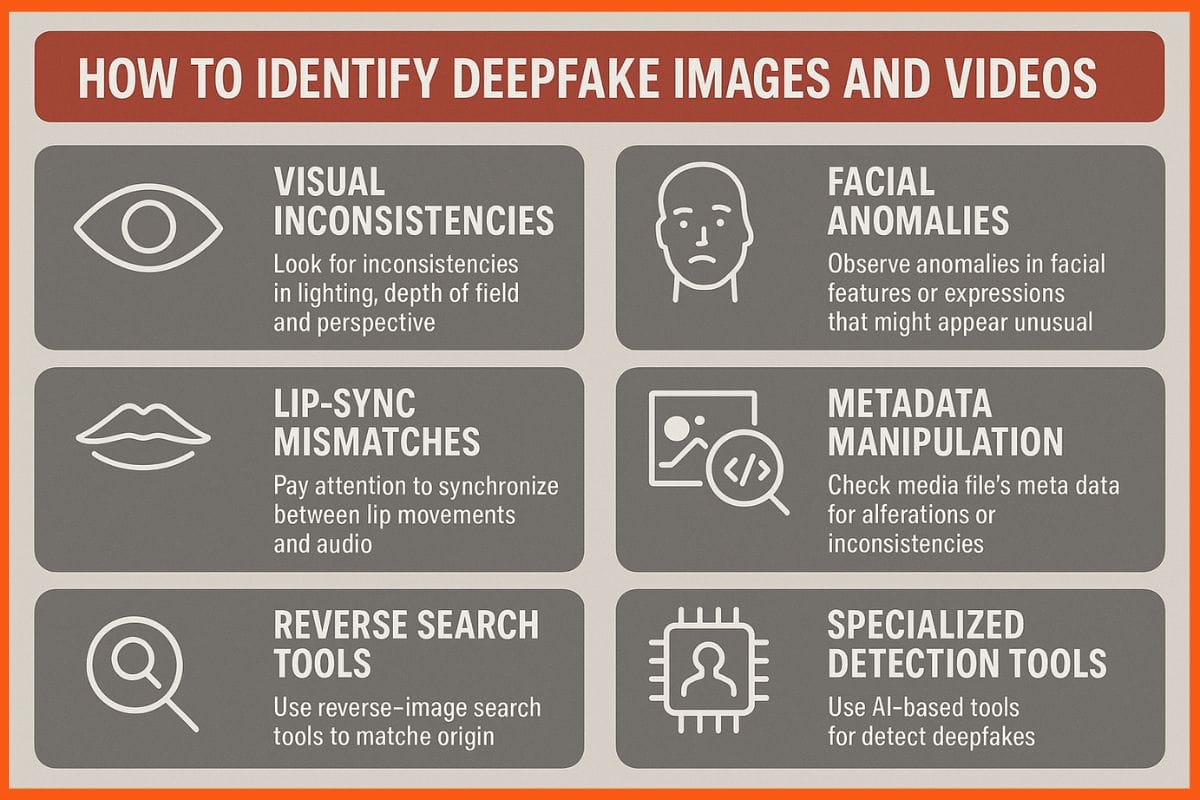
How to Identify DeepFake Images and Videos Like a Pro?
How to Identify DeepFake Images and Videos
Detecting a DeepFake isn’t always easy, but there are visual, behavioral, and technical clues that can help. Here’s what to look for:
Visual Inconsistencies
Unnatural lighting, flickering edges, blurred backgrounds, or overly smooth skin can indicate manipulation. Also, watch for mismatched shadows or reflections, which AI often fails to reproduce accurately. Small distortions in the background or objects may further reveal that the video has been altered.
Facial Anomalies
Misaligned eyes, distorted teeth, unusual blinking, or inconsistent aging between facial features are common giveaways. Pay attention to subtle asymmetries in the face, such as uneven lips or jawline changes, which often appear in DeepFakes. These imperfections may not be immediately obvious, but can raise suspicion.
Lip-Sync Mismatches
When the audio doesn’t align perfectly with the mouth movements, it’s often a warning sign. Listen for unnatural pauses or timing errors in speech, and observe if facial expressions match the tone and emotion of the voice. Inconsistencies here are common in AI-generated videos.
Facial Hair, Moles, and Details
Facial hair may look unnatural, or moles and freckles may shift inconsistently. Check whether beards, sideburns, or mustaches appear patchy or blurry. Tiny features like blemishes, scars, or beauty marks may also move or change shape unnaturally.
Metadata Manipulation
Check file creation and modification dates. DeepFake tools often alter or erase metadata, leaving behind inconsistencies. If metadata seems missing or contradictory, it could indicate that the video was exported or tampered with multiple times. Comparing metadata across similar files can reveal suspicious discrepancies.
Reverse Search Tools
Use TinEye or Google Image Search to track original images or video thumbnails. If a similar video exists elsewhere with different content, it’s likely a fake. This can also help identify if a frame from a video has been reused in a different context, a common tactic in misinformation campaigns.
Specialized Detection Tools
Free browser plug-ins like DeepFake-o-Meter or AI platforms like Microsoft Video Authenticator and Intel’s OpenVINO can analyze content for DeepFake artifacts. These tools can detect subtle inconsistencies that are invisible to the naked eye, such as unnatural pixel patterns, temporal inconsistencies, or AI-generated noise.
With practice, anyone can become more adept at spotting DeepFakes by paying attention to these subtle signs. Over time, combining observation skills with technical tools will significantly improve your ability to discern real from fake.
As deepfakes become more sophisticated, AI offers powerful ways to spot them. Here are the main techniques used in detecting fake media:
Convolutional Neural Networks (CNNs)
CNNs analyze images by detecting edges, textures, and patterns through multiple layers. Trained on real and manipulated media, CNNs spot subtle anomalies in skin texture, lighting, facial landmarks, or blinking patterns that humans might miss. They excel at detecting inconsistencies in facial features, resolution, and reflections in the eyes.
Recurrent Neural Networks (RNNs)
RNNs specialize in analyzing sequential data, making them ideal for videos. They detect irregular motion, lip-sync errors, or unnatural expressions over time. LSTM-enhanced RNNs track temporal patterns to identify inconsistencies in movements or speech.
Autoencoders
Autoencoders learn to compress and reconstruct authentic images or videos. When fed a deepfake, the reconstruction often contains subtle errors or artifacts. These discrepancies help reveal AI manipulations in pixel distributions or overall structure.
AI-Based Audio Analysis
AI can analyze voice tone, rhythm, and modulation to spot fake audio. Deepfake audio often has unnatural pitch, cadence, or breath patterns. Spectral analysis further highlights frequency or amplitude inconsistencies typical of synthetic speech.
Biometric Analysis
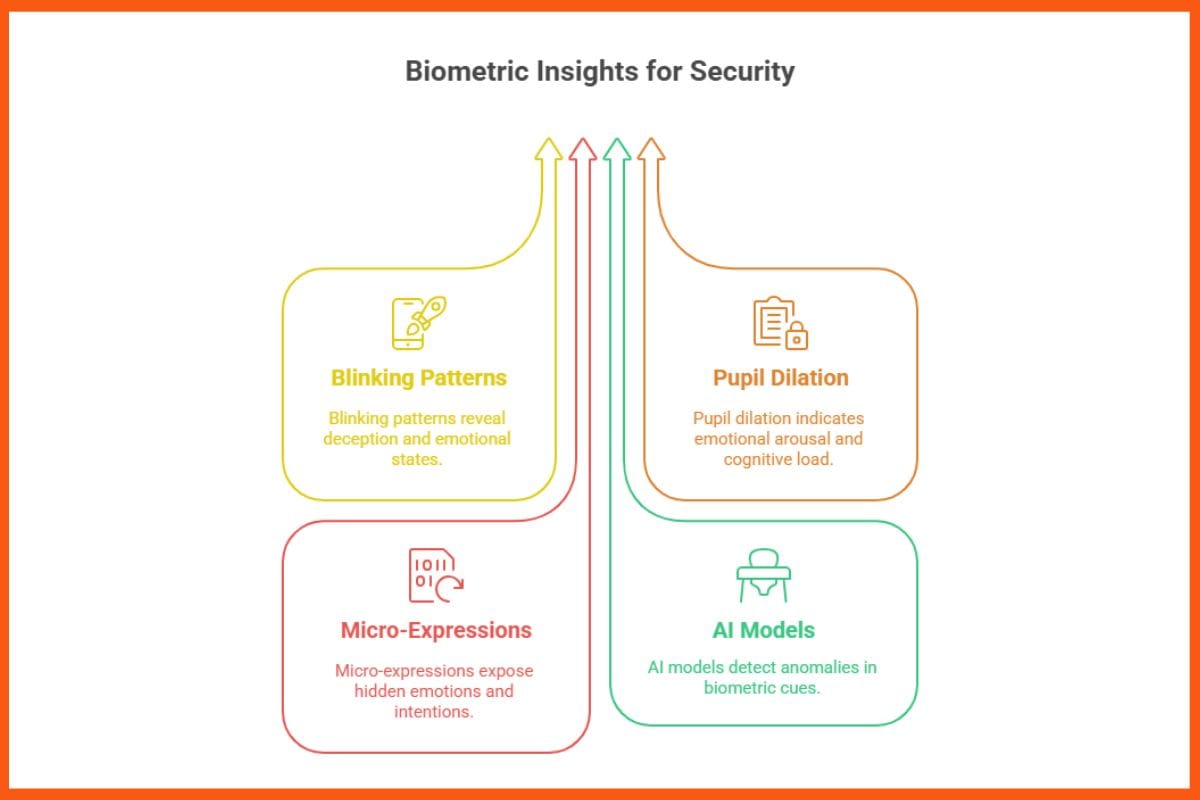
Biometric Insights for Security
Biometric cues like blinking patterns, pupil dilation, and micro-expressions are difficult to fake. AI models can detect abnormal gaze, unnatural facial movements, or inconsistent micro-expressions, especially useful for authentication and security contexts.
Adversarial Training
Generative Adversarial Networks (GANs) train detection models against fake generators. The discriminator learns to identify subtle forgeries while the generator improves, creating a constantly evolving detection system that adapts to new deepfake techniques.
Forensic Analysis
AI examines digital fingerprints such as metadata, compression artifacts, and noise patterns. Irregular timestamps, abnormal pixel noise, or unusual compression artifacts often reveal tampering in images, videos, or audio.
Transfer Learning
Pre-trained AI models are adapted to detect new deepfake types quickly. By fine-tuning models on updated datasets, transfer learning allows rapid detection of emerging manipulations without starting from scratch.
Attention Mechanisms
AI models focus on high-risk areas, like eyes, mouth, or lighting inconsistencies. This targeted analysis helps detect subtle artifacts, such as mismatched reflections or shadows, that might otherwise go unnoticed.
Hybrid Models
Hybrid models combine CNNs, RNNs, and attention mechanisms for robust detection. By integrating spatial, temporal, and focused analysis, they excel at spotting complex manipulations in both images and videos, useful for news verification, legal evidence, and social media monitoring.
Conclusion
Deepfakes represent a major challenge in the digital age, but AI provides powerful tools to detect and combat this growing threat. By learning sophisticated machine learning models, we can identify and mitigate the risks posed by deepfakes, protecting the integrity of information in our increasingly digital world. As AI continues to advance, so too will our ability to detect and defend against these forgeries.
Furthermore, raising public awareness and promoting digital literacy can help individuals critically assess the content they encounter online. Collaboration between tech companies, policymakers, and researchers is essential to create effective regulations and detection standards. Ultimately, a combination of AI innovation and human vigilance will be key to maintaining trust in digital media.
A deepfake is a type of synthetic media—video, audio, or image—created using AI to mimic real people or events. They often involve face swaps, lip-sync alterations, or voice cloning.
How can I spot a deepfake video or image?
Look for visual inconsistencies like unnatural lighting, flickering edges, mismatched shadows, or blurred backgrounds. Check facial anomalies such as odd blinking, distorted teeth, or shifting moles and freckles.
What are the signs of deepfake audio?
Deepfake audio often has robotic tone, unnatural pauses, or inconsistent breathing. AI-generated voices may lack natural pitch variations or emotional expressions.
Statsig, a product testing business, has been bought by OpenAI. Vijaye Raji, the startup’s Indian-origin founder and CEO, has also been named the new Chief Technology Officer (CTO) of apps by the Microsoft-backed artificial intelligence (AI) business. Raji will handle key systems, infrastructure, and product lines in his new position as product engineer for ChatGPT and Codex.
Who is Vijaye Raji? Indian-Origin CTO of Apps
Raji’s background as a founder and his ten years as the head of consumer engineering at Meta, the company claims, will help OpenAI grow its business and transform its research into “intuitive, safe, and useful tools”. He will answer directly to OpenAI’s CEO of apps, Fidji Simo. Statsig is a platform that offers real-time decision-making, feature flagging, and A/B testing. Raji and his colleagues founded Statsig with an emphasis on data-driven product development and quick testing.
Company to Operate Independently at its Seattle Office
OpenAI will hire Statsig staff after the acquisition. The business will continue to serve its current clientele and run autonomously out of its Seattle headquarters. To ensure continuity for clients, any upcoming integration would be handled gradually. Regulatory approval and other standard closing requirements apply to the purchase.
OpenAI already uses Statsig’s platform to facilitate experimentation and product development. It is anticipated that bringing it in-house will increase these capabilities throughout OpenAI’s Applications organisation.
Statements from Fidji Simo and Vijaye Raji
“Vijaye has a remarkable record of building new consumer and B2B products and systems at scale,” Simo wrote in a blog post discussing Raji’s appointment. “His leadership will help transform that advancement into safe applications that give people a variety of new tools to improve their lives, help businesses become more influential, and enable developers to create faster and better products. He is joining at a time when our models are opening up completely new ways to build.” Simo added.
“Being the CTO of Applications at OpenAI is a fantastic opportunity for me to apply my experience building consumer and corporate products to a cause I firmly believe in: developing AI in ways that are dependable, capable of tackling challenging issues, and genuinely helpful to people everywhere. I’ve had a really fulfilling career with Statsig, which has brought me to this point and strengthened my belief that we will keep assisting teams in producing better software every day,” Raji stated.
Quick
Shots
•Vijaye
Raji, Statsig’s Indian-origin founder & CEO, named CTO of Apps at OpenAI.
•Raji
to oversee ChatGPT, Codex and app product engineering, reporting to Fidji
Simo.
•Raji
was Head of Consumer Engineering at Meta for 10+ years before founding
Statsig.
The promoters of Urban Company and notable investors like Accel India, Elevation Capital, Bessemer India, VY Capital, and Tiger Global have seen a significant increase in the value of their holdings since the company revealed that the price range for its next public offering would be INR 98–103 per share. Opening on 10 September and closing on 12 September, the IPO aims to raise around INR 1,900 crore.
Promoter and Investor Gains
Around 9.77 crore shares, purchased at minimal cost, are held by promoters Abhiraj Singh Bhal, Chairperson, Managing Director, and Chief Executive Officer; Raghav Chandra, Executive Director, and Chief Technology and Product Officer; and Varun Khaitan, Executive Director, and Chief Operating Officer. Their respective holdings are now worth little more than INR 1,000 crore apiece, a more than 10,000-fold increase in value.
Private Equity Investors to Reap Gains
Accel India IV, which holds 14.52 lakh shares that were bought at an average price of INR 3.77, has seen the value of its holding increase from INR 55 crore to approximately INR 1,500 crore, a huge gain of more than 26 times. Private equity investors are also expected to make significant returns.
With 9.47 crore shares purchased at INR 7.14, Bessemer India Capital Holdings has increased its investment by approximately 13 times, from INR 68 crore to INR 976 crore. Formerly SAIF Partners, Elevation Capital now owns 15.9 crore shares that were purchased at INR 5.39, increasing in value by roughly 18 times from INR 85.7 crore to INR 1,638 crore.
The value of the stake has increased by 67%, from INR 375 crore to Rs 627 crore, after Internet Fund bought 6.08 crore shares at INR 61.65. With 13.46 lakh shares purchased at INR 20.40, VYC11 has seen a 400% increase in value, going from INR 275 crore to INR 1,386 crore.
Urban Company’s Business Model & Expansion
The largest tech-enabled home services marketplace in India was established in 2014 and is based in Gurugram. It operates in 51 locations around India, the United Arab Emirates, and Singapore.
Cleaning, pest control, plumbing, electrical work, beauty and wellness services, and appliance repair are all included in Urban Company’s repertoire. Under its “Native” brand, the company has expanded into residential solutions during the last two years, launching items like electronic door locks and water purifiers.
The IPO’s proceeds will be used for marketing costs, office lease payments, cloud and technology infrastructure, and other general business needs. In the quarter that ended in June 2025, Urban Company reported a net profit of INR 6.9 crore, which was 45% less than the INR 12.6 crore it made in the same quarter the previous year.
A joint venture loss of INR 8.6 crore, poor operating metrics, and increased expenses were the causes of the decline. EBITDA loss increased to INR 4.8 crore from INR 3.36 crore, while revenue increased 30.8% year over year to INR 367.3 crore from INR 280.9 crore.
Quick Shots
•IPO
seeks to raise around INR 1,900 crore.
•Each
founder’s stake now worth over INR 1,000 crore, marking a 10,000x+ gain.
•IPO
proceeds to be used for marketing, office leases, cloud infrastructure, and
general expenses.
•Q1
FY26 results: Net profit down 45% YoY to INR 6.9 crore due to JV losses, weak
metrics & higher costs; revenue up 30.8% YoY to INR 367.3 crore.
Choosing a franchise in India has never looked more promising. One of the most interesting shifts in recent years has been the rise of eco-conscious businesses. With climate change debates and government schemes promoting renewable energy, opting for eco-friendly franchises is a rewarding choice.
Nowadays, organic food stores are opening in every major city, solar power companies are finding takers in both homes and factories, and recycling ventures are turning waste into opportunity. Analysts believe India’s green economy could grow $200 billion by 2030, which explains why franchise brands built around sustainability are attracting serious interest from entrepreneurs.
If you are one of those who want to start an eco-friendly business franchise in India that not only makes money but also creates a positive impact, this article brings you a hand-picked list of the most promising eco-friendly franchise opportunities.
The concept of a green franchise or eco-friendly franchise refers to a business that operates under an established brand and offers products or services that are environmentally friendly. Sustainability is a key focus of these franchises, and they strive to lessen the negative impact on the environment.
Green franchises span a wide range of sectors, including renewable energy, organic food, eco-friendly cleaning services, and sustainable products. With growing consumer demand for environmentally conscious solutions, these franchises allow entrepreneurs to run a profitable business while contributing to a greener economy.
How Green and Sustainable Business Franchises are Molding the Business Future?
India’s business landscape is shifting as sustainability takes center stage. With growing awareness of climate change, stricter plastic bans, and government-led initiatives, eco-friendly businesses are becoming the future.
Major initiatives like the Smart Cities Mission and Make in India are driving greener practices, while India’s COP26 pledge to achieve net-zero carbon emissions by 2070 underscores its long-term vision of balancing growth with responsibility.
The market outlook is equally promising. Studies show that India’s green technology sector is projected to grow at a CAGR of 16.41% (2024–2031), and the eco-friendly product market has expanded by 73% in the last 5–7 years, reflecting rising consumer demand for sustainable alternatives.
Why Should You Invest in Green or Eco-Friendly Franchises?
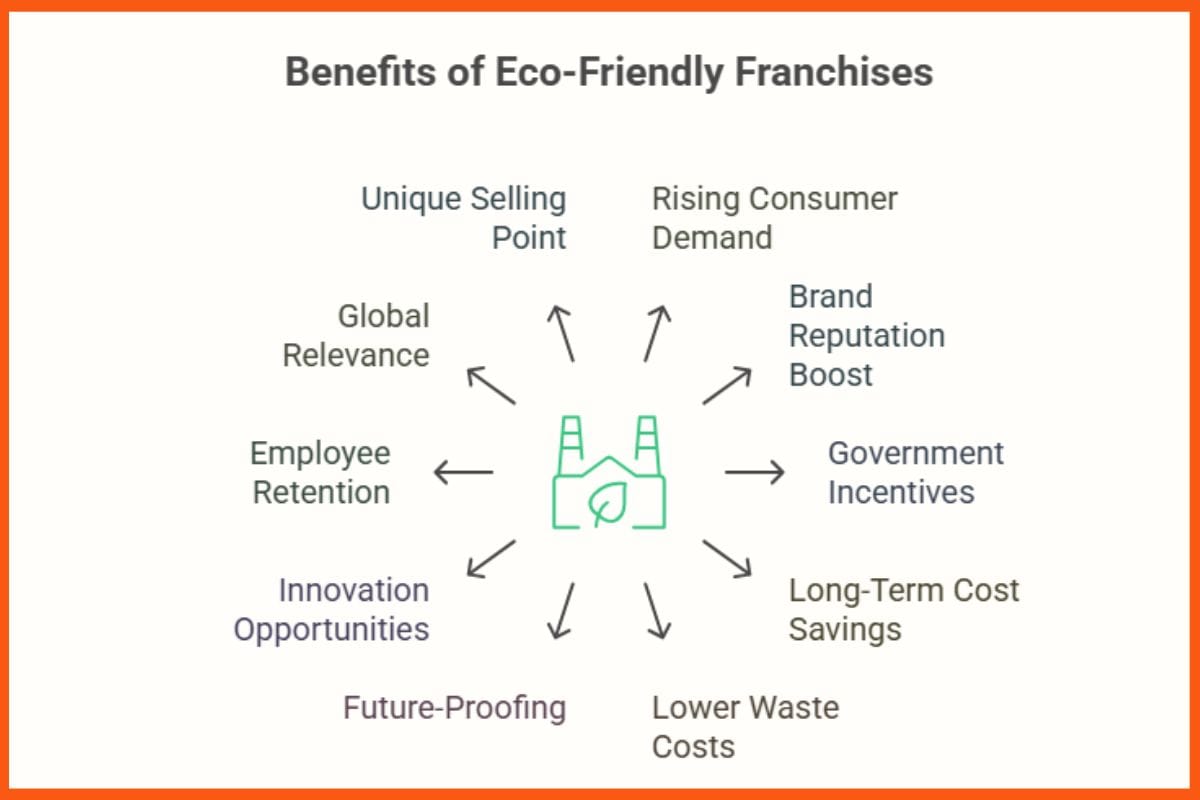
Benefits of Eco-Friendly Franchises
Franchising in the green business space is not only profitable but also purpose-driven. Here’s why it makes sense in 2025 and beyond:
Rising Consumer Demand: Customers are actively choosing eco-friendly goods and services, creating a growing market.
Brand Reputation Boost: Aligning with sustainability strengthens brand image and builds consumer trust.
Government Incentives: Eco-conscious franchises may qualify for tax breaks, grants, or funding support.
List of Green and Eco-friendly Franchises Opportunities In India
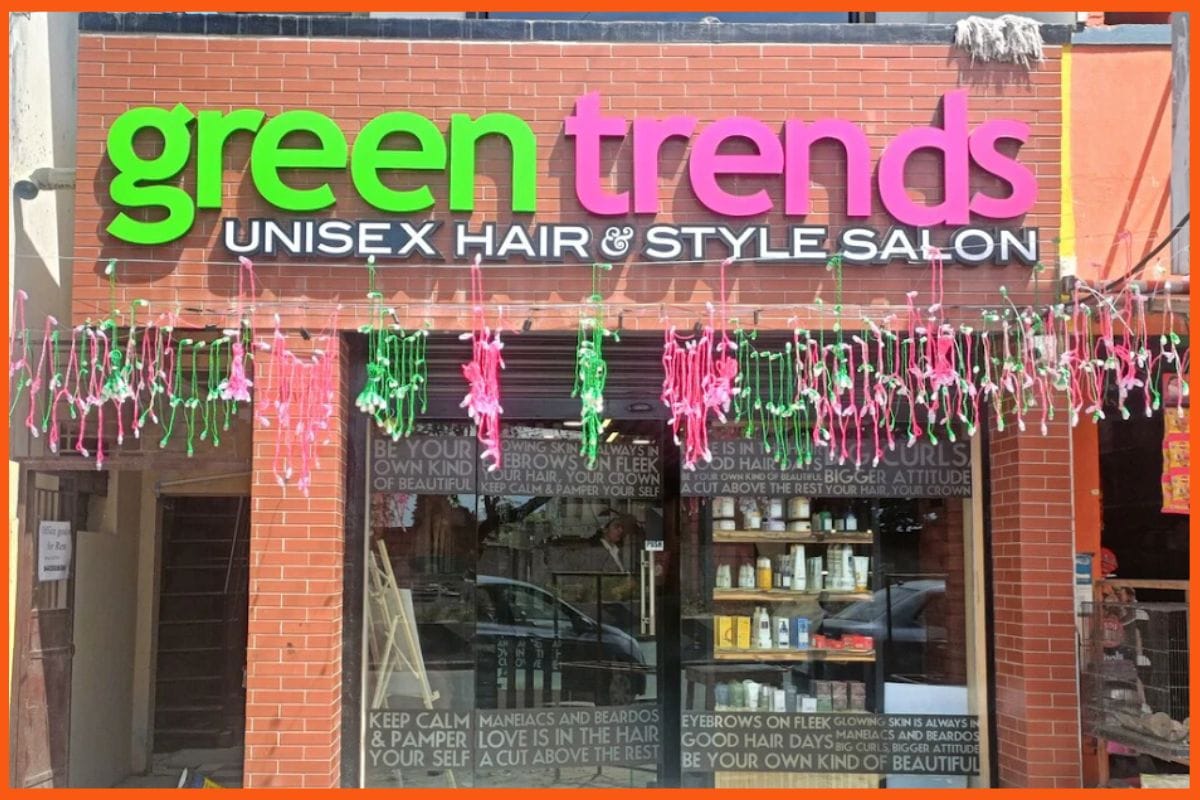
Green Trends (Salon) Franchise
Franchise Fee
INR 5–10 lakhs
Interior Cost
INR 15–20 lakhs
Equipment Cost
INR 15–20 lakhs
Green Trends – Top Eco-Friendly Franchise Businesses in India
A leading salon brand promoting organic and eco-friendly beauty products. 375+ salons across 50+ cities offer haircuts, styling, skincare, makeup, and spa services. Green Trends combines sustainability with luxury, making it attractive to eco-conscious clients seeking high-quality salon services. The brand regularly updates its product line to stay ahead in the organic and chemical-free beauty market.
AUM Nature Franchise
Dealer Franchise Area
750 sq. ft.
Investment
INR 2–10 lakhs
Brand Fee (Unit)
INR 1.25 lakhs
Brand Fee (Master)
INR 4 lakhs
AUM Nature offers eco-friendly products like bags, stationery, organic foods, and handmade items. It is known for quality and sustainability, and it is a trusted brand for green products. The brand emphasizes ethical sourcing and handcrafted products, appealing to environmentally conscious consumers. It also provides training and support to franchisees to ensure smooth operations and brand consistency.
Simply Fresh Franchise
Model Type
FOFO / FOCO models available
Investment
INR 12–15 lakhs
Revenue Sharing
Franchisee 90%, Franchisor 10%
Break-even
6–12 months
Simply Fresh – Top Eco-Friendly Franchise Businesses in India
A technology-driven agriculture brand using hydroponics and AI for high-quality produce. It is well-known as India’s largest “Plant Factory.” Simply Fresh helps franchisees adopt modern farming techniques, ensuring high yield and quality produce. The franchise also benefits from strong brand recognition and industry expertise in innovative agriculture.
Organik Zone – Top Eco-Friendly Franchise Businesses in India
Organik Zone, a part of Ethix Health Care, provides organic snacks, confectionery, personal care, and wellness products with CGMP-certified units. The brand appeals to health-conscious families and individuals seeking authentic, chemical-free products. Organik Zone also offers ongoing support in store management, marketing, and product training.
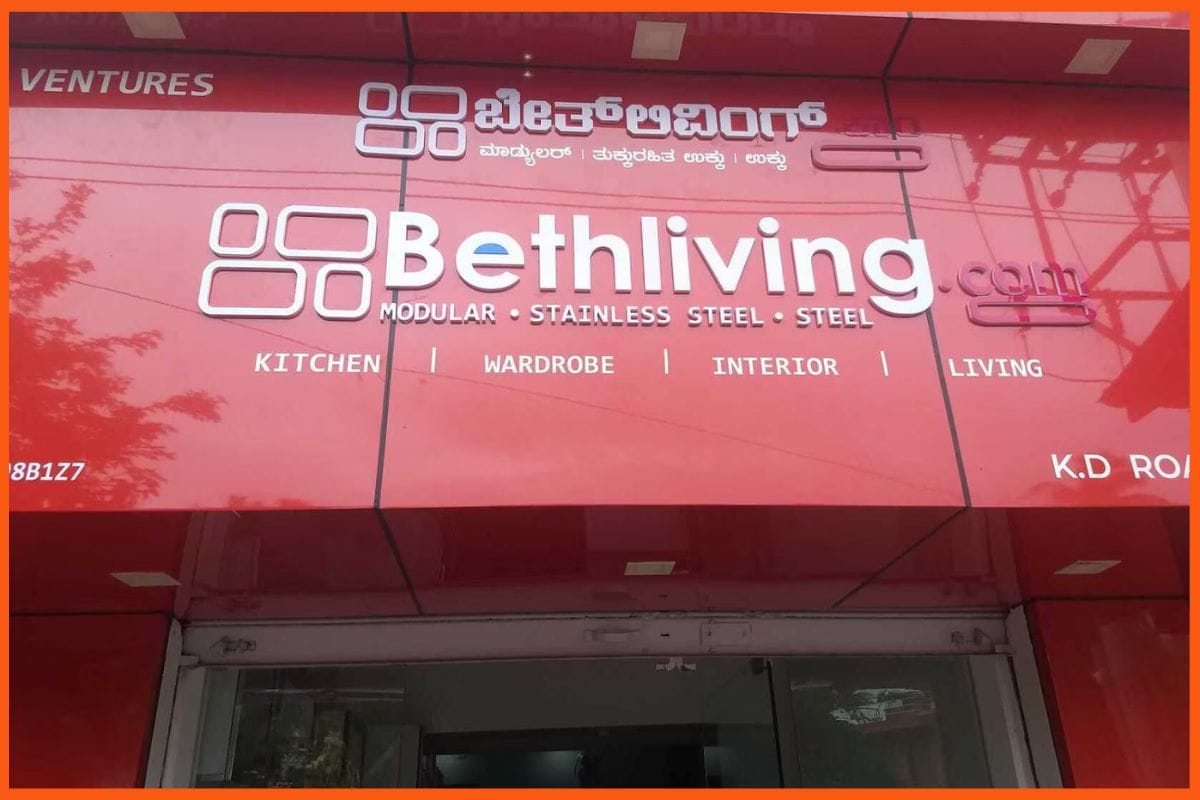
Bethliving Franchise
FOFO (Franchisee-owned, Franchisee-operated)
INR 13–18 lakhs
FICCO (Franchisee-invested, Company-operated)
INR 25 lakhs
Bethliving – Top Eco-Friendly Franchise Businesses in India
It was founded in 2014 in Bangalore. Bethliving specializes in eco-friendly home décor, including modular kitchens and durable, sustainable products. The brand uses advanced technologies to ensure its products are durable, eco-conscious, and visually appealing. Furthermore, this brand provides marketing support and design consultation for franchisees to attract premium customers.
Terragreens Organic Franchise
Area required
600–700 sq. ft.
Investment
INR 20–30 lakhs
Terragreens Organic – Top Eco-Friendly Franchise Businesses in India
Terragreens Organic, based in Hyderabad, offers cereals, dry fruits, and spices with a focus on purity and chemical-free products. The brand focuses on affordable organic options to reach a wider customer base while maintaining high-quality standards. Terragreens provides franchisees with training, marketing support, and supply chain assistance to ensure smooth operations.
The Kabadiwala
Investment
INR 3–5 lakhs
Monthly returns
INR 30,000–INR 60,000
The Kabadiwala – Top Eco-Friendly Franchise Businesses in India
Sahil Goyal envisioned a tech-enabled, efficient waste management system that empowers communities to recycle more effectively. The Kabadiwala franchise allows entrepreneurs to operate local collection centers, directly contributing to cleaner neighborhoods while generating steady income. Franchisees also benefit from government initiatives like Swachh Bharat, which provide grants and subsidies to help scale operations sustainably.
Banyan Nation – Top Eco-Friendly Franchise Businesses in India
Banyan Nation, recognized by the World Economic Forum for its innovative approach, uses data analytics and technology to optimize plastic recycling. Franchisees operate local collection centers that feed into large-scale processing operations, supplying recycled plastic to multinational brands. The brand provides strong operational and marketing support, making it a scalable and socially impactful business opportunity.
GreenNest India
Investment
INR 3 lakhs
Average monthly profits
INR 30,000
GreenNest India was founded by Shruti Sharma, driven by her passion for greenery and sustainable living. Franchisees benefit from comprehensive support, including hands-on training and guidance on marketing to urban clientele, making it an attractive, eco-friendly business opportunity.
Country Veggie Franchise
Franchise fee
INR 2–3 lakhs
Infrastructure investment
INR 10–20 lakhs
Total investment
INR 12–23 lakhs
Space
1000–1500 sq. ft.
ROI
80%
Payback period
12–24 months
Set-up time
30 days
Country Veggie – Top Eco-Friendly Franchise Businesses in India
Country Veggie connects local farmers with retailers, restaurants, and hotels, ensuring the efficient supply of fresh produce. The brand promotes farm-to-table freshness while supporting local agriculture and maintaining high-quality standards. Franchisees benefit from a robust logistics network and a strong demand for fresh produce in both urban and semi-urban markets.
Conclusion
Investing in a green franchise isn’t just beneficial for the planet; it can also be highly profitable. These eco-friendly businesses demonstrate that small, sustainable steps can create a significant impact. By choosing to go green, you not only contribute to a healthier environment but also tap into a growing market with strong potential. Start your sustainable journey and make a meaningful difference, while building a rewarding business at the same time!
How long does it take to break even in an eco-friendly franchise?
On average, most green franchises reach break-even within 6–24 months depending on investment size, operational efficiency, and customer demand.
Do I need prior experience to run a green franchise?
Not necessarily. Many eco-friendly franchise provide full training, operational support, and marketing assistance to new franchisees, making them beginner-friendly.
Which eco-friendly franchises are the best to start in India?
India is quickly becoming a major production location for Google Pixel smartphones. The Economic Times said that Alphabet is planning to export its high-end Pixel 10 Series devices in addition to expanding local production of these devices.
The company is taking this action in an effort to strengthen its supply network outside of Taiwan and lower the risks associated with US tariffs. The US tech giant is in advanced talks with Dixon Technologies and Foxconn, its current Indian manufacturing partners, as well as possible new suppliers like Bhagwati Products, which is owned by Micromax.
According to the news article, Alphabet may soon phase out the Pixel 9a model, which these vendors now assemble.
Pixel Likely to Follow Apple’s Export Model
According to the news article, industry insiders have suggested that India may be used as a production hub for global markets, including the US, even though Alphabet has not confirmed particular export destinations.
Pixel 10 Production Partners: Dixon, Foxconn & Micromax’s Bhagwati Products
According to an executive cited in the news story, Pixel exports may follow a similar trajectory if Apple is able to ship large quantities of goods from India to the US. Additionally, Alphabet is attempting to increase its visibility in India. In addition to selling handsets through Reliance Digital, Croma, Sangeetha Mobiles, Poorvika, and more than 2,000 smaller retail locations, the business has hired 18 distributors.
Since local production began a year ago, import taxes have been lowered by 16.5%, increasing the competitiveness of Pixel smartphones against Apple’s iPhone and Samsung’s high-end Galaxy models.
Pixel’s Distribution Network in India
With the help of 18 distributors, including Reliance Digital, Croma, Sangeetha Mobiles, and Poorvika, the company is also increasing sales in India. These phones are sold in more than 2,000 small, multi-brand retailers.
Alphabet began manufacturing Google Pixel smartphones in India a year ago because local manufacturing lessened the burden of duties, allowing these phones to compete with the iPhone and Samsung’s high-end Galaxy models. Smartphone import taxes in India are 16.5%.
Alphabet Layoffs: Reorganization in Platforms & Devices Unit
According to a media report, this year Alphabet’s Google has let go of hundreds of workers from its Platforms and Devices business. This division is in charge of important products like the Chrome browser, Pixel devices, and Android software.
The layoffs come after a voluntary departure programme that was made available to staff members in January. The action is a component of a continuous reorganisation that started last year when Google combined its Chrome and Android teams under the Pixel and Devices group. This group is headed by Rick Osterloh, a company executive. The combined company employed around 20,000 people at the time of the merger.
Quick Shots
•Move aims
to reduce reliance on Taiwan and mitigate risks from US tariffs.
•Manufacturing
partners include Dixon Technologies, Foxconn, and Micromax-owned Bhagwati Products.
•Pixel 9a
may be phased out, as vendors shift focus to Pixel 10 assembly.
•Exports
from India may follow Apple’s model of shipping iPhones to the US.
This article has been contributed by Chandan Bagwe, Founder and Managing Director, C Com Digital.
There is a huge change happening in the Indian digital marketing world. As marketers chase traditional SEO KPIs, a revolution is quietly changing how people shop: visual search mixed with advanced technical SEO. The harsh truth? If brands don’t pay attention to this, they’ll become obsolete.
The Visual Search Boom in India
India’s economy, which is based on mobile devices, is excellent for visual search to take off. Google has more than 99% of the market for mobile search in India, and retail mobile commerce is expanding by more than 28% every year. This means that the foundation for visual search to take over is already in place.
The stats tell a strong story: Indian users spend an average of three hours online daily, mostly looking at pictures and videos. But most brands are still stuck in text-based optimisation tactics, which are quickly becoming useless.
Fashion E-commerce Revolution: A Case Study
Myntra is a great example of how visual search may work in India’s complicated fashion world. Their visual search lets consumers quickly upload pictures of clothes and identify comparable items. What are the results? People who use visual search are three times more likely to interact with your site and forty per cent more likely to buy something than people who use regular search.
It’s not only about technology; it’s also about understanding how Indian consumers act. In a market where cultural and regional differences make word searches useless, visual search fills the gap between finding inspiration and making a buy.
Technical SEO: The Secret Base
Visual search gets people’s attention, but technical SEO is the hidden base that decides whether a site will succeed. Technical SEO has changed since 2025. It now includes AI-readiness and optimising visual material, in addition to traditional optimisation.
Technical performance is now a make-or-break aspect because of Google’s Core Web Vitals. Websites that fulfil these standards have 24% more mobile conversions, 15% longer sessions, and 12% fewer people who leave the site immediately.
Problems in the Indian Market
There are certain special problems that technical SEO in India has to deal with:
Network Variability: Making the most of connection speeds from 2G to 5G.
Device Diversity: Making sure that all cellphones, from affordable to high-end, work well.
Multilingual Complexity: Keeping technological performance up while supporting 22 official languages.
The Strategy for Convergence
BigBasket shows how visual search and technical SEO may work together. Their implementation includes thorough image schema markup, visual search for supermarket products, and advanced technological optimisation for various devices.
The results: organic exposure went up by 35%, visual search traffic by 45%, and mobile conversion rates by 28%.
Framework for Implementation
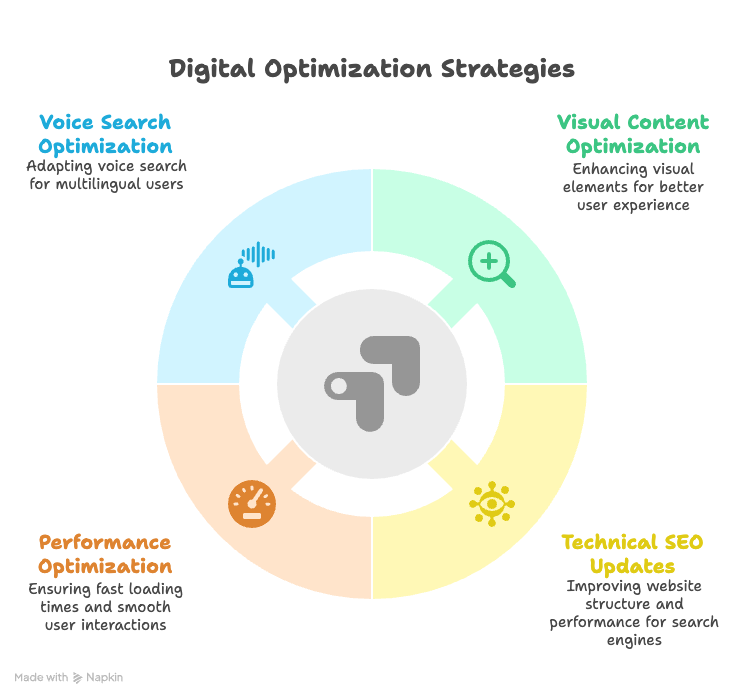
Optimising Visual Content
Using the WebP format makes pages load 30% faster.
Optimising responsive images for performance on specific devices
Advanced schema markup for all visual content
High-resolution pictures of products from different angles
Updating Technical SEO
Optimising Core Web Vitals for Indian network conditions
Setting up a CDN with edge locations in India
Building Progressive Web Apps for app-like experiences
Optimising voice search for questions in more than one language.
Nykaa’s Omnichannel Excellence: A Success Story
Nykaa’s all-around approach shows how powerful convergence may be:
Visual Search: AR-powered “try-on” features that let you search visually
Technical Foundation: 99.9% uptime, loading speeds of less than 2 seconds, and PWA implementation
Results: organic traffic grew by 200%, and visual search conversions grew by 150%.
Strategies for Adapting to Different Regions
In North India
Festival-specific optimisation (for Diwali and Holi), visual search for winter clothes, and colour preferences by location.
The South of India
Recognising traditional attire, regional food, and classical design patterns
The West India
Business formal dress optimisation, modern lifestyle items, and solutions for urban spaces
East India
Recognition of handloom crafts, cultural artefacts, and the use of regional art
The Reality Check for 2025
Because of how people’s behaviour changes, brands are at a critical decision point; you can’t live without visual search capabilities anymore.
Important Performance Metrics
Conversion rates for visual search: 4.5% for clothes and 6.2% for home decor. Sessions for visual search last 2.5 times longer than those for text search.
Technical SEO effect: 95% of Core Web Vitals must be met
What you need to invest
Visual search technology costs ₹15–50 lakhs a year for business solutions.
Technical SEO tools cost between ₹2 and ₹8 lakhs a year.
Expected ROI time frame: 12–18 months for results that can be measured
The Competition
Amazon India is the market leader, handling over 100,000 visual search requests daily. The camera search on Flipkart gets 40% more clicks. Reliance Retail connects visual search in more than 12,000 outlets.
SME Opportunities: cheap SaaS solutions, making Google Lens work better, integrating social media, and participating in local marketplaces.
The Strategic Need
Visual search and technical SEO are more than just fads; they are the future of how people in India will find things online. The combination of more digital infrastructure, more smartphones, and changing customer behaviour presents opportunities that have never existed before.
To succeed, you need to change how you think about search, discovery, and user experience. Companies that excel at this convergence will not only be able to compete in today’s market but also shape the future of digital commerce.
The Indian market is the best place to test these new ideas because it is big, diverse, and has a high digital penetration rate. To do well here, businesses need to devise plans for expanding around the world and maintaining their competitive edge.
Conclusion: The End of the Road
Visual search and technical SEO will distinguish the market leaders from the followers as we move into 2025. It’s not a matter of whether to invest; it’s a matter of how quickly you can use these tools to take advantage of the huge opportunity ahead.
Businesses that use visual search SEO today will rule the search environment of the future. People who don’t will become increasingly irrelevant in a digital future driven by AI and focused on visuals.
The revolution is unfolding right now. You can choose.
About the Writer: He is a digital marketing expert who focuses on new search technologies, visual search implementations, and digital and AI. He has been in digital marketing for over 20 years and has attentively watched it change.
Sources of Data: Statista: India’s share of the Google Mobile Search Market Shipments of smartphones to India Statista: Online shopping in India Mobile Commerce Stats for 2024
In order for the recently passed Promotion and Regulation of Online Gaming Act to be effective, the Delhi High Court ordered the Centre on 2 September to establish an authority and publish the regulations. On a suit contesting the new online gaming law, a bench consisting of Chief Justice Devendra Kumar Upadhyaya and Justice Tushar Rao Gedela issued the rulings.
The Act, which was approved by Parliament on August 21, encourages e-sports in addition to “safe online social and educational games” and outlaws all types of online money games.
The judges pointed out that the Centre had not yet established a body to supervise the law’s application. “Until you constitute the authority and promulgate the rules, you will not be able to work on the act,” the court stated. After eight weeks, the matter was scheduled for hearing.
Sharing his views on the development, Kamal Karanth, Co-Founder Xpheno- A specialist Staffing Firm stated, “While the focus and buzz has been on real money gaming (RMG), it is important to note that most gaming enterprises operate across three verticals—RMG, social gaming, and eSports. The skills and talent deployed across these lines are highly adjacent and transferable. This adjacency provides a talent agility which has helped the sector remain resilient despite regulatory uncertainties.”
“Gaming tech skills—ranging from AR/VR and app development to AI and immersive design—are not just central to gaming but are also critical to emerging sectors like fintech, edtech, and healthtech. The potential is hence high for redeployment and absorption of talent within the enterprise or within gaming and other adjacent sectors,” he added.
Argument in the Court
The government is now establishing an authority under the Act, according to Solicitor General Tushar Mehta, who spoke on behalf of the Centre during a brief session. According to him, the Central Government is now creating regulations and establishing its authority. Although online gaming is encouraged by the government, youngsters who play for real money become addicted and commit suicide.
The online carrom game platform Bagheera Carrom (OPC) Private Limited filed the petition, arguing that the new law was enacted in excessive haste and without adequate stakeholder participation, violating fundamental rights. The new rule, according to the petition, indiscriminately prohibits all online real-money games, regardless of whether they are skill-based or chance-based.
Already, Many Players Shutting Real Money Gaming From System
Shortly after the Indian government’s online gaming bill was approved by both Houses of Parliament, India’s leading real money gaming (RMG) companies, including Dream11 parent company Dream Sports, Gameskraft, Mobile Premier League (MPL), Zupee, and Nazara-backed PokerBaazi, started to stop holding money-related competitions and games on their platforms.
The measure forbids online money games, which are those in which players deposit money either directly or indirectly in the hopes of winning.
All ‘Pay to Play’ competitions on Dream Picks, a newly released fantasy sports app that allows users to create four-player teams and compete in both innings, have been suspended by Dream Sports. Additionally, Dream Play, the company’s casual RMG app, is being discontinued.
Wave of Layoffs in the Indian Online Gaming Sector
The Mobile Premier League (MPL), one of the largest gaming businesses in India, has announced significant employment layoffs as a result of the country’s decision to ban paid online games. Reuters reports that the Bengaluru-based startup will lay off roughly 300 employees, or 60% of its India workforce, because the new rule eliminates revenue from its primary fantasy and card gaming business.
Moonshine Technology, which was supported by Nazara Technologies and ran PokerBaazi, began firing its staff. According to sources who spoke to several media sites, the business has begun to lay off workers, with up to 50% of its personnel potentially affected.
Quick
Shots
•Delhi High Court directs Centre to
constitute an authority and frame rules for the new Promotion and Regulation
of Online Gaming Act.
•Act, passed on August 21, promotes
e-sports and safe social/educational games but bans all real-money online
games.
•Bench of Chief Justice Devendra Kumar
Upadhyaya and Justice Tushar Rao Gedela stressed law cannot function without
rules and authority.
•Government assured it is working on
setting up the authority and framing regulations.
The Board of Directors of New Delhi Television Limited (NDTV), one of India’s leading entities in news broadcasting and digital journalism, at its meeting held on 2nd September 2025, approved the capital raise of up to INR 400 Crore through a Rights Issue to its eligible shareholders.
This proposed capital raising will mark a significant step in strengthening NDTV’s balance sheet and enhancing its financial flexibility. The additional resources will enable the Company to pursue its growth agenda with greater resilience, including expansion of distribution to widen its domestic and international presence, investment in brand-building, development of new intellectual properties, reduction of debt, and other general corporate purposes.
NDTV has an established track record of delivering news content in both English and Hindi, with a legacy of credible journalism. The Company is focused on digital-first growth through branded content, data-driven advertising, and partnerships with global platforms to expand its reach. It is also exploring opportunities in regional language news, international broadcasting through NDTV World, and live events.
‘This rights issue is a decisive step in strengthening NDTV and preparing it for its next phase of growth. With the resources we raise, we will expand our reach and deepen our impact while staying true to the kind of journalism we have always stood for – credible, trustworthy, and uncompromising. This investment will also help us explore new areas of growth, with the digital world opening up new possibilities and new audiences for us. Our vision is to build a stronger, future-ready NDTV that reflects the aspirations of a new India,’ said, Rahul Kanwal, CEO and Editor-in-Chief, NDTV.
About NDTV
NDTV operates as a division of AMG Media Networks Limited, a wholly owned subsidiary of Adani Enterprises Limited. Incorporated in 1988, NDTV is engaged in the business of news broadcasting and digital journalism in India. The Company operates television channels and digital platforms with distribution in India and internationally. NDTV and its journalists have, from time to time, received national and international awards in recognition of their work in the field of journalism.
Dropshipping in a country like India is gaining popularity with each passing day. The unmistakable profit potential of dropshipping is tempting people to delve into it. In recent times, numerous companies have been established to meet the requirements of various resellers.
If a person owns a dropshipping store, he gets deals from some prominent companies, thereby negotiating a reasonable sum of money for their service. Dropshippers can deal with various niches and types of products according to your or the needs of resellers. According to a survey, the dropshipping business in India will grow at a rate of 10% every year.
Dropshipping is a form of e-commerce business in which you sell products that you never use. You only purchase these items at wholesale cost after your customer has already paid you at retail cost. You don’t have to worry about fulfillment or inventory issues at all.
Dropshipping companies are divided into two categories. Companies that connect producers and retailers, such as you, are first-class companies, while companies dealing in various products are second-class. Some of these companies may choose to concentrate on a particular niche like phones, laptops, leggings, jewelry, laptops, and other accessories.
The dropshipping market size in India is growing rapidly. In 2024, it was valued at around USD 10.8–20.8 billion and is expected to reach USD 67–102 billion by 2030–2033, growing at a CAGR of 22–26%. Fashion is the largest segment, while food and personal care are growing fastest. This growth is driven by rising internet use, smartphones, e-commerce platforms, low investment needs, and supportive digital policies, making it a promising opportunity for entrepreneurs.
Benefits of Dropshipping
The Dropship Model
Dropshipping offers several benefits to online retailers:
Indiamart is undoubtedly the best company that allows suppliers to connect with retailers. It lets consumers negotiate directly with the wholesalers. After signing up on their site, you can have access to wholesale suppliers of different products like furniture, food, jewelry, etc. IndiaMart acts as a platform connecting businesses with potential drop-shippers rather than being a single drop-shipper itself. In addition to this, it is the topmost Indian drugstore drop shipper.
TradeIndia
TradeIndia was established in 1996 as a B2B company which helps retailers to connect to wholesalers. This company has done very well, especially in ensuring that dropshippers have access to trusted suppliers. There are lots of suppliers in its database to meet your dropshipping needs. The best part is that it is free to join. Instead of offering its own products, TradeIndia hosts suppliers and manufacturers who handle inventory and shipping while you, the retailer, focus on marketing and sales. They offer a variety of services ranging from general merchandise to pharmaceuticals, with prices varying depending on the product and provider.
Global Dropshipping Market Size (FY2020 – FY2026)
ExportersIndia
As the name itself implies, ExportersIndia is aB2B portal where Indian suppliers and manufacturers are connected with resellers from all over the world. Due to the support it has provided to the resellers, this company has received lots of positive reviews over the years. As a reseller, there are lots of benefits to registering with a company like this since it is completely dedicated to dropshipping. The directory enables retailers to access top brands like ACE, MIRAJ, PARAG, and so on.
BaapStore
Baapstore
Another company dedicated to dropshipping is Baapstore. It is one of the first sets of websites for dropshipping, founded some years ago in India. It is a platform to access various types of products that you can take advantage of.
Baapstore constantly continues to upgrade its services to ensure the best experience for resellers. For example, they have joined forces with leading brands like Speed Post, Aramax, Ecom Express, FedEx, and Delhivery. These partnerships allowed them to deliver items promptly. They also protect customers when products are not compliant with the required standard.
Cokoon
Cokoon (Previously Coorgle Dropshipping) is one of the best-automated platforms problems in India, which works in the sector of wholesale dropshipping. The UI of the portal is simple, which allows people to access it quickly and without facing any issues. You can use this if you are into this business for the first time and do not want to face any problems. Retailers who do not like the name of wholesalers everywhere on the product can access this portal and get products without any wholesaler trademark. The company has also acquired Bluember to expand its portfolio and cater to a larger audience. Hence, Cokoon is considered one of the best sites for retailers.
JimTrade, like TradeIndia, is a B2B portal connecting dropshippers with the best dropshipping suppliers in India. Since its foundation, JimTrade has aimed to broaden the exposure of dropshippers to a vast array of products, providing access to thousands of Indian manufacturing products. It operates as an online directory where manufacturers, exporters, and traders can showcase their offerings to potential buyers, both domestic and international. If you have a fondness for Indian products, exploring this website is a must to discover the best dropshipping suppliers in India.
Hothaat
Hothaat, an Indian dropshipping company established in 2012, is among the modern dropshipping outfits in India. It has successfully integrated top features into its website to empower Indian dropshipping suppliers, enabling them to maximize their earnings from marketing endeavors.
Hothaat is a different company from the others stated above. Also, it is always in search of new and innovative products that dropshippers can sell. A major advantage of working with this company is the support it gives. It ensures that dropshippers don’t have any problem selling products from its platform.
Webdealindia functions as one of the best Indian dropshipping companies, operating as an online wholesale marketplace. This implies that manufacturers from India and other countries around the world can display their products. This website has been known over the years to give dropshippers access to premium companies all over the world. It is a website that is very easy to navigate as you can browse by category. It also enables dropshippers to know when manufacturers introduce new products into the market.
Market Size of E-commerce Industry Across India (FY2014 – FY2030)
Snazzyway
Snazzyway Dropshipping, one of the leading dropshipping providers in India, specializes in offering lingerie to dropshippers. You gain access to high-quality bras, panties, bikinis, and more. Over the years, this website has perfected its niche, ensuring that only top-tier fashion lingerie is accessible to dropshippers. With a commitment to offering only the highest standard of fashion lingerie, Snazzyway has become a trusted choice for those in the dropshipping business, ensuring both quality and style.
Shopify
Shopify, a leading marketplace, enables you to host and resell products on your eCommerce site. Oberlo, its dropshipping feature, eliminates upfront inventory costs. Shopify stands out for its transparency, profit potential, and excellent support for any delivery issues. It provides a user-friendly platform to manage various sellers and set prices for your products effortlessly.
Wholesalebox
WholesaleBox is an Indian B2B platform catering specifically to dropshippers and small retailers. They focus on providing fast-selling products across various categories like clothing, homeware, and accessories, all sourced directly from factories at competitive prices. Their dropshipping model eliminates the need for retailers to hold inventory, as WholesaleBox handles storage, packaging, and shipping once a customer order is placed. This allows businesses to start with minimal investment and scale up quickly. Additionally, WholesaleBox offers credit facilities, website creation tools, and dedicated customer support, making it a comprehensive solution for aspiring entrepreneurs in India.
This key player in dropshipping has established its reputation by offering a comprehensive platform for online sellers’ success. With over 8,000 vetted wholesale and dropship suppliers, SaleHoo provides access to 1.6 million popular products at lucrative prices. Noteworthy features include 24/7 support and a supportive online seller community. Additionally, they provide free training to aid in business expansion.
Top Dropshipping Stores
Meesho
As a leading Indian social commerce platform, Meesho aims to be the go-to for dropshipping. With a mission to onboard 20 million entrepreneurs, it has been backing 2 million resellers and 20,000 manufacturers across 500 towns since its 2015 inception. They typically charge a 10-15% commission on each sale, prioritize an anti-counterfeit policy, and deactivate seller accounts violating their policies. Plus, they provide robust customer support and regular training sessions for sellers’ success.
Seasonsway, a highly dependable dropshipping company, stands out by collaborating with some of the world’s leading brands. With Seasonsway, you can buy products at affordable rates and have the flexibility to set your own selling prices. The company offers comprehensive support, taking care of the entire process from storage to packaging and shipping. This means you only need to focus on taking orders from your customers while Seasonsway handles the logistical aspects. In essence, Seasonsway takes away the stress of investing in and storing inventory, streamlining the entire order delivery process for your convenience.
Modalyst
Modalyst mainly sells jewelry and hair accessories, including hair extensions and clothes. Since India is famous for its gold, Modalyst becomes a perfect partner if you want to dropship jewelry in India.
It connects easily with Alibaba, BigCommerce, Wix, and Shopify. Once set up, the system automatically sets your product prices, shows your profit margin, capital cost, and final sale price.
After an order is placed, you’ll also get a tracking number that you can share with your customer to keep them updated.
FAQs
What is Dropshipping Business?
Dropshipping is an online retail business where you act as an intermediary. You don’t need to keep products in stock. When a customer orders, you buy the product from a supplier who ships it directly to the customer. You earn a profit on the difference between the selling price and the supplier’s cost.
Why is Dropshipping important?
Dropshipping is a low-investment, inventory-free business that allows you to sell anything, anywhere, anytime, and earn a passive income.
How to do dropshipping in India?
Starting a dropshipping business in India involves 5 key steps:
Find a niche and products
Source reliable suppliers
Set up your online store
Market your store
Provide excellent customer service
Does dropshipping work in India?
Dropshipping can work in India with the right products, marketing, and reliable suppliers, but it’s not a guaranteed quick-fix or get-rich-quick scheme.
Which are the best dropshipping platforms in India?
Top dropshipping platforms in India include Shopify, Meesho, IndiaMART, WholesaleBox, and SaleHoo, each offering strengths like niche-specific products, easy store setup, or COD integration.