A backlash has begun as Google employees protest against Trump’s new $100,000 fee on H-1B visas. A group of unionized Google workers outside the New York office voiced concerns about the 6,600% increase in H-1B visas. The policy was imposed as a security measure, but its rules only proliferated more confusion. The confusion is leading to more fear among the H1-B visa holders. And so the employees are coming together to fight. Will Google favor the employees? Will the government consider the workers’ anger? Learn more.
Why Did the Workers Protest?
Especially the tech industry in the US is hit hard with panic as the fee grew by a whopping 6,600%. Many fear losing their jobs, and companies are forced to pay the fee themselves.
That’s why the workers are protesting:
The employees want Google to stand with its employees and speak against the policy.
The employees are demanding special support for immigrant Google employees, such as extended severance pay, in the event that H-1B workers are laid off.
These matters demand attention because H-1B holders have only a short time to find another job. In case they don’t find one, they’ll end up losing their legal status in the US.
What Did Google Do Internally?
Immediately after Trump’s order, Google’s immigration law firm (BAL) sent an urgent internal memo. The memo informed that H-1B employees traveling abroad should return immediately. The memo also warned the employees traveling abroad of the difficulties of entering the US.
What Did the White House Clarify Later?
The White House clarified that the new $100,000 fee policy will only apply to new H-1B applications starting in March 2026.
Therefore, current H-1B visa holders (and those renewing their visas) don’t need to worry, as they won’t be affected.
The confirmation came from the White House so late that panic had already taken hold among the employees, and they were taking to the streets to protest.
Even now, there’s no clear understanding of how the fees will be collected and whether they will be collected annually or each time the US is entered.
How Big Is the Impact?
Notably, Google has applied for 5,500 H-1B visas in 2024, so the immediate effect is, of course, on the existing employees. However, the new policy will have a severe impact on Google in the future, especially for these applications.
Reactions From the Tech World
The policy made headlines on the news, and many have gotten off the planes (happened at San Francisco airport), worrying if they would be allowed back.
Many tech giants (like Amazon, Microsoft, Google, and Tesla) have sent internal messages to their employees asking them not to travel and to return on immediate notice.
Voices From the Protest:
Parul Koul, president of the Alphabet Workers Union, said, “Google is one of the most powerful companies in the world, but they haven’t spoken up for their own workers.”
Tim Traversy, a Google software engineer, asked, “Will they stand with the immigrant workers who helped build this company?”
Where Things Stand?
Current visa holders are safe, but the future ones aren’t. New applicants have to pay $100,000 starting from March 2026. Google is silent at the moment, but its employees want the company to speak up. But the real question is, with Trump standing on the other side of the policy, will Google still speak up for its employees?
Continuing our journey through Navratri’s inspiring stories, we now explore the radiant world of Goddess Chandraghanta. On the third day of Navratri, we pay homage to this powerful goddess, depicted as a warrior with ten arms, riding a tiger, and wearing a crescent moon on her forehead.
Chandraghanta stands as a symbol of courage, strength, and wisdom, qualities that women entrepreneurs hold close to their hearts as they address the challenges of the business world. With this in mind, we at StartupTalky asked these remarkable women an important question about how they address challenges in their businesses.
Their insights give you a glimpse of their strong determination, much like Goddess Chandraghanta herself. Here are their stories of turning challenges into opportunities with courage and clarity.
Ambika Bhaik, CEO, Yellow Fertility
Each challenge is an opportunity to learn and lead. My style is to remain observant, rather than reactive, to examine situations calmly and then move forward. Courage to me is the willingness to make difficult decisions, to pivot the strategy, to invest in new technology, or to stand up for what’s right, even if it’s not popular.
💡
Takeaway: Calm observation before action helps turn challenges into bold leadership choices.
Gopika B Raj, Co-Founder & CCO, MyDesignation
As a cofounder and CCO, I believe challenges are an inevitable part of the journey. I believe that good things do come to good people. We will have to overcome many challenges. We should be willing to step out of our comfort zone and embrace the uncomfortable. I see it like water, we have to bend, twist, and adapt to whatever shape the situation demands. Just like an ECG, the ups and downs are a sign of life; a flat line means no pulse. Similarly, in business, those fluctuations, complicated days, unexpected turns, and tough calls are proof that we are alive and moving forward.
For me, it’s about making peace with that rhythm, standing alongside my teammates, and knowing that at the end of the day, everything will find its way to work out.
💡
Takeaway: Flexibility and acceptance of ups and downs are vital for long-term growth.
Tejasvi Madan, Founder and CEO, Beyond Bound
Being a woman founder in a largely male-dominated industry isn’t easy. At times, it feels like you are asked to prove yourself twice over. Chandraghanta’s courage reminds me that belief in oneself has to come first. Whether it was deciding to take risks with unconventional designs or standing firm on size inclusivity, every bold move has shaped BeyondBound into what it is today. Obstacles don’t disappear, but courage transforms them into stepping stones.
💡
Takeaway: Self-belief and courage turn every obstacle into a stepping stone for progress.
Nidhi Sabbarwal, Founder at Kalyanamm Holy Waste Recycling Pvt. Ltd.
Chandraghanta inspires bravery and diligence, qualities I rely on and use when faced with challenges. When approaching a traditional market where charcoal was standard for incense, it took bravery; it was no easy task to get consumers to abandon routines that had lasted generations. Diligence included tracking consumer trends, being aware of changes in the industry, and pursuing environmentally sustainable practices.
I think that every challenge is an opportunity to reaffirm why we began: to make rituals healthier and more sustainable. Encountering challenges with courage and practising with discipline, we turn every setback into a learning opportunity. I feel we have transformed challenges into opportunities for growth and impact.
💡
Takeaway: Discipline and courage help challenge traditions while staying true to purpose.
Dishi Somani, Founder of DishiS Designer Jewellery
The jewellery business is constantly evolving, and challenges arise daily, whether it’s due to changing consumer tastes or shifts in the market. I address challenges proactively by maintaining vigilance, identifying emerging trends early, and systematically analysing customer feedback. Courage is built upon having faith in the uniqueness of my brand and taking courageous decisions, either through trying out new designs or changing business strategies. Just like Chandraghanta, in my view, staying alert, responding swiftly, and leading with courage are essential to turning challenges into catalysts for growth.
💡
Takeaway: Staying alert to trends and customer needs fuels resilience and growth.
I tackle every challenge with care by remaining attuned to global beauty trends and domestic consumer behaviour. Bravery emerges when we dare to step beyond our comfort zone, whether through bold choices or innovative ideas that disrupt the market. Just like Chandraghanta, I find that challenges are best confronted with knowledge and bold action, because each challenge brings with it the potential to learn, innovate, and build the brand even more.
💡
Takeaway: Knowledge combined with boldness turns challenges into innovations.
Samiha Jha, Founder & Director of Sammyukk
Chandraghanta’s courage influences how I confront challenges in business. Entrepreneurship requires not only passion but also the tenacity to make difficult decisions and the discernment to foresee challenges. Faced with uncertainty or failure, I prefer to act, not react, with courage, strategy, and poise. We’ve converted challenges into opportunities at Sammyukk by remaining vigilant, being able to pivot quickly, and believing in our purpose. Similar to Chandraghanta, I think courage does not mean being fearless, but getting up with purpose every time fear comes knocking on your door.
💡
Takeaway: True courage is not fearlessness but rising with purpose each time fear appears.
Final Thoughts
Just as Goddess Chandraghanta symbolises courage, vigilance, and wisdom, these women entrepreneurs show us that challenges are not roadblocks but turning points. Their stories remind us that staying alert, believing in oneself, and acting with purpose can transform obstacles into growth. This Navratri, may their journeys inspire us to face challenges with the same courage and clarity.
This article has been contributed by The Mr Prashant Kumar, Co-founder of Zingbus
India’s travel landscape is experiencing a notable transformation, as the appetite for intercity travel is swiftly outpacing the antiquated supply-driven infrastructure. This shift in logistics is paving the way for intercity bus services to become a pivotal player in India’s mobility revolution, especially in ‘Bharat,’ or non-metro regions, where the middle class and aspiring youth are seeking travel options that are not only budget-friendly but also reliable, comfortable, and tech-savvy. As of the fiscal year 2023, the Indian intercity bus market boasts a valuation of INR 539 billion ($6.7 billion), which is more than double its worth from the previous year. The market is anticipated to continue its upward trajectory with a robust 8.5% Compounded Annual Growth Rate (CAGR). This impressive growth of the bus market is vital for nurturing a more mobile and economically prosperous India.
Responding to a New Generation of Travelers
A key factor fueling this boom is the rising desire for cozy long-distance journeys among India’s expanding middle class and adventurous wanderers. Although numerous travelers still view expenses as a significant barrier, there’s a clear shift towards pursuing enhanced comfort and modern conveniences. In light of this, forward-thinking companies are enhancing their services with tiered models that address this varied demand. This shift in consumer habits has prompted bus operators and aggregators to reevaluate their offerings, providing tiered choices to cater to all market segments. One clever tactic they’ve embraced is a dual-brand strategy. Companies that are targeting budget-minded customers promote a “Lowest Price Guarantee” along with a money-back promise.
Simultaneously, these companies offer premium choices for those seeking a more luxurious experience. This includes sleeper or semi-sleeper seats, free drinks, and entertainment systems. This approach of addressing diverse customer preferences highlights the industry’s growth to satisfy the complex needs of a changing travel market, making affordable travel in India more attainable.
Filling the Gaps in Transport Network
The bus industry is proving its importance by addressing the significant gaps in India’s transportation system. While Indian Railways is an affordable option, its immense popularity has led to persistent problems with capacity and booking delays, with several trains being overbooked in just a few days. On the other hand, air travel is quick but way too pricey for most people and only connects a few major hubs, with most of the flights going to just six major cities.
Programs like the UDAN scheme are trying to enhance regional air connectivity, but they’re a long-term project and don’t yet offer the detailed point-to-point service that buses do. In this scenario, buses are the adaptable, scalable, and cost-effective answer. Buses can offer more regular services and span a wider area, connecting smaller towns and cities that lack direct rail or air links. The convenience and flexibility of buses, along with the rise in digital usage, make them an excellent choice for travelers. They help avoid the ‘airport hassle’ and the unpredictability of train bookings.
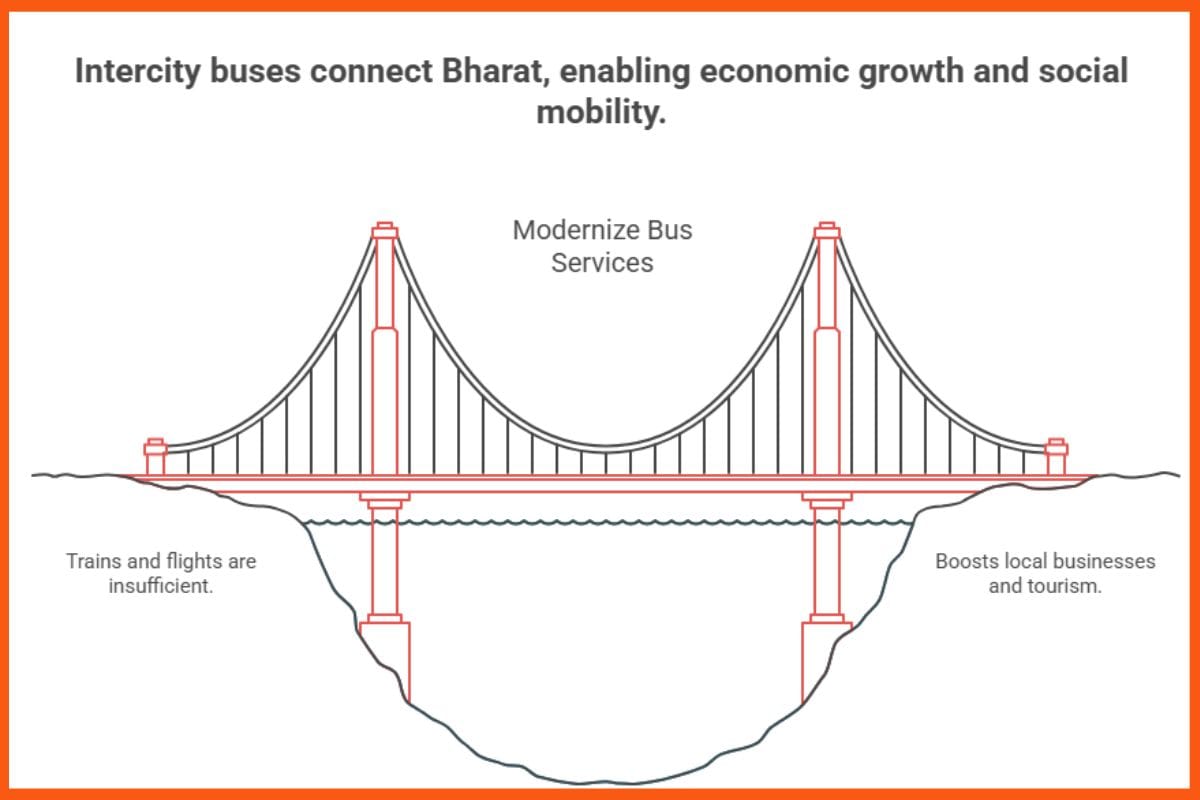
Intercity buses connect Bharat, Enabling Economic Growth and Social Mobility
Outside of metros, intercity bus travel plays a vital role for what many refer to as “Bharat,” which highlights the economic strength of Tier 2 and Tier 3 cities. These cities are rapidly evolving travel hubs, acting as essential centers for economic development, student movement, and workforce relocation. The bus system is a key part of workforce migration, offering a dependable and frequent transportation option for millions of workers who commute regularly between their hometowns and expanding industrial areas.
This network is also crucial for student mobility, with universities being significant trip generators as students head home for holidays multiple times a year. The significance of this transport connection became glaringly obvious during the COVID-19 lockdown when the halt of public transport left countless migrant workers stranded. In these areas, where trains and flights often fall short, buses serve as an essential means for social connectivity and for bolstering regional economies. By providing last-mile connectivity and reaching a wide array of smaller towns and cities, modern bus services facilitate the movement of goods, services, and people, which in turn enhances local businesses and tourism.
The Future of Intercity Mobility
The future of intercity mobility is being influenced by two major trends: the complete integration of digital tech and a significant shift towards sustainability. With over 690 million active internet users across Tier 2 and Tier 3 cities, there’s been a surge in mobile-first bus ticket booking. This digital-first strategy is evolving from just booking tickets to offering a comprehensive digital experience that features live GPS tracking for better transparency and punctuality, along with customer assurance programs. For instance, some companies provide an ‘On-Time Guarantee’ that gives a 50% refund if delays go beyond 45 minutes. This emphasis on reliability and customer service, paired with tech solutions to monitor driver fatigue and ensure proper ticket access, is bringing professionalism to a market that has traditionally been quite fragmented.
The second big trend is the shift to electric buses in India (EV buses), which brings a ton of environmental and economic perks. Looking at it from an environmental angle, one EV bus can cut carbon emissions by almost 71% when compared to a diesel bus. On the economic side, even though the upfront cost for an EV bus is quite steep, the long-term savings really make up for it. Operators can save several lakhs per bus each year, mainly because of lower fuel and maintenance expenses. This shift is backed by government programs like FAME II, which provide incentives and subsidies to help make EVs more affordable. Some companies, such as Zingbus, are already taking advantage of this by rolling out electric fleets on key intercity routes.
A New Era for Indian Mobility
The intercity bus sector in India is undergoing a major transformation, shifting from a fragmented and chaotic market to a modern, digitally integrated, and passenger-centric system. This swift growth, driven by the expanding middle class in ‘Bharat’ (non-metro regions), represents more than just statistics; it marks a significant shift in travel preferences. As the sector matures, it is successfully bridging the crucial gaps that result from the limitations of rail capacity and the expense of air travel. In the future, this transition will likely accelerate with new product innovations and greater urgency attached to their environmental sustainability. The use of digital platforms to enhance the passenger experience with features like live tracking, reliable schedules, and more convenient booking will continue to strengthen passenger loyalty and trust in what is commonly regarded as an unreliable industry.
Meanwhile, the electrification of buses will change this industry forever, with government incentives and a lowering of the total cost of ownership, lowering operational overhead, not only making bus travel greener but also making it a more economically attractive choice for operators. All things considered, the intercity bus service is much more than a transportation option in light of the developing narrative; it supports economic growth, social connection and environmental sustainability and has the means to help facilitate the future of intercity mobility in India.
This article has been contributed byNeha Mishra, Senior VP- Human Resources, Homesfy.in
Success in today’s workplace is more than productivity and profit; it is about safety, trust, and inclusivity. As organisations grow geographically and embrace hybrid models, creating culturally safe workplaces is no longer optional — it is essential. HR leaders must move beyond policies to embed behaviours and systems that ensure employees feel respected, empowered, and protected.
Compliance must be a living process that empowers employees to expect dignity and respect. A people-first approach views a safe workplace culture as trust-driven, where organisations nurture employees for success and growth.
A Safe Workplace Culture
Workplace culture is more than posters on a wall or compliance checklists. A truly safe culture provides psychological security, respect, and dignity to all employees. In India, this also means aligning with the Prevention of Sexual Harassment (PoSH) Act, while creating an environment where employees can confidently raise concerns, share ideas, and represent themselves without fear of retaliation.
Implementing safety measures goes beyond drafting policies. It requires continuous sensitisation programs, leader accountability, regular PoSH training, and an open-door grievance redressal system. When misconduct is reported, a zero-tolerance policy must be applied with thorough investigation, making it clear that employees can speak up safely and without judgment. True safety is achieved when employees feel heard and protected without compromise.
The Prevention of Sexual Harassment (PoSH) Act plays a pivotal role in safeguarding workplace dignity and ensuring equal opportunity for all employees. However, true compliance is not limited to meeting statutory requirements; it depends on building an environment of trust, transparency, and accountability where employees know their rights and feel supported throughout the process.
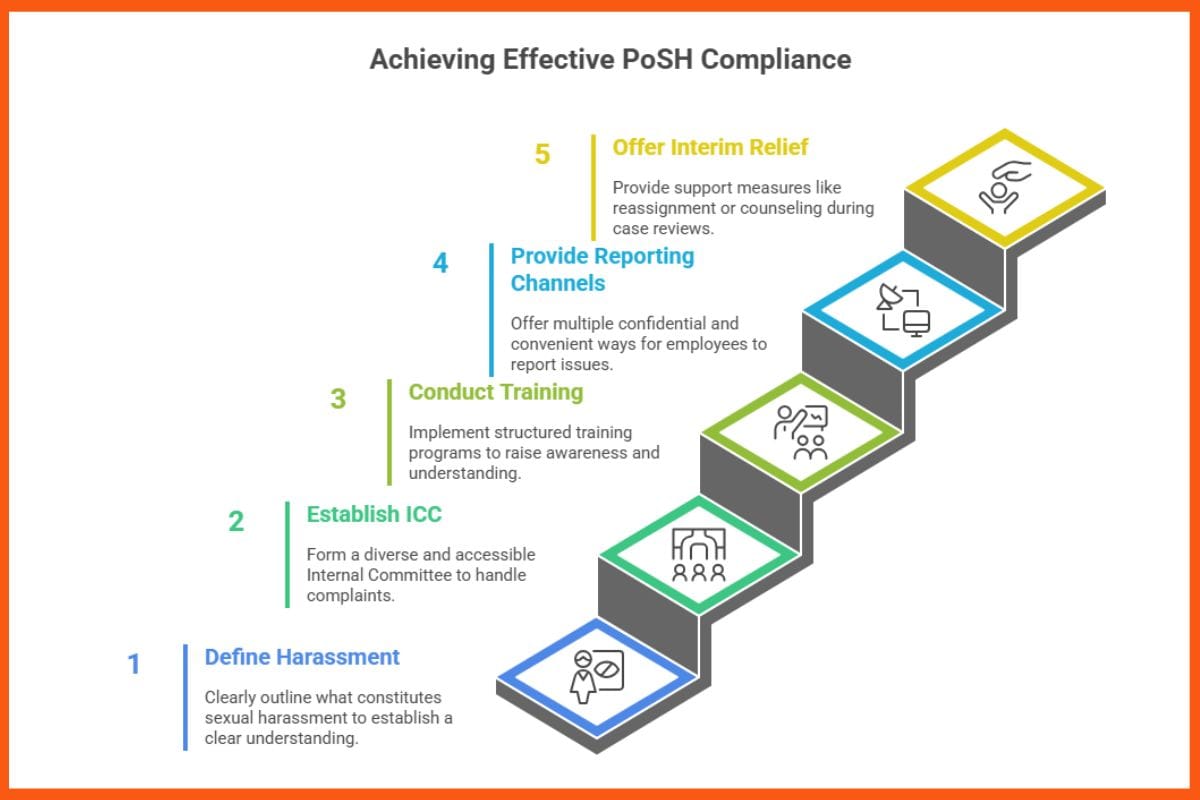
A robust PoSH framework starts with clearly defining what constitutes sexual harassment, outlining zero-tolerance for misconduct, and putting in place transparent redressal pathways. The Internal Committee (ICC), composed of trained members from diverse genders, functions, and including an external expert, is central to this mechanism, and details of its members should be easily accessible across the organisation.
Awareness is reinforced through structured induction and annual training programmes, which go beyond legal obligations to cover bystander intervention, confidentiality, and protection from retaliation. Multiple reporting channels — from direct access to the ICC, to encrypted digital forms, email, or helplines — ensure that every employee has a safe, confidential, and convenient way to raise issues. Best practices also include offering interim relief measures such as temporary work reassignments, flexible working arrangements, or access to medical and psychological support while cases are under review.
When complaints are raised, organisations must act with sensitivity and urgency. If conciliation is requested, it should be conducted with the consent and comfort of the complainant. Otherwise, the ICC is required to complete its inquiry within 90 days, with the employer implementing any recommended actions within 60 days.
Ultimately, compliance on paper is not enough. A PoSH framework becomes truly effective when it reflects the organisation’s commitment to trust, fairness, and psychological safety, values that must be consistently demonstrated in practice, not just in policy.
Information Security
Information security should be an integral part of an organisation’s culture and processes; it is not just an obligation, but also critical for compliance and for fostering trust with employees.
For any PoSH matters, sensitive HR data is managed through a secure case management system with limited task-based access to the details, permitting only the ICC Chair, investigator HR representative, and Head of HR to view the information. No changes can be made to the system or uploaded documentation without authentication. All access is logged, and data is encrypted both at rest and in transit. The limit on sharing from the case management system is strictly within a secure enterprise method.
Sensitive and important matters must be handled with both empathy and process, promoting dignity and fairness at every stage. The first priority is the safety and wellbeing of all involved. Risks, relevant medical needs, requests for separation, and the urgency of evidence must be assessed as soon as possible.
Investigations should be trauma-informed: participants are in safe places, always have supporters present, sensitive questions are asked with care, and breaks are allowed as needed. Evidence is ethically collected, including emails, chats, CCTV, and call logs, and devices are preserved only with consent or through legal processes. Custody logs should be kept when items are preserved for potential future use via appropriate procedures.
Decisions must be fair. Proven cases require respective disciplinary action and significant workplace changes, unproven cases are counter-productive and should restore people’s reputations, and malicious complaints must be acted upon in accordance with policies. After resolution, focus should shift to aftercare. This includes checking participant well-being, expanding support when they return to work, monitoring for anti-retaliation, and providing confidential updates and support.
Scaling Culture
As organisations grow, it is culture, not just processes, that sustains safety and inclusivity. Leaders act as custodians, consistently modelling values across teams and geographies. Formal codes of conduct, culture audits, and open feedback loops help maintain alignment and accountability.
When trust and safety are embedded in the DNA of the organisation, compliance naturally follows. Scaling responsibly means ensuring that no matter where employees work, they experience the same standards of dignity, protection, and respect.
India’s startup ecosystem saw significant activity on 23rd September 2025, with Rocket, Zealthix, and other startups raising notable funding rounds. Key business updates include NPCI introducing EMI options on UPI, JioBlackRock launching its Flexi Cap Fund, and the rollout of Perplexity Comet AI Browser in India.
Daily Indian Funding Roundup – 23rd September 2025
Company
Amount
Round
Lead investor(s)
Sector
Rocket
$15 Mn
Seed
Salesforce Ventures
[Not specified, likely tech/enterprise]
Grest
INR 16 Cr
[Not specified, likely Seed]
Equentis Capital
Electronics re-commerce
Navo
INR 8 Cr
Seed
India Quotient
[Not specified, likely tech]
Zealthix
$1.1 Mn
Seed
Unicorn India Ventures
Health tech / SaaS
Paar Autonomy
INR 3.5 Cr
[Not specified, likely Series A]
Venture Catalysts
Autonomous vehicles / Mobility tech
Distil Networks
$77 Mn
Series A
Jungle Ventures, CE Ventures
Cybersecurity / AI
Blacksoil Capital
INR 210 Cr
Debt
[Not specified]
SME Lending / Fintech
Amwoodo
$4 Mn
[Not specified, likely Seed]
[Not specified]
Furniture / D2C
Rocket raises $15 Mn in seed round led by Salesforce Ventures
Enterprise tech startup Rocket has raised $15 million in a seed funding round led by Salesforce Ventures. The investment will help the company enhance its product offerings, strengthen its technology platform, and expand its operations across new markets. Rocket plans to leverage the funding to accelerate growth, attract talent, and scale its enterprise solutions to serve a wider customer base.
Grest raises INR 16 Cr led by Equentis Capital
Electronics re-commerce startup Grest secured INR 16 Cr in funding led by Equentis Capital. The capital will be used to scale the company’s reverse logistics and re-commerce operations, improve inventory management, and enhance customer experience. The funding supports Grest’s mission to create a sustainable and efficient marketplace for pre-owned electronics.
Navo raises INR 8 Cr in seed round led by India Quotient
Tech startup Navo raised INR 8 Cr in a seed round led by India Quotient. The funds will be deployed to enhance its platform, develop new features, and expand market reach. Navo intends to use the investment to accelerate growth, build strategic partnerships, and strengthen its product offerings to address evolving customer needs.
Zealthix raises $1.1 Mn in seed round led by Unicorn India Ventures
Health tech startup Zealthix raised $1.1 million in a seed funding round led by Unicorn India Ventures. The investment will be used to expand the company’s digital health services, develop new healthcare solutions, and strengthen its technology infrastructure. Zealthix aims to improve accessibility and efficiency in healthcare delivery through its platform.
Paar Autonomy raises INR 3.5 Cr led by Venture Catalysts
Autonomous mobility startup Paar Autonomy has raised INR 3.5 Cr in funding led by Venture Catalysts. The company plans to use the funds to develop autonomous vehicle technologies, expand its operations, and strengthen its R&D capabilities. The investment will help Paar accelerate innovation and deploy solutions for urban mobility and industrial applications.
Distil raises $77 Mn in Series A led by Jungle and CE Ventures
Cybersecurity startup Distil raised $77 million in a Series A funding round led by Jungle Ventures and CE Ventures. The company will use the capital to scale its AI-driven cybersecurity platform, expand globally, and enhance product development. Distil aims to provide enterprises with advanced solutions to detect and prevent digital threats efficiently.
Blacksoil Capital raises INR 210 Cr debt in H1 2025 to expand SME lending
Financial services firm Blacksoil Capital raised INR 210 Cr in debt during the first half of 2025 to expand its SME lending operations. The funds will support the firm’s lending programs, enable greater credit access for small and medium businesses, and enhance risk management practices. Blacksoil aims to strengthen its presence in the SME lending market across India.
Amwoodo raises $4 Million
Furniture startup Amwoodo raised $4 million to scale its direct-to-consumer operations, enhance its online presence, and optimize supply chain management. The funding will help the company expand product lines, improve customer experience, and strengthen its position in the growing D2C furniture market.
Key Business News for 23rd September 2025
NPCI to introduce EMI option on UPI to boost digital lending
The National Payments Corporation of India (NPCI) is set to enable consumers to convert their UPI payments into Equated Monthly Installments (EMIs). This initiative aims to enhance the accessibility of digital credit, allowing users to make purchases via UPI and repay in manageable installments. Fintech companies are expected to integrate this feature, facilitating smoother credit access for consumers and small businesses. This move aligns with NPCI’s goal to increase UPI’s transaction volume and promote financial inclusion across India.
JioBlackRock Asset Management launches JioBlackRock Flexi Cap Fund
JioBlackRock Asset Management, a joint venture between Jio Financial Services and BlackRock, has introduced its first active equity fund—the JioBlackRock Flexi Cap Fund. This fund adopts a Systematic Active Equities (SAE) approach, combining big data analytics with human expertise to invest across large, mid, and small-cap stocks. The New Fund Offer (NFO) is open from September 23 to October 7, 2025, and aims to provide long-term capital appreciation for investors seeking diversified equity exposure in dynamic market conditions.
Perplexity Comet AI Browser rolls out in India for Windows and Mac users
Perplexity has launched its AI-powered Comet browser in India, initially available to Pro subscribers on Windows and macOS platforms. Built on the Chromium engine, Comet integrates an AI assistant that offers features like summarizing web pages, managing tabs, drafting emails, and automating tasks. The browser emphasizes user privacy, with encrypted storage of credentials and local data processing. While currently accessible to a limited user base, Perplexity plans to expand availability and features in the coming weeks.
Tanya Mittal, currently starring on Bigg Boss 19, and is stealing the limelight, making headlines. While her remarks on the show range from luxurious lifestyle claims to quirky personal narratives, she has kept social media buzzing. There’s another side to her story that deserves attention. Tanya is an entrepreneur, podcaster, content creator, and spiritual storyteller who has steadily built her own identity beyond television.
Growing up in a business-oriented family, with her father active in real estate, she was exposed to the workings of entrepreneurship and ambition at an early age. That strong foundation provided her both the confidence and perspective to pursue ventures that carry legacy with innovation. Today, Tanya has created a buzz due to effectively managing business, digital influence, and spirituality by offering inspiration to a generation seeking authenticity in success.
Tanya Mittal was born on September 27, 2000, in Gwalior, Madhya Pradesh. She completed her schooling at Vidya Public School and obtained a degree in Architecture from Chandigarh University. Her journey took a significant turn in 2018 when she was crowned Miss Asia Tourism Universe, a title that not only brought her into the limelight but also paved the way for her entry into the world of influencing and content creation.
Tanya Mittal – Entrepreneurial Journey
Tanya Mittal is both an entrepreneur and a social media influencer. She is the founder of her lifestyle brand, Handmade with Love by Tanya, which features a range of products including handbags, handcuffs, and sarees. With a strong following of over 2.9 million on Instagram, Tanya uses her platform to share motivational messages, spiritual insights, and glimpses into her journey as a young entrepreneur.
It started with only INR 500 and now offers handbags, sarees, and even handcuffs. Today, Tanya has built a community of over 2.5 million followers on Instagram, where she shares motivational talks, spiritual reflections, and lifestyle content. Beyond her business, she devotes time to social causes, partnering with Girl Up to advocate for women’s health and equality and even adopting a village near Gwalior to improve healthcare. She also personally supports two children, taking care of their education and everyday needs.
According to Times Now, Tanya earns more than INR 6 lakhs each month through brand collaborations, endorsements, and her growing business. Her estimated net worth of around INR 2 crores has made her one of the standout young entrepreneurs this season. From luxury cars and designer sarees to other high-end possessions, Tanya isn’t shy about enjoying the fruits of her hard work. On Instagram, she confidently calls herself the “youngest millionaire.”
But Tanya’s journey hasn’t been easy. In a recent episode, she opened up about her painful past after a fellow contestant, Kunickaa Sadanand, mentioned her mother. Fighting back emotions, Tanya revealed, “My father used to beat me, and my mother was the one who always saved me. I’ve come this far with a lot of struggle. Starting my business wasn’t easy; I had to fight for permission just to step out of the house. At 19, I was expected to get married, and at that time, I honestly felt like I didn’t want to live anymore.”
Tanya Mittal – Family Involvement
Tanya Mittal on National TV
Tanya Mittal’s father, Amit Mittal, is a successful businessman who prefers to stay away from the public eye. Yet, when Tanya appeared on the reality show, her parents openly shared their feelings in a heartfelt statement on Instagram. They described a “mix of emotions” watching their daughter on national television.
“We cannot explain the mix of emotions we feel seeing our Tanya on the country’s biggest reality show. As parents, nothing makes us prouder than watching her win hearts. But at the same time, nothing hurts more than seeing her being targeted, misunderstood, or spoken about so cruelly by people who don’t even know her heart,” the statement read.
Addressing critics, they added, “To everyone questioning her or making allegations, we request you wait until her journey is complete before passing judgment. She deserves that much. Your reels and comments may gain attention, but they leave scars that last a lifetime. We also ask, please keep us, her family, out of this. We never imagined that our daughter, whom we raised with nothing but love, would face such negativity on a public stage. Every harsh word affects us too. All we can hope is that humanity and kindness prevail. Until then, we continue to stand by Tanya, with love and faith. We love you, stay strong like the boss we raised you to be.”
Tanya Mittal – Net Worth
Tanya Mittal earns an impressive monthly income of around INR 6 lakhs, primarily through advertising her own brand and products. According to her Instagram profile, she is recognized as one of the youngest millionaires in the influencer space. Reports suggest that her overall net worth stands at approximately INR 2 crores, reflecting both her business ventures and her growing presence on social media.
Tanya Mittal – Philanthropy and Charity Work
As Tanya Mittal’s career has grown, so has her commitment to giving back to society. Passionate about creating a positive impact, she has actively volunteered with organizations like Girl Up and Pink Legal, championing women’s equality and empowerment. Beyond advocacy, Tanya serves as the Associate Director of the Bliss Foundation, an organization dedicated to uplifting underprivileged communities.
She has also taken a personal initiative by adopting a small village near her hometown of Gwalior, where she supports education and essential needs. On top of that, Tanya is a foster mother to two children, ensuring they have access to education and a nurturing environment, exemplifying her dedication to making a real difference in people’s lives.
FAQs
Who is Tanya Mittal?
Tanya Mittal is a prominent contestant on Bigg Boss 19, known for her luxurious lifestyle claims, motivational talks, and spiritual storytelling. Besides her television presence, she is an entrepreneur, content creator, and influencer with a strong social media following.
What is Tanya Mittal’s educational background?
Tanya completed her schooling at Vidya Public School, Gwalior, and holds a Degree in Architecture from Chandigarh University.
What businesses does Tanya Mittal own?
Tanya Mittal is the founder of Handmade with Love by Tanya, a lifestyle brand offering handbags, sarees, and handcuffs. She started the business with only INR 500 and has grown it into a successful venture.
BlackSoil Capital, the Non-Banking Financial Company of BlackSoil Group, has raised ₹210 crore in debt in the first half of 2025 (Jan to Jun). The fundraise highlights BlackSoil’s expanding role as a trusted alternative credit partner for India’s SMEs and high-growth businesses.
Despite the ongoing NBFC crisis and softening sentiment in credit markets, BlackSoil’s ability to mobilise fresh capital demonstrates strong investor confidence in its robust risk management, diversified granular portfolio, and proven track record in SME-focused alternative credit lending.
The majority of the latest capital raise came through Non-Convertible Debentures (NCDs) and co-investments from marquee family offices and HNIs. New lenders include global impact investor GrayMatters Capital and a public sector financial institution, alongside repeat participation from three existing lenders. This growing base of banks, NBFCs, and institutional partners reinforces BlackSoil’s resilience, borrowing capacity and expanding market presence.
The fresh capital will fuel BlackSoil’s SME-focused sector-agnostic lending strategy, with SMEs forming 80% of its portfolio across AgriTech, ClimateTech, EVs, SaaS, Healthcare, FinTech, and B2B platforms. A key driver is supply chain finance, where its arm SaralSCF provides tailored working capital solutions to ease liquidity and cash flow gaps for SMEs.
BlackSoil Capital’s SME lending capabilities are set to further expand through its strategic merger with Caspian Debt, a pioneering impact investor with a deep SME lending franchise. Once approved by the National Company Law Tribunal (NCLT), the combined entity will create a comprehensive alternative credit platform for SME lending, enhancing BlackSoil’s reach across sectors and geographies.
Chirag Shah, President – Fundraising & Strategy, BlackSoil, said, “This fundraise reinforces BlackSoil’s differentiated position in India’s alternative credit landscape. The demand for non-dilutive, flexible capital is accelerating, particularly from SMEs that form the backbone of India’s economy. With the upcoming merger with Caspian Debt and the growing scale of SaralSCF, we are doubling down on enabling SMEs to scale sustainably while retaining ownership.”
The Company’s portfolio spans ten unicorns and eight publicly listed entities. In the enterprise segment, it includes leading names such as Yatra.com, ideaForge, BlueStone, MobiKwik, Curefoods, Battery Smart, Jumbotail, and Moneyview. In the SME segment, the portfolio features Cellecor Gadgets, Manba Finance, Dar Capital, Parag Milk, among others. This diversified exposure reflects BlackSoil’s ability to back both emerging SMEs and category leaders, while effectively mitigating risk.
With India witnessing rapid digital adoption, SME-driven economic growth, and structural shifts in the financing landscape, BlackSoil is well-positioned to continue unlocking innovative credit solutions and accelerate the next phase of SME empowerment.
About BlackSoil
Established in 2016, BlackSoil is an alternative credit platform comprising an RBI-registered systemically important NBFC and a SEBI-registered AIF. It provides alternative credit debt to Small and Medium Enterprises (SME), emerging corporates, financial institutions, and supply chain finance solutions for Micro, Small and Medium Enterprise (MSME) channel partners. The credit solutions, offered by BlackSoil, are designed to help fast-growing, scalable and underserved new economy businesses with their short-term financing needs.
MIRA Money, the cutting-edge Technology-First Investment Management platform, has reached another important goal: it now has more than ₹300 crore in Assets Under Management (AUM), just five months after achieving the ₹250 crore mark in March 2025. The company’s amazing 20% growth rate puts it well ahead of its goal of ₹600 crore by the end of the year.
The quick rise from ₹250 crore to ₹300 crore in just five months shows that MIRA Money is dedicated to being consistent and putting the needs of its clients first. This milestone was reached without spending any money on marketing, which shows how important it is to have real relationships with customers and make great products.
Important Performance Highlights
In this life-changing five-month period, MIRA Money has done very well on all of its major metrics:
SIP Growth: The number of Systematic Investment Plans grew by 63%.
Client Expansion: The number of clients grew by 34%.
Zero Marketing Spend: All growth came from happy clients who referred others.
Anand K Rathi, Co-founder of MIRA Money, noted, “This milestone taught us an important lesson about being consistent. Doing the right thing over and over will pay off, but sometimes it will happen right away, and other times it will take a while. We asked ourselves every day, “What can we do today that will help our customers in the long run?”
The “Client First” Way of Thinking
MIRA Money’s “Client First” policy has been the key to its success. This way of thinking goes beyond just helping customers; it means putting the needs of investors ahead of short-term profits. Serious investors who want to have trustworthy digital investing experiences still really like the company’s focus on openness, making decisions based on facts, and investing based on goals.
The platform’s own RAPID™ architecture keeps giving better results by combining disciplined active investing with powerful analytics and decades of experience managing funds. This data-based approach to choosing and managing funds has continued to do better than traditional investment funds over the long run.
Faster Growth Path
With this recent achievement, MIRA Money is now in a good position to reach its original goal of ₹600 crore AUM by the end of 2025. The company’s steady growth, especially among young, serious investors, shows that there is a huge market need for clear, technology-based investing solutions.
MIRA Money was started in 2022 by Anand K. Rathi (Co-Founder & Chief Business Officer), Naveen Shetty (Co-Founder & Chief Investment Officer), and Girish Ippadi (Co-Founder & CEO). The company is still using over 70 years of combined investment management experience to change the way India invests.
“We want to thank all of our clients and supporters who helped us reach this milestone,” the founders said. “For a bootstrapped company like ours, getting this big without spending any money on marketing is a dream come true. We ask for your continuous support as we progress toward the next steps.”
What’s Next
MIRA Money is happy about this success, but the company is still focused on its main goal: providing ready-made portfolios that assist customers reach their financial goals over different time frames. The platform keeps adding new services, such as PMS, AIFs, and international funds, all of which are underpinned by clear, data-driven asset allocation techniques.
MIRA Money is set to keep growing at an exceptional rate while keeping the faith and confidence of its growing base of investors. This is because it has a history of consistently delivering results and putting clients first.
About MIRA Money
MIRA Money (Money Invested in Right Assets) is a Technology-First Investment Management platform that offers tailored investment solutions based on your goals. The platform was started in 2022 and uses its own technology and decades of experience in fund management to offer clear, data-driven investing recommendations. The RAPID™ framework from the corporation focuses on investing that is fair and low-cost, which has traditionally done better than other ways of investing.
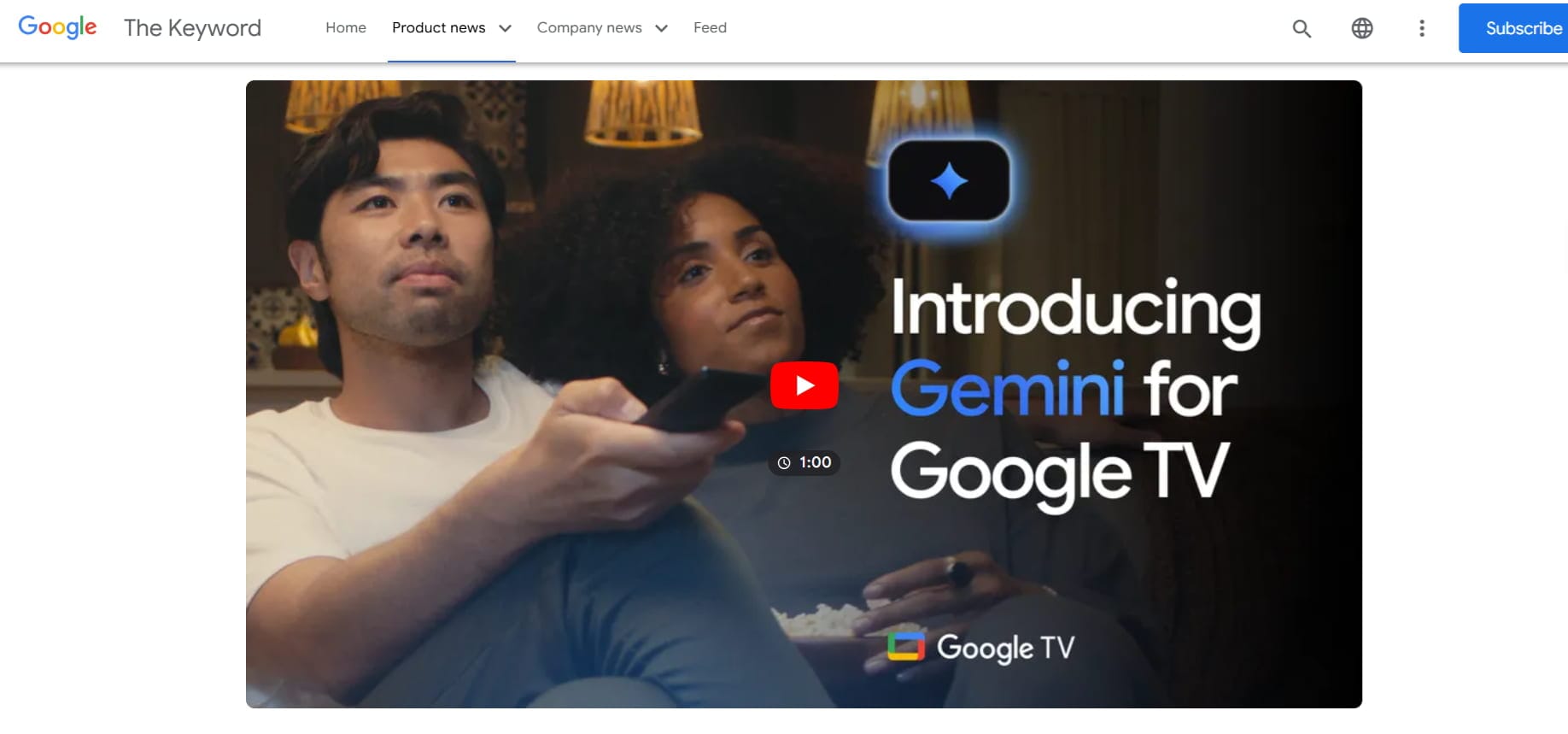
AI is everywhere, on mobiles, laptops, tablets, and now TVs too. Google’s Gemini is now coming to your TVs. The announcement came out on September 22, 2025. This means more features, like you can talk to your TV more naturally and handle it without buttons. Help you find shows that you like, so don’t need to go back and forth from your remote to your phone. Well, does that mean that traditional TV is gone? What more can you do with the Gemini on your big screens? Learn more details.
Google’s official annoucement of Gemini on Tvs
Gemini Is Making Your Tvs Smarter
Google Powered Gemini will now roll out on (started on September 22, 205) TCL QM9K TVs.
The update will soon be live on Google TV Streamer, Walmart onn 4K Pro, Hisense 2025 U7/U8/UX models, and TCL 2025 QM7K/QM8K/X11K TVs.
The announcement also affirmed that it will bring more features to these devices in the days to come.
What It Does on TV:
Human-like interaction – You interact (like naturally talking to the TV like a person) in a natural tone with the Gemini on TV.
Shows and movie suggestions:
The AI will suggest shows and movies you’ll like.
Talk a little about what happened in the previous seasons.
Check the reviews directly on TV to see if the show is what you’ll like watching.
No more forgetting the names of the shows, the AI will help you find them with ease.
What More Can Gemini Do on Tvs
The AI will respond to you like it normally does on your phone or laptop.
You can plan a family trip or even ask the Gemini to answer your homework questions.
All you have to do is say “Hey Google” or press the audio button on the remote.
Important Note:
No, this Gemini feature will not replace the old Google Assistant on your TV. Or make the TV any different from what it traditionally does. Commands like “turn on the TV” or “play music” will still work as it is.
The feature is still new, and once rolled out fully, it will be available on 300 million+ devices that use Google TV or Android TV OS.
It’s a TV plus:
Watch shows.
Learn.
Plan.
And interact, all with your voice.
New Gemini Version vs Google Assistant on Tvs
Feature
Old Version (Google Assistant)
New Version (Gemini AI)
Basic TV control
Traditional tasks like turning the TV on/off, change volume, switching inputs, playing/pausing, and opening apps.
Same as before, nothing changes.
Entertainment search
Simple commands like “Play Stranger Things” or “Open Netflix.”
Smart search: “Find a thriller movie released in 2025,” “Remind me what happened last season, or episode,” or “What do the reviews say about Nobody 2?”
Conversations
Short, command-based voice controls.
The new version allows free-flowing, natural language chats (you can talk to it like a person).
According to reports, the National Payments Corporation of India (NPCI) is working on enabling customers to convert their payments into EMIs in an effort to further boost the adoption of the Unified Payments Interface (UPI).
According to the Economic Times, the payments authority will permit fintech firms to incorporate the capability that enables consumers to convert their UPI payments into EMIs. As per the report, the capability would be comparable to card payments made at PoS terminals. Interestingly, the NPCI already offers two UPI credit products: RuPay credit cards and UPI credit lines.
Commented on the development, Rohit Pateria, Founder & CEO, Lark Finserv stated, “NPCI’s initiative to enable EMI on UPI is a transformative step that will democratize access to credit at the point of digital payment. By allowing consumers to instantly convert their UPI payments into manageable monthly instalments, this innovation is set to deepen financial inclusion, empower merchants with higher sales, and expand the credit ecosystem within India’s most widely used payment platform. It marks a pivotal evolution from a payment system to a comprehensive credit network, fostering sustainable growth in the digital economy.”
“Currently, UPI handles approximately 20 billion transactions monthly, with an active user base of 250-300 million. The ability for these millions of users to convert their UPI payments into EMIs at the point of sale, similar to how credit card EMIs work, will be greatly beneficial for the credit industry. This will impact individuals and MSME businesses who may not possess a credit card. For instance, or a family making a high-value appliance purchase could now opt for EMI through their UPI app by simply scanning a QR code, without needing additional paperwork. Similarly, a small vendor could offer their regularcustomers the option to pay in instalments, thereby improving cash flow for both parties. This can position UPI as an important credit tool for micro and small enterprises,” said Dipal Dutta, CEO & Founder- RedoQ.
How UPI Credit Line Works?
In 2023, the UPI credit line feature was introduced. It enables banks to provide pre-approved credit lines to consumers and small enterprises, which can then be used for UPI transactions.
The credit line on UPI service is currently available from several finance businesses, including Paytm and PhonePe. Actually, just week ago Paytm reintroduced its BNPL offering as a UPI credit line. In the meanwhile, in 2022, the RuPay credit card for UPI was introduced.
Many startups are now pushing the feature, which is widely used. In order to mainstream UPI-linked credit cards, Kiwi raised INR 208.5 Cr (about $24 million) last month.
Expanding Network of UPI
Earlier this year, Dilip Asbe, MD and CEO of NPCI, stated that the RuPay network handled about 16% of all credit card transactions in India. According to Asbe, UPI was used to process about half of these credit card transactions.
The introduction of the EMI function for UPI payments is anticipated to fuel UPI’s upcoming growth phase and bring the NPCI one step closer to its goal of 100 billion UPI transactions per month.
In August, UPI transactions reached a new all-time high of 20.01 billion, up 2.8% month over month. This represented a 34% YoY increase. Compared to INR 25.08 Lakh Cr in July, the value of UPI transactions in August was INR 24.85 Lakh Cr.
Quick
Shots
•NPCI is working to allow UPI payments
to be converted into EMIs.
•Fintech firms can offer this feature
similar to card PoS EMI options.
•RuPay credit cards and UPI credit
lines already available.
•Launched in 2023; provides
pre-approved credit lines for consumers & small businesses.
•Paytm, PhonePe, and other fintechs
already offer UPI credit lines; Paytm recently reintroduced BNPL via UPI.
•RuPay handled around 16% of all
credit card transactions; UPI processed around 50% of these.