AI-based photo editing software has transformed how shoppers can edit and transform a photograph to achieve a professional finish that is available to everyone, without any experience with technology. Using artificial intelligence, these tools automate sophisticated editing steps making it possible to make fast changes and creative transformations. By offering the capability of removing a background, the subjects can be automatically extracted (from the background) from the input image without manual selection.
Object removal using AI provides a seamless, unobtrusive method to remove artifacts which in turn results in cleaner and even more stylized images. Image enhancement methods including automatic controls of not only the luminance and contrast levels but also color balance, improve rendition quality with little maneuverability. These tools promote creativity through features such as AI art generation, and services allow a user to create original artwork from a simple text prompt. Batch processing features allow the incorporation of these changes to several images together at the same time, which considerably saves time in case of bigger works.
personalize your content using top photo editing tools that take zero professional experience to work with
Picsart – AI Tools for Photo Editing
Picsart is a flexible, as-a-service AI editing application, aimed at individual creators (as well as for businesses). As supported by mobile and web applications, it makes creating, personalizing, and distributing visually engaging content easy. With a vibrant community of over 150 million active users, PicsArt is celebrated for its intuitive tools and extensive features that inspire and empower creativity.
Among the remarkable functions are advanced deep learning-based tools including AI Enhance to sharpen an image and reduce the amount of noise, and a background changer to achieve the best background removal or replacement. For eye-catching designs, the collage maker allows for tailor-made designs, or users can find a large template library with social media posts, advertisements, and logos. The platform also enables AI image generation based on text-to-word streams, providing the possibility of novel content generation. Adding, among other things, a meme creator and tools for community interaction (tutorials, collaboration, etc.) is a multimedia tool that meets the needs of all creativity users, Picsart, for all their creative needs.
Pros
Intuitive design is usable for novices and experts.
There are many photo and video editing tools available.
Available on both mobile devices and web browsers.
Continuous introduction of new features keeps the platform fresh.
Cons
Not necessarily all file types are supported by professionals.
Some advanced features are only available in paid plans.
reating stunning graphics, presentations, and social media content easily
Canva – AI Tools for Photo Editing
Canva has established itself as a market leader in graphic design and photo editing with simple interfaces and sophisticated deep learning technology, which is an artificial intelligence. Suitable for novice and professional makers, Canva makes image creation and design tasks easy to manage thanks to its intuitive controls that help images look better and design tasks are simpler.
The professional photo editing toolbox built into the intelligent photo editing suite of Canva provides a wealth of new tools for editing pictures, eliminating unwanted elements and generating new content easily. The Magic Edit tool allows users to select parts of an image and tell the AI what to do, i.e., the AI generates creative output. Magic Eraser not only removes unwanted objects but also can restore the background seamlessly. Background Remover intelligently separates the objects, and it can create a clean and professional appearance. Both methods can be used to get a maximum visual quality in the minimum possible way by automation (i.e., Auto Adjust) and to adapt to the most relevant for achieving the desired result (i.e., Smart Crop).
Pros
Easy to navigate, making it ideal for users with varying levels of experience.
Provides various editing features for a variety of purposes.
Streamlines the editing process with intelligent automation.
Accessible on both desktop and mobile devices.
Cons
However, most powerful tools are only available in the Pro version.
Luminar Neo is an advanced AI-assisted photo editing software designed to streamline the process of photo editing for both hobbyists and professional photographers. From improving an image, removing objects, or adding creative effects, Luminar Neo simplifies routine editing actions, and it is a winner for the creatively minded.
The software includes strong functionalities such as GenErase which removes extraneous features and fills voids with artificial-intelligence-generated content and GenExpand, allowing the user to extend the image boundaries in a smooth way with realistic extensions. GenSwap is a tool that enables the substitution of parts with AI-generated replacements. For landscape photography, Sky AI treats a gray sky by replacing it with a colorful one taking into account sky reflections, and so on, and Enhance AI manipulates the various components through a single slider. Relight AI generates adaptive luminous effects to compensate for overexposed photographs. Luminar Neo is also very good at image quality enhancements utilizing the tools of Noiseless AI in noise reduction, Supersharp AI in sharpening, and Background Removal AI in selective subject isolation.
Pros
Designed for ease of use, making it accessible for beginners.
Quickly enhances images with intelligent automation, reducing editing time.
Provides a lot of features that apply to many different types of editors.
Edits are reversible, ensuring original images remain intact.
Cons
Although simple modifications are easy, mastering all options can be time-consuming.
May require a more powerful computer for optimal performance.
Pricing
Plan
Pricing
12 months subscription
$69/yearly
Lifetime perpetual license
$119 one-time payment
Pixlr
WEBSITE
PIXLR.COM
Rating
4.4
Free Trial
Yes
Best for
anyone needing a free, web-based photo editing and graphic design tool
Pixlr – AI Tools for Photo Editing
Pixlr is a powerful platform with an inbuilt AI feature for free online photo editing that can automate image enhancement transformation. Pixlr’s smart tools speed up editing and enable the creation of great images without a lot of skill. Its AI Generative Fill enables one to insert, delete, or change image elements employing just text commands, producing new images that blend well. Instant Background Removal tool can autonomously segment subjects from backgrounds which is acceptable for general applications.
Such as precise Object Cutouts and automatic AI-based image Processing to simplify, clarify, and stylize editing without the required technical skills. Generative Expand allows the user to make image size in any direction constantly growing, filling new regions for a panoramic effect or creative composition. Increased versatility due to use cases like Face Swap, Super Sharp, and Super Scale that each provide image resolution and image quality enhancements and spawn fun applications for portraits, products, and social media, all play into increasing image resolution and picture quality and encouraging a range of fun applications for portraits, products, and social media.
Pros
Software is not required, access is available on any device with an internet connection.
Provides a rich set of functions that are appropriate for a variety of editing purposes.
AI automation speeds up complex editing tasks significantly.
Cons
Other advanced editing features may be less powerful in comparison with specialized tools.
The interface and tools of Pixlr might require a lot of time to be dedicated to learning the tools.
Pricing
Plan
Pricing
Plus
$2.49/month
Premium
$9.99/month
Team
$16.99/month
PhotoRoom
WEBSITE
WWW.PHOTOROOM.COM
Rating
4.7
Free Trial
Yes
Best for
create professional-quality images for all kinds of projects, including product photos and social media campaigns
PhotoRoom – AI Tools for Photo Editing
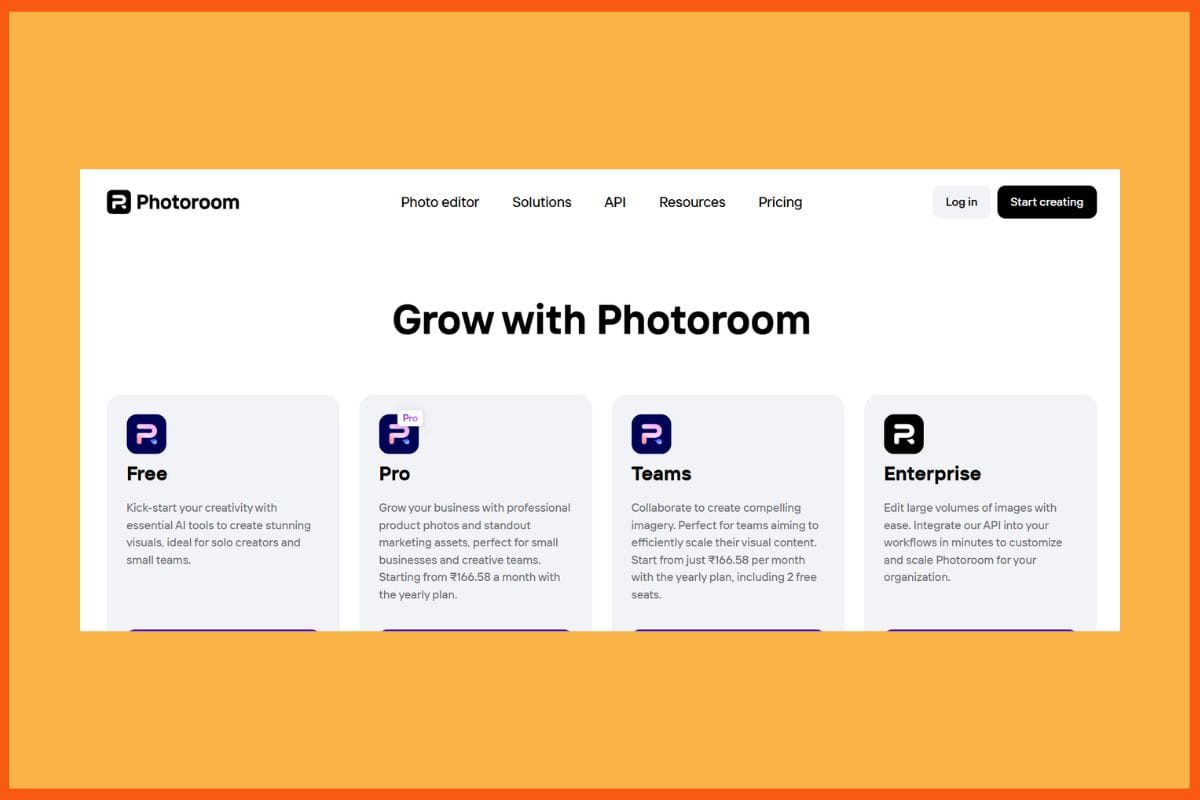
PhotoRoom is an image editing software based on artificial intelligence, which is tailored for e-commerce, and social media content producers. Its intuitive interface and built-in functionalities allow for the creation of high-quality professional-looking images in a very short time, a feature fitting into the fast flow of digital content creation. PhotoRoom allows simple difficult manipulations, enabling users to create high-quality image-based content for marketing and branding.
Major functionalities are Background Removal which algorithmically separates subjects from backgrounds by separating subjects from backgrounds and AI Backgrounds which enable users to replace subject background by either default background or using custom designs. Batch editing allows the manipulation of images, e.g., background removal or reshaping, thus significantly shortening the time. The Magic Retouch and AI Upscale algorithms let remove unwanted parts or retouches in just one swipe on the canvas and image upscaling for sharper, clearer images in the latter. Smart Resize guarantees that the images are accurately scaled to suit all platforms (social media e-commerce, and so on) without compromising quality.
Pros
Easy to use, thus enabling access for users having little prior experience in editing.
Suitable for multiple applications such as product shots, social media copywriting, and branding.
Time-saving as it is possible to edit multiple pictures at the same time.
Cons
Free version doesn’t include many background swap options
Retouch feature, though effective, can sometimes hyper-process images to the extent that the results are unnatural.
Pricing
Plan
Pricing
Pro
$12.99/month(single seat)
Teams
$12.99/month(3 seats included)
Enterprise Custom Pricing
PhotoRoom offers custom pricing; contact them for a quote.
Conclusion
Booming technologies surrounding artificial intelligence have changed how these industries handle various quantities of visual content manipulation with cutting-edge photo editing. Including–be it quick enhancements or complex manipulation–each platform boasts at least one unique feature for its specific creative intention. AI automation in photo editing speeds and improves the process, freeing the creator’s ability from the shackles of technicalities, while at the same time, the AI interfaces through which assistants are made quite aesthetically pleasing and user-friendly. Social media; e-commerce; and fine art are only some of the many applications for which these platforms suffice. With continual research and amenities in AI tech, the photo editor software is evolving, one just has to wait and see.
The AI and analytics industry is growing quickly, changing how businesses work. Companies are adopting AI to improve efficiency, make better decisions, and stay competitive. By 2030, the global AI market is expected to reach $826.73 billion, with a CAGR of 27.67% from 2025 to 2030.
One company making an impact in this space is Polestar Solutions & Services. Founded in 2012, it helps businesses use data, analytics, and cloud technology to improve their operations. With customised solutions, it supports companies in making smarter decisions and achieving long-term success.
In this article, learn more about Polestar Solutions, its founders, business and revenue model, funding, challenges, and more.
Polestar Solutions – Company Highlights
Company Name
Polestar Solutions and Services India Pvt. Ltd.
Headquarters
Dallas, Texas
Sector
AI & Analytics, Business Consulting & Services
Founder
Chetan Alsisaria, Amit Alsisaria, Ajay Goenka
Founded
2012
Website
polestarllp.com
Polestar Solutions – About
Founded in 2012 with a clear vision of helping organisations harness the power of their data, Polestar Solutions has continuously evolved. While its foundation was in data management and analytics, the company recognised early on that the future lay in AI and intelligent automation.
Today, the company is at the forefront of what it calls “intelligent enterprise transformation.” It is not just another analytics company but it is, building and delivering an ecosystem of analytics platforms with pre-packaged AI capabilities and autonomous agents that help businesses leapfrog years of traditional digital transformation.
What sets Polestar Solutions apart is its ability to combine deep industry expertise with cutting-edge AI innovation. With a client base of over 300 global organisations, ranging from Fortune 1000 companies to ambitious startups, each engagement reaffirms the company’s belief that the future belongs to organisations that can rapidly deploy intelligent solutions.
Polestar Solutions – Industry
Polestar Solutions operates in a rapidly expanding market. The global data analytics market is projected to exceed $300 billion by 2030, while the global AI market is expected to reach $1.3 trillion by 2032. Notably, while 55% of organisations are using AI in at least one function, only around 30% have integrated it across multiple business units.
The company’s focus sectors—CPG, retail, manufacturing, and pharmaceuticals—are at a critical inflection point, transitioning from experimental AI projects to enterprise-wide implementations. Collectively, these industries are expected to invest over $215 billion in AI and analytics solutions by 2026 (IDC), presenting a significant opportunity for specialised providers like Polestar Solutions.
Looking ahead to the next five years, several transformative trends are shaping the industry. Enterprise AI is shifting from experimental to mission-critical applications, traditional BI is being reimagined with generative AI capabilities, and there is an increasing demand for industry-specific, pre-built AI solutions—precisely where Polestar Solutions is positioning itself.
In terms of growth strategy, the company maintains a clear and measured approach. While the AI and analytics sector is expanding rapidly, Polestar Solutions prioritises focus and consistent value delivery. The company aims to capture approximately 1% of the market share in its focus industries through its specialised AI platforms and solutions—a significant opportunity given the market size. By 2034, Polestar Solutions envisions becoming the preferred partner for autonomous intelligence solutions in these sectors, with a projected client base of over 1,000 enterprise customers who view it as integral to their AI transformation journey.
Polestar Solutions – Founders and Team
Polestar Solutions Founders – Amit Alsisaria, Chetan Alsisaria, and Ajay Goenka (left to right)
The idea for Polestar Solutions emerged from a shared vision between Chetan Alsisaria, Amit Alsisaria, and Ajay Goenka. Observing businesses struggling to implement effective analytics strategies, the trio leveraged their combined expertise—Amit’s proficiency in business operations and Ajay’s financial management skills—to bridge this gap. What began in a family storage room has since evolved into a global enterprise, marked by a successful rebranding, fundraising efforts, and a decade of growth.
Amit Alsisaria, Co-Founder and Executive Director, leads business operations while overseeing the company’s strategic direction. Before embarking on his entrepreneurial journey, he successfully delivered analytics solutions for Fortune 500 clients worldwide. His tenure at Accenture Consulting saw him providing consulting solutions across 20 countries, specialising in supply chain planning, inventory optimisation, and business process analysis. Amit is an alumnus of DTU and IIT Bombay.
Ajay Goenka, Co-Founder, CFO, and Executive Director, brings over 24 years of experience, including nearly 18 years in the Indian capital market. He has played a pivotal role in establishing Polestar’s financial and human resource practices. Before co-founding Polestar, he was instrumental in setting up capital market operations for CitiBank Wealth Advisors in India and later led wealth operations for JM Financials, one of India’s top five wealth service providers. A qualified Chartered Accountant, he was also a member of the ICAI Committee for Technology Initiatives, reflecting his ability to excel across multiple domains.
Chetan Alsisaria, CEO and Executive Director, focuses on identifying strategic growth areas and building partnerships to strengthen Polestar’s data analytics and enterprise performance management offerings. Before founding the company, he worked with leading consulting firms such as PricewaterhouseCoopers, Deloitte, and Ernst & Young. He is an alumnus of Jadavpur University.
Polestar Solutions currently has a team of approximately 650 professionals across seven locations, with plans to expand significantly in the United States. The company’s hiring strategy emphasises a diverse talent pool, incorporating engineers, mathematicians, and statisticians while balancing experienced professionals with fresh perspectives from top institutions.
A unique aspect of Polestar’s hiring approach is its three-stage evaluation process, designed to identify individuals capable of driving innovation in AI and analytics. The first stage assesses core technical skills and problem-solving abilities, followed by an in-depth evaluation of domain expertise. The final stage involves personality assessments to ensure cultural alignment with the company’s collaborative and innovation-driven ethos.
This structured approach enables Polestar to build teams that not only possess technical expertise but also bring diverse perspectives and problem-solving capabilities, crucial for delivering cutting-edge AI solutions. The company maintains strong ties with academic institutions, allowing it to attract passionate technologists who understand the broader impact of data and AI transformation.
Polestar Solutions – Startup Story
The inspiration behind Polestar Solutions stemmed from recognising a gap in the market for customised data analytics solutions. In 2012, businesses were collecting vast amounts of data but struggled to translate it into actionable insights. Identifying this opportunity, Polestar Solutions set out to develop tailored, industry-specific solutions to help organisations unlock the true potential of their data.
To validate this idea, the company conducted extensive market research, engaging with industry experts, business leaders, and potential clients. Their feedback confirmed the need for smarter, more personalised enterprise solutions. While early mentors and clients were generally supportive, some expressed caution about the complexity of implementation. This insight shaped Polestar Solutions’ commitment to developing powerful yet easy-to-integrate solutions.
With a background in consulting, the founders were deeply passionate about addressing these challenges. As mobile applications and transactional systems matured, they recognised data as the next frontier in business transformation. Understanding its pivotal role in reshaping industries, this passion ultimately led to the creation of Polestar Solutions.
At its core, Polestar Solutions’ vision is built around two transformative goals. First, the company is committed to developing robust, enterprise-grade data and AI infrastructure that serves as the foundation for intelligent decision-making. In the immediate term, its focus is on empowering organisations with AI-driven analytics applications and accelerators that make advanced decision-making both accessible and impactful.
However, its long-term vision is even more ambitious. Polestar Solutions aims to foster true analytics-driven cultures within organisations, particularly in sectors such as CPG, retail, manufacturing, and pharmaceuticals. The goal is to democratise access to data and AI capabilities across every level of the enterprise, ensuring that intelligent insights reach every decision-maker, from the boardroom to the frontline.
What truly sets Polestar Solutions apart is its approach. The company believes that technology implementation alone is not enough—it is about creating a lasting impact. This philosophy is embedded in its business model, which is designed to understand and address the unique challenges of each industry it serves. While many companies discuss digital transformation, Polestar Solutions takes a different path. Its vision is to become the premier partner that not only implements solutions but actively reshapes how businesses operate in the AI-first era.
True transformation happens when AI and analytics capabilities permeate an organisation. Polestar Solutions is not merely building tools; it is enabling a future where data-driven decision-making becomes second nature for enterprises.
A guiding principle for the company is simple—it measures success through its clients’ achievements. Every decision, from investing in new AI capabilities to designing industry-specific platforms, is driven by a single question: Will this help clients thrive in a rapidly evolving business landscape?
Polestar Solutions – Name, Tagline, and Logo
Polestar Solutions Logo
The name Polestar has a meaningful connection to the company’s mission. Just as the North Star, or Polaris, has guided travellers for centuries, Polestar Solutions aims to be a constant guiding force for enterprises navigating the complex world of data and AI. The focus is not on being the brightest star but on being the most reliable point of reference—an essential quality in today’s noisy technology landscape.
In 2022, Polestar Solutions underwent a significant brand evolution to reflect its transformation from a data analytics company to an AI-first enterprise solutions provider. This evolution is captured in the company’s new logo, which features a stylised Polestar replacing the letter ‘A’ in its name. This was not merely a design choice but a representation of Polestar’s role as a steady guide in an increasingly complex digital world.
The geometric design of the logo tells its own story. Referred to as the ‘connected star,’ each point symbolises the connection between people, technology, and possibilities. The simplicity of the design, combined with the deliberate use of uppercase letters, presents a bold and confident stance while remaining approachable. This visual representation underscores Polestar Solutions’ commitment to making advanced technology both accessible and impactful.
Polestar Solutions – Products/Services
Polestar Solutions’ journey is centred on transforming how enterprises leverage data and AI. Established in 2012 with a simple yet powerful vision—to help businesses unlock the true potential of their data—the company aimed to be more than just another analytics provider. Instead, it set out to become a trusted, go-to partner for the enterprises it serves, a commitment reflected in its repeat business ratio of approximately 90%.
Founded by Chetan Alsisaria, Amit Alsisaria and Ajay Goenka, Polestar Solutions initially operated as a traditional business intelligence firm. However, it quickly recognised that the future of data was not merely about analysis but about evolving with the market to create intelligent, predictive solutions capable of fundamentally transforming business operations.
A pivotal shift occurred between 2020 and 2021 when the company identified the massive potential of AI. Transitioning from a pure-play analytics firm to an AI-first solutions provider, Polestar Solutions moved beyond delivering dashboards to developing autonomous intelligence platforms designed to revolutionise enterprise decision-making.
The company specialises in industry-specific AI platforms that combine deep domain expertise with cutting-edge technologies such as Large Language Models, multimodal AI, and autonomous agents. In the CPG sector, for example, its solutions can predict consumer behaviour, optimise supply chains, and generate strategic insights in real-time.
A key differentiator for Polestar Solutions is its Innovation Lab, which serves as more than just an R&D centre—it acts as a hub for future technologies. The company has assembled specialised teams focusing on data engineering and enterprise-grade generative AI implementations, integrating technology stacks from leading OEMs such as Microsoft, Databricks, Anaplan, AWS, and Snowflake. Its Gen-AI team, in particular, is at the forefront of developing the next generation of intelligent business solutions.
Polestar Solutions serves a diverse range of clients, including Fortune 1000 companies, innovative startups, and government organisations across North America, APAC, ANZ, and the UK. However, its global presence is not merely about scale but about understanding unique industry challenges and delivering tailored AI solutions to meet them.
Polestar Solutions – Business and Revenue Model
Polestar Solutions’ revenue model is strategically structured across three key streams, enabling the company to meet diverse client needs while ensuring sustainable growth.
The first stream is the solutions business, where Polestar offers pre-built, industry-specific AI and analytics platforms on a licensing model. These solutions, particularly in areas such as intelligence platforms like 1Platform, demand forecasting, revenue growth management, supply chain optimisation, and customer intelligence, deliver immediate value while creating recurring revenue streams.
The second stream follows a managed project model for enterprise-wide transformations. In this approach, Polestar takes complete ownership of outcomes—from implementation to value realisation. This model is particularly effective for clients undertaking comprehensive AI and analytics initiatives where the scope and deliverables are clearly defined.
The third stream operates on a time-and-material model for specialised engagements, particularly in emerging technologies such as generative AI and autonomous agents. This model provides clients with the flexibility to scale their teams while leveraging Polestar’s specialised talent pool.
What makes this revenue model effective is the company’s ability to integrate these approaches based on client needs. For instance, a client may begin with a specific solution and later expand into a managed services engagement as their requirements evolve.
Polestar Solutions – Launching Company Strategies
Securing the first 100 customers was a key milestone for Polestar Solutions. The company initially utilised personal networks, industry connections, and referrals to establish its client base.
Content marketing played an important role in building credibility, with a focus on thought leadership on LinkedIn and the publication of case studies. Additionally, Polestar adopted an outcome-based approach, delivering measurable results that built trust and led to further referrals.
Email outreach also proved to be an effective tool for engaging potential clients. By maintaining a client-centric approach and consistently delivering value, Polestar successfully acquired its initial customers, laying the foundation for future growth.
Polestar Solutions – Customer Growth and Retention Strategies
Polestar Solutions’ growth is built on three key pillars.
First, the company focuses on building strong and lasting client relationships, leading to a 90% repeat customer rate. Delivering transformative results has turned clients into advocates.
Second, Polestar Solutions has established strategic partnerships with leading technology providers such as Qlik, Microsoft, Databricks, AWS, and Snowflake. These partnerships are not just about accessing technology but also about bringing advanced solutions to clients more efficiently.
The third pillar, which has been crucial for exponential growth, is a scalabledelivery framework. The company has invested heavily in building robust processes that allow it to scale without compromising quality. This includes establishing specialised teams across sales, delivery, and solutions development, each bringing unique expertise to clients.
What’s particularly interesting about Polestar Solutions’ growth trajectory is how geographical expansion has been approached. Rather than simple linear growth, the company has focused on building different market sensibilities across regions – understanding that what works in North America might need a different approach in Europe, the UK, or APAC. This has helped exponentially increase the opportunity funnel.
The company’s talent strategy has also evolved alongside its growth. Hiring is not just about adding numbers but about fostering innovation and solving real client problems. Teams are structured to rapidly prototype and deploy solutions, ensuring quality while scaling operations.
Talking about marketing, the approach has been a little different. While typical enterprise services companies spend 10-15% of revenue on marketing, Polestar Solutions has maintained a more focused approach, investing 6-8% primarily in thought leadership and client success stories. This efficiency comes from a strong referral network – when a pharmaceutical client reduces operational costs by 30% through AI-driven optimisation or a retail client transforms customer experience using predictive analytics – those results naturally drive growth.
Marketing investment is strategically allocated: about 30% goes to thought leadership and content creation, 40% to industry events and partnerships, and the remainder to digital presence and targeted campaigns. This lean approach has helped maintain a customer acquisition cost that’s viable, while sustaining high-quality growth.
Looking ahead, Polestar Solutions is doubling down on what works – deepening technology partnerships, expanding the thought leadership platform, and most importantly, continuing to prioritise client success over rapid scaling. In the AI and analytics space, sustainable growth comes from building trust and delivering consistent value.
Polestar Solutions raised an undisclosed amount in Series A funding from a US-based strategic investor in early 2022. This investment was driven by the company’s strong revenue growth, increasing traction across multiple segments and geographies, and the competitive advantage it has built over the years. Since then, the company has fueled its growth in the US and India, expanded its sales, customer success, and delivery teams, and scaled its services to meet the growing demand for data intelligence and actionable insights.
Polestar Solutions further plans to strengthen its US presence, attract top talent, and deepen its reach in the markets it operates in. The journey to securing funding involved networking and strategic outreach, leveraging relationships with industry contacts, and participating in programs designed to connect high-growth companies with potential investors. While the process presented challenges, particularly around timing and identifying the right investor fit, the partnership has paved the way for accelerated growth and global expansion.
Polestar Solutions – Startups Program/External Support
Polestar Solutions’ early growth was significantly supported by programs like Microsoft for Startups (formerly BizSpark), which provided crucial resources such as product credits and software licenses. This assistance enabled the company to establish a strong foundation without requiring heavy initial infrastructure investments.
Additionally, its OEM partnerships have evolved beyond just technology access. Leadership teams from these major technology brands have played a key role in the company’s growth journey—offering strategic guidance on market opportunities, refining solution offerings, and supporting expansion plans.
Polestar Solutions – Challenges Faced
The biggest challenge Polestar Solutions faced early on was establishing credibility and trust in a competitive market. As a young company, it had to prove itself, especially in new geographies like the U.S. This was overcome by focusing on delivering exceptional results from day one and building strong relationships with early clients, which led to referrals and repeat business.
Marketing was also underestimated in the early years. It was not prioritised enough, and it took time to realise the value of having a structured marketing function. Once this was recognised, content marketing and SEO became key drivers in building awareness.
Currently, the company is navigating the challenge of scaling operations efficiently while expanding into new markets. It is also working on enhancing AI capabilities and talent acquisition to stay ahead of the rapidly evolving tech landscape. However, perseverance has always been a core belief at Polestar Solutions—no matter how tough the challenges, the results have always been worth it.
Polestar Solutions – Awards and Recognitions
Polestar Solutions has received multiple accolades from industry bodies and mentions from analyst firms for its work. Some of these recognitions include:
Gartner Market Guide for Revenue Growth Management Solutions for Consumer Goods – 2024
Everest Group’s Leading AI & Analytics Services Company – 2024
GPTW – Great Place to Work certified (September 2024 – September 2025)
Newsweek Exemplar of Corporate Excellence – 2023
Financial Times – High Growth Companies (APAC): 5 Years in a Row
AIM PeMa Quadrant for Top Generative AI Services Providers – 2024
AIM’s Best 50 Firm for Data Scientists to Work – 2024
ISG Provider Lens for Specialty Service Provider – Supply Chain & Specialty Service Provider – Retail – 2024
Beyond these industry accolades, two moments stand out as particularly significant for the company:
Response to the COVID-19 Pandemic: During the global crisis, Polestar Solutions prioritised employee well-being by offering flexible work options, mental health support, and ensuring safety across all geographies. The team’s resilience and unity during this challenging time remain a source of pride.
Recognition by the Prime Minister on Republic Day: The company was honoured when the Prime Minister of India acknowledged its work with the Government e-Marketplace (GeM) during his Republic Day speech. This recognition highlighted Polestar Solutions’ contribution to the digital transformation in the public sector, making it a truly special moment for the entire organisation.
Polestar Solutions – Future Plans
Polestar Solutions has identified three key initiatives that will shape its next 24 months.
First, the company is launching ‘Industry Intelligence Platforms’—pre-built AI solutions tailored for specific industry challenges. It has already started rolling out solutions such as intelligent demand forecasting for CPG and predictive demand fulfilment AI agents for manufacturing, with more in the pipeline. Early results from pilot implementations have been highly promising.
Second, Polestar Solutions is establishing an AI Co-Innovation Programme, where it partners with enterprises to co-create solutions. This initiative is being developed in collaboration with OEM alliances, allowing the company to merge its AI expertise with deep industry knowledge from partners. Several Fortune 500 companies are already engaged in this programme.
Finally, the company is strengthening its global delivery capabilities, with a particular focus on the U.S. market. Specialised teams are being built around key technologies like generative AI and autonomous agents, ensuring rapid prototyping and deployment of solutions that deliver immediate business value within weeks rather than months.
These initiatives are not just growth strategies—they are designed to build a sustainable model for enterprise AI adoption, benefiting Polestar Solutions, its partners, and clients alike.
FAQs
What does Polestar Solutions do?
Polestar Solutions is a leading provider of AI and analytics solutions, offering services such as data analytics, enterprise performance management, and digital transformation consulting across various industries.
Who are the founders of Polestar Solutions?
Polestar Solutions was founded in 2012 by Chetan Alsisaria, Amit Alsisaria, and Ajay Goenka.
What industries does Polestar Solutions serve?
The company serves various sectors, including consumer packaged goods (CPG), retail, manufacturing, and pharmaceuticals, among others.
Khatabook is a prime fintech platform for small and medium businesses (SMBs) that provides a digital ledger application to facilitate financial management. It operates on the freemium model, providing free features for basic bookkeeping applications while deriving revenue through premium features and various value-added services. The platform allows users to digitally record credit or debit transactions, replacing conventional and time-consuming paper ledger lies. Its customer management features include automated payment reminders sent through SMS or WhatsApp and easy payment collection through UPI and QR codes. Besides, business performance monitoring is made easier with an analytical overview of insights from the platform.
Khatabook became a success in solving real problems by digitizing manual transaction tracking, thereby translating into accuracy and efficiency for SMBs. Khatabook’s freemium model encourages many downloads, out of which many end customers will convert to paid service subscribers over time. It is purposely designed for a user-friendly experience, and among its functionalities, different regional languages enhance this app’s ease of navigability. Khatabook aims to engage customers and earn lifelong loyalty while bundling financial services into an ecosystem.
Khatabook, which emerged in 2018 from Ravish Naresh, and his team directly pertains to the digitization of the traditional bookkeeping processes engaged in by small and medium-sized enterprises (SMEs) within that country. This concept originated from the founders’ former company that was Kyte.ai a digital spend management application based in 2016. While Kyte was initially catching on, it could not scale, as it was targeting metropolitan users, who were primarily using digital methods of payment. So, after observing that most new Internet users in smaller towns worked in cash and old-style kata (ledger books), the complete team pivoted to create Khatabook.
The earliest version of Khatabook was rolled out in January 2019 as a product with features like lists of customers and transactions, SMS integration, and automatic payment reminders. SMEs found the app useful from the first day of its introduction, stating that it removed manual errors, created real-time transaction visibility, and simplified cash-flow management. By November 2019, Khatabook recorded over $5 billion in cash transactions and had raised $25 million through Series A funding.
Khatabook has had an extremely fast growth trajectory ever since its launch, catering to millions of people around the length and expanse of India with services such as inventory management, digital payments, and business analytics because of the strategic merging it did with Biz Analyst in 2021. Today, it is one of the top fintech platforms for SMEs in India.
Khatabook works on a freemium business model catering to small and medium businesses (SMBs) in India. It was developed as a pure-play digital ledger app and allows merchants to go paperless. The app records credits and debits, keeps track of customer balances, plans SMS and WhatsApp transaction reminders, and comes integrated with digital payment mediums like UPI and QR-based payments. The platform generates revenues through transaction fees. The possible use by businesses is that it is data-driven insights and actual performance management analytics that businesses could use to study whether their firm is performing at par or better compared to a previous time.
Khatabook is none other than its easy and free-framed service strategy, a complete ecosystem. Even the translations of the application into several languages made it usable across various regions. While free core functionalities are maintained, premium subscriptions provide advanced features such as analytics and inventory management for a continuous revenue pipeline. Khatabook offers standalone end-to-end integration of multiple financial solutions by integrating its application as a one-stop solution to improve business access efficiency, enhance customer loyalty, and strengthen its stance in India’s fintech space.
How Khatabook Makes Money I Revenue Model of Khatabook
Khatabook requires a freemium business model and therefore the free important financial management tools but earning from numerous other income streams. Premium subscription plans provide advanced features like detailed analytics, multi-device access, and inventory management for businesses requiring these extended capabilities. In addition, it earns transaction fees from digital payments through UPI, QR Codes, and other gateways. Khatabook is also into lending as it offers business loans and working capital financing of small businesses, earning them from the interests and commissions charged by their financial partners.
Beyond these core service offerings, Khatabook monetizes its platform further by diversifying into cross-selling such financial products as insurance and investment, earning commission sales. This will allow it to provide advertising on its platform for brands that want to target consumers within its user base. Premium customer support as a value-added feature, API-added integration, and other benefits result in monetization as well. By availing themselves of free services, Khatabook keeps an effective way of attracting SMBs with very lucrative paysite channels that build their strength in India’s competitive fintech ecosystem.
The company has significantly grown over the years in terms of revenue from operations. For FY24, it reported INR 102.70 crore compared to INR 80.88 crore in FY23. An additional surge above that year was seen in FY22, where revenue totaled INR 71.1 crore, raising it four times from INR 16.9 crore in FY21.
Khatabook Unique Selling Proposition
Khatabook has a unique selling proposition that can simplify financial management for small and medium businesses in India via a highly friendly digital ledger that can replace traditional bookkeeping. Moreover, it is multilingual for different people using it as well as automated in payment reminders, invoice creation, etc., so that SMBs can improve their cash flow management. In addition, apart from cash accounting, the app helps customers manage accounts, analytics, and online stores (‘MyStore’) to transform businesses into the next possible e-commerce location.
It also builds a trust-based platform for them to share experiences, enhancing site-customer engagement and customer loyalty. The most pertinent differentiator from other offerings that Khatabook brings is a proposition tuned in to the peculiar challenges the most common type of user: micro, small, and medium enterprises (MSMEs) that conduct cash transactions and do not have access to banking facilities would face in operationalization to financial management. All this makes Khatabook a beneficial solution that combines intuitive technology and automation with localized support to become the preferred financial management tool for small businesses wishing to transform or grow.
Khatabook SWOT Analysis
Khatabook SWOT Analysis
Strengths
Strong Brand Recognition: Khatabook is very popularly recognized among small business owners with an 89% recall and a trusted name in the Indian fintech.
Usability: The application blocks easy access to even the non-techie world because its rating speaks pretty high- 4.8/5 at the Google Play Store.
Full-Featured Solution: Transaction tracking, payment reminders, analysis, and much more which culminates in value addition for the users.
Most affordable solution: Basic services are free with economic premium packs (1,500/month, starting) which cost less than traditional bookkeeping.
The App Reaches the Mark: More than 10 million downloads and constructing more around the user in India.
Continuous Updates: Enhancements to the same feature based on user feedback make the feature more appropriate and keep the user.
Weaknesses
Limited International Presence: Operations are primarily focused on India while neglecting the global markets.
Smartphone Dependency: This bias toward mobile technology leaves out people who don’t own a smartphone since the smartphone penetration in India is only 54%.
Issues of Data Privacy: Unrestricted access to any sensitive financial data involves the possibility of them being influenced by tighter rules-for instance: India’s Personal Data Protection Bill.
Very High Competition: It is also competing against other larger providers like Paytm, PhonePe, and Google Pay that have greater manpower and market penetration.
Scalability Challenge: High growth rates maintained in the past may well gas out with the very requirement of continuous innovation in keeping with the changing dynamics of user requirements and the market itself.
Opportunities
Geographic Expansion: Underserved areas, particularly rural India and international regions, present forations for significant growth.
AI Integration: AI and machine learning can be utilized for personalized services that improve customer experience and operational efficiency.
Strategic Partnerships: Partnerships with fintech companies or financial institutions may serve to diversify products and services and enter new markets.
Post-Pandemic Digital Adoption: SMBs increased their reliance on digital solutions post-pandemic, which opens further adoption opportunities for Khatabook services.
Service Diversification: Opportunities to branch into loans, invoicing, and other financial tools to become a one-stop solution for SMBs.
Threats
Cybersecurity Risks: Threats of data breaches can disturb user trust and lead to financial penalties averaging $200,000 per breach.
Market Saturation: Increasing competition in the digital ledger space may reduce user engagement with flooding participation of new entrants.
Regulatory Compliance Issues: Increasing data privacy laws could entail increased operational costs and challenges in meeting compliance.
Economic Turn Down: Even small businesses which influence the sale of Khatabook products could reduce their expenditure in times of economic challenges, affecting growth in revenue.
Conclusion
Khatabook, with its fascinating and highly user-friendly digital ledger application, has emerged as a major fintech solution provider for small- and medium-sized enterprises in India. Its value proposition amalgamation of simplicity, multi-language support, and overall financial management tools- is distinctively positioned within an already highly competitive domain. Because of these strengths, such as brand recognition and already very satisfied users, the company has established a foundation on which it continues to grow.
However, some of the challenges Khatabook has to deal with are competitive intensity, data privacy, and the ability to scale up. Khatabook will need to use all its capabilities of geographic expansion-availing resources of new-age technology, such as AI, and diversifying the service portfolio to further strengthen its presence in the market and develop ways for the organization to be sustainable.
FAQs
What is Khatabook?
Khatabook is a mobile app designed to help small businesses digitally manage their ledgers and transactions.
What problem does Khatabook solve?
It simplifies bookkeeping for small businesses, replacing traditional paper ledgers with a digital platform.
Is Khatabook free for users?
The core bookkeeping features of Khatabook are generally free for small business owners.
Haldiram has established itself in the form of one of the largest food and snack manufacturing companies in India that has plenty of retail outlets as well. There are numerous food products that it offers, including, but not limited to namkeens, drinks, banana chips, halke fluke, papads, sweets, takatak, frozen frozen rice, frozen thali, curries, frozen paratha, frozen snacks and canned sweets.
Also, it has been in the business over the years and has developed a strong online presence, allowing customers to place orders online. The products arrive in the customs boxes and also the specialisised festive boxes. The website is a highly customisable and navigable one that allows customers to place bulk orders and also access quick delivery.
A Brief Introduction to Haldiram’s Marketing Strategy
Haldiram’s Product Strategy
The product strategy has become a part of the marketing mix for the company as the products are available in various sizes to satisfy the preferences and requirements of the customers. In addition to that, Haldiram pays huge attention to the attractive packaging of the products, utilising attractive colours to encourage buying among customers.
Also, the product packaging is done in boxes that have nitrogen for the increased shelf life of the products. That being said, Haldiram has proved itself as one of the top companies in the delivery of quality products, taking into consideration stringent quality checks and in-house support, especially by involving their own family members. Also, the quality and authenticity of the products are what have led to the tremendous success of the brand.
Popularity throughout the years
Haldiram’s has earned a reputation for its range of food products, including bhujia, sev, and various traditional sweets. Also, products are quality and flavourful, ensuring that they satisfy the needs of the customers. The product line that Haldiram’s has specialised in over the years has earned the loyalty of the consumers. In 2003, the company started the process of developing convenience foods that were marketed to customers.
In 2014, Haldiram earned the rank of 55 among India’s most trusted brands in 2017. The company also earned a reputation for being the country’s largest snack company. Today, Haldiram witnesses an annual turnover of INR 4000 crores and has established a good name for itself as one of the biggest snake makers in India.
Basic highlights
Haldiram founded its establishment in 1937 in the form of a retail sweets and namkeen shop that was based in Bikaner, Rajasthan. Ganga Bhishen Agarwal, popularly known as Haldiram’s Ji. had founded it. To drive expansion, the company started manufacturing in Kolkata. Haldiram’s focuses mainly on providing high-quality authentic products based in India.
Also, they pay much attention to food safety and hygiene regulations, ensuring meeting consumer preferences and requirements. Also in their business objective, they pay priority to customer satisfaction and contributing to the community. Barclays Hurun India Rich List 2024 has named Haldiram as India’s most valuable unlisted company, valued at INR 63,000 crores.
35.07 % of the brand’s customers are between the 25 and 34 age group, in 69.99% of the total customers are male. According to similarweb.com, the top traffic source to Haldiram’s.com is Organic Search traffic, with 55.61% of desktop visits last month. Paid Search serves as the second source of traffic, with 22.64% of traffic.
According to the report by similarweb.com, for the last 3 months, the global ranking has increased from 128275 to 172943.
Here, we will break down further details about the target audience and top traffic sources:
Direct traffic: 17.7%
Referrals traffic: 2.7%
Organic search traffic: 55.61%
Paid search: 22.64%
Social traffic: 1.04%
Mail traffic: 0.03%
Display traffic: 0.28%
Regarding social media traffic to Haldiram’s.com, it’s known that the site witnesses most of the social media traffic from YouTube, followed by Facebook and Linkedin (Desktop). Reddit has been showing new opportunities for the business.
Key Elements of the Company’s Marketing Mix
Product
Haldiram’s has earned much popularity across India for its plethora of sweets and snacks. The brand has a list of around one hundred authentic food items. An array of products is as follows:
Namkeens including Sev, Mathri, Samosa, Gol Kachori, Murukku, Panchratan Mixture, Navratan Mixture, Lite Chiwda, Bhel, Chana Choor, Aloo Lachha, Dry Fruit Mix, and Salted Kaju.
Indulgent sweets include Mango Bite, Gulab Jamun, Soan Papdi, Peanut Chikki, Rajbhog, Kaju Katli, and Badam Barfi.
Drinks like Pineapple Squash, Orange Squash, and Rose Sharbat.
Dairy products, including Rassagolla, Sandesh, and Chamcham.
Kesar sticks kulfi and Ice creams.
Assorted biscuits include Kaju Butter, Pista Badam, and Kaju Nankhatai.
Pappad.
Ready-to-eat products like Punjabi Choley, Pav Bhaji, and Dal Makhni.
As per the updated items in 2024, Haldiram’s product mix includes:
Regarding the pricing strategy, what is known is that Haldiram pays priority to the value-based pricing. Haldiram’s is focused more on providing the customers with the pricing of the products based on the perceived value that they provide in terms of quality, taste and brand reputation.
Place
Haldiram’s has established itself in the form of a renowned brand known for its quality and flavour and has expanded its presence that include other nations like Thailand, New Zealand, Japan, Australia, Canada, UAE, the UK and Sri Lanka.
Also, within India, it has been operating in several locations with plenty of retail outlets, making the products easily accessible. Food stores, confectionery shops, convenience stores, bakeries, local markets, discount stores, hypermarkets, and supermarkets have been selling Haldiram’s products.
The initial manufacturing facility was based in Kolkata, but there are now manufacturing facilities based in Bikaner, Nagpur and New Delhi. Also, Haldiram has been boasting some of the best manufacturing facilities and outlets in the cities, including Kolkata, New Delhi, Mumbai, Nagpur, and Bengaluru. In addition to its physical locations, it has also continued with a good online presence through the official website and partnerships with various e-commerce platforms.
Promotion
Haldiram has witnessed plenty of competition and thus has made some of good changes in its promotional policy. It has adopted the profile advertising strategy and has also designed several mailers. The company has been offering brochures and attractive posters for the enhancement of brand visibility.
In addition to that, the company has also been relying on the print media and advertisements of the entire product range with the help of magazines and newspapers. Also, it relies on billboards in the high traffic areas, including the railways and bus stations, while also displaying on the vehicles, including buses and trucks. The survey in 2014 found that Haldiram’s has earned the rank of 55 in terms of trust amongst customers.
The company has also been very particular about the presentation and packaging for maintenance of the product’s taste, flavour, and freshness for extended periods. Haldiram’s has also been we are involved in making deals for the promotion of the products. In August 2014 it had started catering to the operations for Paschim Express of Indian Railways that was running between Mumbai and Amritsar station.
The promotional strategy of Haldiram’s is focused on the following:
Festivities and seasonal campaigns: Haldiram’s has been running targeted marketing, especially during special occasions and festivals, so that they can pay priority to cultural relevance for boosting sales.
Product sampling and in-store promotions: Haldiram’s has been focused on sampling events and in-store promotions for the encouragement of trial and purchase while also enhancing customer engagement and loyalty.
Digital marketing and social media: These are the two sources that drive company engagement, and so Haldiram’s has been utilising both social media and digital advertising for the creation of brand awareness and showcasing their product offerings.
Key Marketing Strategies that Boost Haldiram’s Sales
Similar to many other successful businesses based in India and the world, Haldiram has also been quite focused in terms of marketing strategies. They are as follows:
A deeper understanding of consumer preferences: Haldiram’s has always prioritised understanding the diverse Indian requirements, and so it has come up with the region-specific snacks. Some of them include ‘Bhujia’ in North India and ‘Murukku’ in South India. So, in this way, they can especially cater to the needs of the local preferences.
Adaptation to the markets: There has been a growing health consciousness among consumers, and in this regard, Haldiram’s has expanded the product line to include the healthiest snack options, including diet mixes and baked goods, helping them venturing into a new customer segment.
Consistency in terms of innovation and quality: Haldiram has faced the challenge of maintaining quality at scale, and so it has invested in automated production lines to ensure consistent quality while also enabling the introduction of a variety of new products.
Marketing and brand positioning: Haldiram has strengthened its online presence with the utilisation of social media platforms for engagement with the younger audience. Also, they pay attention to using storytelling to showcase the rich heritage and commitment to quality. Haldiram’s has also been differentiating itself from both domestic and international competitors.
Brand trust and loyalty: Haldiram’s has paid attention to the commitment to the traditional recipe and also high-quality ingredients usage in the products. And that has served as one of the core points in the marketing campaigns that have built consumer trust and loyalty.
Haldiram’s is dependent on an omnichannel marketing strategy for engaging its customers and driving sales.
Online Presence
The brand has a navigable and user-friendly official website, ensuring a positive online shopping experience. Virtual assistant bot resolves customer queries. The website is SEO-optimised, and as per the past reports in October 2023, the brand attracted 313.3K visitors. The average duration was 03:49 minutes.
What promotes the brand is the usage of strategic keywords, leading to organic search traffic of 64.52%.
The brand is also quite active on social media, especially Facebook and Instagram, ensuring the development of an active and engaging presence by sharing captivating content. Branded hashtags that the brand uses also ensure the generation of buzz and engagement. In addition, the brand posts UGC content as well as influencer collaborations that guarantee increased visibility.
Offline Presence
Haldiram’s boasts over 250 outlets and specialises in plenty of physical stores, standalone and within malls. The outlets are around the nation including in locations like Pune, Nagpur, Kolkata, Mumbai, Delhi, and Noida. The brand pays attention to boosting the overall customer experience through well-thought-out displays and layouts. Also, the brand relies on supermarkets, grocery chains, and other retail outlets, ensuring that the products are accessible to a wider audience.
Marketing Strategies of Haldiram’s that Make it Stand Out
SEO Strategy
Strategic content creation and targeted campaigns have been the reason Haldiram has earned much success in building a strong digital community. With these strategies, it has been able to develop brand messaging and drive brand loyalty. Search engine optimisation and online advertising that Haldiram relies on help with the expansion of its reach and visibility.
Social Media Strategy
Marketing and Brand Positioning are also highly beneficial for Haldiram in the manner that it uses these elements as a way to strengthen its online presence. Also, the brand is dependent on the use of social media platforms for engaging, especially with younger audiences. Storytelling that they rely on also ensures showcasing their rich heritage and commitment to quality. Also, it has served as an approach making them quite distinct from the domestic and international competitors.
Paid Advertising Campaigns
Haldiram’s has launched its new campaign asking not to wait for happy moments for the consumption of mithai. Also, it is highly recommended that consumers indulge in sweets so that they can rather transform the activity into something that creates moments.
Visual Advertising
The ads that Haldiram’s creates to engage the consumers present the business’s role in making every occasion memorable and delightful. Thus, over the years, the business has specialised in a range of sweets and namkeens and has come up with some innovative advertising campaigns, including the “Dhina Dhin Dha”. These advertisements are known for targeting the emotion that people experience when they’re trying out the delights.
Email Marketing
Haldiram’s has been quite focused on online delivery, and the option is highly appreciated by consumers. They have delivery facilities online for Haldiram’s sweets. The company makes use of social media platforms and email marketing, in addition to online advertising, for engagement with consumers and the promotion of products. Also, they have been adopting the omnichannel marketing strategy for reaching and engaging with the customers and driving sales.
TV Advertising
The TV advertising campaigns of Haldiram’s are impressive and always focus on the point that the consumption of sweets shouldn’t be limited to only celebrations and occasions. Rather, eat those sweets even when you are just choosing to stay happy. They have come up with plenty of campaigns run across the different multiple platforms, including hoardings, print, television and digital media. Also, the Indian snacking brand has come up with a television commercial, “Dhina Dhin Dha,” for the celebration of joy.
Prominent Marketing Campaigns that Contributed to Haldiram’s Success
Haldiram’s Pack Kiya Kya
Haldiram’s Pack Kiya Kya Campaign
Varun Dhawan and Jahanvi Kapoor promoted their film Bawaal and talked about different Haldiram’s products and how the brand has been focused on delivering taste and convenience. Collaborating with Bollywood stars has made it an effortless task for the business to reach customers and prospects. Haldiram’s relies on celebrity endorsements, adding a personal touch to the brand.
Haldiram’s Minute Khana
Haldiram’s took another approach to the promotion of the frozen food range. In this regard, the business created an ad film featuring a girl who misses authentic homemade dal, and that’s when a boy shares Haldiram’s dal. Storytelling, humour, and demonstration of the product also added an emotional touch.
Pyaar ke Naam, Haldiram’s
The Diwali campaign ad film focuses on how beautiful a family can be, especially the relationship that is shared between a mother and a son. The campaign displayed a mother-son duo featuring a boy spending Diwali away from the family. Mother and he son send each other Haldiram’s sweets and that’s how they shared their love and wishes for each other.
Haldiram’s has expanded its reach over the years. Regardless of the humble beginning with a small shop, over the years, through being strategic, Haldiram’s has established itself as the leading Indian MNC. The fuelling factors that have contributed to the business are inclusive of but not limited to audience targeting, strategic brand positioning, and marketing strategies and campaigns.
In this exclusive interaction with StartupTalky, Pallavi Jha, Chairperson and MD of Walchand PeopleFirst Limited and Dale Carnegie Training India, shares insights into professional development. She explains how Dale Carnegie adapts their training methods to meet today’s business needs, using AI, digital tools, and behavioural science. Jha highlights the rising demand for leadership and public speaking courses in India and how customised training delivers real results. She also discusses empowering women leaders and key trends shaping the future of professional learning.
StartupTalky: Dale Carnegie has been transforming lives for over a century. How has the company evolved its training methodologies to meet the changing needs of professionals and businesses today?
Ms Jha: Dale Carnegie has continuously evolved its training methodologies to align with the changing dynamics of the workplace while staying true to its core principles of interpersonal effectiveness, confidence-building, and leadership. Today, our approach is more dynamic, data-driven, and learner-centric than ever before.
We recognise that meaningful transformation requires both behavioural and emotional shifts. Our Performance Change Pathway™ is designed to facilitate this transformation through a structured process that includes Input, Awareness, Experience, Sustainment, and Output. We are invested in ensuring that participants not only acquire new skills but also develop the habits and mindset necessary for long-term success.
While in-person training has long been the cornerstone of the Dale Carnegie experience, we have expanded our offerings to include live online programs, making high-impact learning more accessible to professionals who prefer virtual formats. Popularly, our blended learning approach integrates in-person workshops with digital reinforcement tools, allowing for continuous skill development beyond the training room.
Additionally, we leverage AI and data analytics to personalise learning experiences, allowing each participant to receive tailored guidance based on their progress and needs. By incorporating the latest research in behavioural science and technology, we enable organisations to achieve scalable and sustainable performance improvements.
StartupTalky: Among leadership, communication, sales, and customer service training, which area sees the highest demand, and why?
Ms. Jha: In India, the highest demand continues to be for Leadership, Public Speaking, and High-Impact Presentation courses, driven by the growing recognition that strong leadership and communication skills are fundamental to organisational success.
As businesses operate in an increasingly complex and competitive environment, leaders must deal with uncertainty and stress, while driving innovation and inspiring their workforce through clarity and confidence. The demand for these skills is particularly pronounced in India, where rapid economic transformation and global market integration have intensified the need for leaders who can engage diverse stakeholders and drive strategic growth. Public speaking and presentation skills have emerged as critical differentiators, shaping how professionals influence decision-making, build credibility, and command attention in high-stakes settings.
At the heart of this transformation is the Dale Carnegie Course, the company’s flagship program that has set the standard for leadership and communication training for over a century. This course remains highly relevant because it does more than impart knowledge—it transforms behaviours. By integrating confidence-building, interpersonal effectiveness, and leadership development into a hands-on, experiential framework, it enables individuals to translate learning into immediate, measurable impact. Its enduring appeal lies in its ability to develop the complete professional, equipping individuals not just to lead, but to inspire, persuade, and build meaningful connections in an ever-evolving business landscape.
StartupTalky: How do Dale Carnegie’s training programmes drive measurable improvements in employee engagement, leadership, and overall organisational performance?
Ms. Jha: Dale Carnegie’s training programmes drive measurable improvements through a systematic approach that connects learning directly to business outcomes. We begin by establishing clear baseline metrics before training starts, using tools like engagement surveys, 360-degree assessments, and performance data to identify specific areas for improvement.
Our methodology focuses on behaviour change rather than just knowledge acquisition. We create both emotional and behavioural shifts that translate into workplace applications. The approach ensures that learning extends beyond the classroom into daily practices that impact key performance indicators.
We implement measurement at multiple levels: immediate participant feedback, behaviour change tracking through follow-up assessments, and organisational impact metrics. This multi-tiered approach allows us to demonstrate ROI through improvements in areas like employee retention, customer satisfaction scores, sales performance, and leadership effectiveness ratings.
Organisations typically report significant results after implementing Dale Carnegie training. For example, companies often see double-digit percentage increases in employee engagement scores, substantial improvements in leadership confidence and effectiveness, reduced turnover rates among high-potential employees, and enhanced team performance on collaborative projects.
By creating accountability structures and providing ongoing support, we help organisations transform isolated training events into cultural shifts that drive lasting performance improvements. Our approach is also adaptive – we continuously gather data throughout the training journey, allowing for adjustments that maximise impact for each specific organisation’s needs and challenges.
StartupTalky: How do you tailor your training solutions to fit different industries and business challenges while ensuring lasting impact?
Ms. Jha: Our training solutions are tailored to the unique needs of each industry and organisation through a structured, insight-driven approach that ensures relevance and long-term impact. We begin with a comprehensive needs assessment, engaging stakeholders through interviews, performance data analysis, and skill gap identification to align training with business objectives. A diagnostic process allows us to move beyond generic frameworks and develop programs that incorporate industry-specific case studies, real-world scenarios, and sector-relevant challenges.
Customisation extends beyond content to application, where participants actively work on real business challenges, bridging the gap between theory and execution. To drive measurable impact, we ensure that training outcomes are tied to business performance. Post-training reinforcement is critical, and we integrate digital reinforcement tools, follow-up coaching, and structured manager engagement, equipping leaders with the resources to sustain and support skill application within their teams.
StartupTalky: With a presence in over 90 countries, how do you adapt leadership and skills training to meet diverse cultural and regional business needs?
Ms. Jha: Our global approach to training begins with a foundation of universal human principles that transcend cultural boundaries while acknowledging that effective adaptation requires deep cultural intelligence. We strike a balance between consistency and localisation by maintaining our core methodologies while customizing content and delivery to align with cultural nuances, business practices, and communication styles in each market.
The adaptability is driven by our deep cultural intelligence and an extensive network of local trainers who bring a first-hand understanding of regional dynamics, ensuring that every program is both globally consistent and locally relevant.
Effective adaptation requires more than translation—it demands a nuanced approach to leadership and communication. In practice, this means adjusting leadership strategies to align with varying power distance dynamics, modifying communication techniques to respect cultural preferences for directness or indirectness, and tailoring team-building exercises to reflect local collaboration norms.
Our curriculum is shaped by extensive market research, allowing us to design training that directly addresses the unique business challenges, regulatory landscapes, and industry priorities of each region.
Beyond regional customisation, our global network facilitates the exchange of best practices, ensuring that successful innovations in one market can inform and inspire approaches in another. The continuous learning cycle strengthens our ability to provide impactful, culturally attuned training while maintaining the integrity of our proven methodologies.
Through this approach, Dale Carnegie remains a global leader in leadership and skills development, empowering professionals across 90+ countries to thrive in their respective business environments.
StartupTalky: What key metrics or indicators do you use to assess the effectiveness of your training programmes for both individuals and organisations?
Ms. Jha: We use a comprehensive framework of metrics to assess training effectiveness at both individual and organisational levels.
For individuals, we assess multiple dimensions of growth by establishing clear benchmarks before training begins. We conduct baseline evaluations of key competencies and behaviours through self-assessments and manager feedback, creating a data-driven foundation for measuring progress. Throughout the program, we track changes in confidence, the frequency of skill application, and observable behavioural shifts through participant self-reporting and structured observations.
Our methodology incorporates NPS and Voice of Customer insights to gauge engagement and perceived effectiveness. Post-program assessments focus on knowledge retention, skill demonstration, and the consistency of application in real-world settings, ensuring that learning translates into sustained professional development.
At the organisational level, our metrics align with business objectives. We track employee engagement scores, measuring factors like team collaboration, innovation contributions, and participation in company initiatives. Leadership effectiveness is assessed through 360-degree feedback, tracking improvements in areas like communication clarity, team development, and decision-making quality. For customer-facing roles, we measure changes in customer satisfaction ratings, retention rates, and relationship growth.
ROI calculations incorporate both hard metrics (sales increases, productivity improvements, error reduction, employee retention) and soft metrics (improved company culture, enhanced communication, strengthened leadership pipeline). We also track department-specific KPIs that clients identify as priorities.
Our measurement approach is collaborative, working with organisations to identify their most meaningful indicators based on their strategic objectives. This ensures that training effectiveness is evaluated not just in terms of participant satisfaction, but in terms of tangible business impact that matters to stakeholders throughout the organisation.
StartupTalky: How does Dale Carnegie support women professionals in leadership roles, and what impact has the #NOW Movement created so far?
Ms. Jha: Dale Carnegie supports women professionals in leadership roles through targeted programs that address specific challenges women face in advancing their careers. We offer specialised workshops that focus on skills like assertive communication, strategic visibility, negotiation, and executive presence – all tailored to help women overcome present gender-based barriers.
Our approach combines classic Dale Carnegie principles with research-based insights into women’s leadership development. Programs create safe spaces for women to practice crucial conversations and build confidence in high-stakes situations The #NOW Movement was created as a catalyst for women’s leadership development, emphasizing that the time for gender equality in leadership is “now” – not someday in the future. It has created a community of practice where women leaders connect, share experiences, and support each other’s growth.
The impact of the #NOW Movement has been significant, with thousands of women participating in events and programs. Participants report increased confidence in their leadership abilities, expanded professional networks, and concrete advancement in their careers. Many organisations have partnered with us to bring these programs in-house as part of their diversity and inclusion initiatives, creating more supportive workplace cultures for women leaders.
The movement continues to evolve, addressing emerging challenges like navigating hybrid work environments and leveraging digital presence for leadership effectiveness.
StartupTalky: What key trends do you see shaping the future of professional development, and how is Dale Carnegie preparing for them?
Ms. Jha: The future of professional development is being shaped by several significant trends that are transforming how organisations approach learning and development.
AI-enhanced personalisation is perhaps the most impactful trend, allowing for truly customised learning journeys that adapt to individual needs and preferences. Dale Carnegie is integrating AI capabilities that can analyse performance patterns and recommend specific skill development paths while maintaining the human connection that remains central to effective learning.
The increased emphasis on social-emotional intelligence reflects organisations’ recognition that technical skills alone are insufficient in today’s complex workplace. As automation handles more technical tasks, uniquely human capabilities like empathy, adaptability, and influence become more valuable. Dale Carnegie’s historical focus on these “power skills” positions us well for this shift, and we’re enhancing our programs to further develop emotional intelligence in hybrid work environments.
Learning in the flow of work is becoming essential as professionals face time constraints. We’re responding by creating more microlearning options and digital tools that deliver bite-sized learning experiences directly integrated into daily workflows, supported by coaching moments that reinforce key behaviours.
The evolution of leadership for distributed teams represents another critical trend. Leaders now need skills for managing across physical and cultural distances while maintaining engagement. Our leadership programs have been redesigned to address these challenges, focusing on virtual collaboration, digital communication, and building trust remotely.
Finally, we’re seeing a growing demand for measurable development outcomes tied to business results. Organisations increasingly expect learning initiatives to demonstrate clear ROI. Dale Carnegie has enhanced its measurement methodologies to capture both immediate impacts and long-term behaviour changes that affect organisational performance metrics.
These trends are reshaping our approach while reinforcing the enduring value of our core principles about human connection and behaviour change.
Lip-Bu Tan is well-known for implementing strategic plans and leadership in the technology and semiconductors domains. As the newly appointed CEO of Intel, Tan brings his expertise and forward-thinking approach to one of the world’s most influential tech companies.
In addition, his appointment leads to a new chapter for Intel as it brings the fast-changing scenario of semiconductors, artificial intelligence, and global competition. He has played a pivotal role in shaping the future of technology as an investor, entrepreneur, and executive for more than three decades.
His leadership at Intel is expected to drive innovation, strengthen the company’s market position, and address the challenges of an increasingly complex industry.
Lip-Bu Tan – Biography
Name
Lip-Bu Tan
Born
November 12, 1959, in Muar, Johor, Malaysia
Nationality
Malaysian-American
Education
B.S. in Physics, Nanyang University, Singapore, M.S. in Nuclear Engineering, Stanford University, MBA, University of San Francisco
Occupation
Chairman of Walden International, Founding Managing Partner of Walden Catalyst Ventures, CEO of Intel Corporation, Business Executive, Investor
Lip-Bu Tan was born in 1959 in Malaysia and is deeply interested in science and technology. He earned a degree in physics at Nanyang University before his higher studies at the Massachusetts Institute of Technology (MIT), where he earned a Master’s degree in nuclear engineering.
Tan later completed an MBA at the University of San Francisco once he recognized the importance of business acumen in the tech industry,
Lip-Bu Tan – Early Career and Rise to Leadership
Tan’s career began in the engineering sector, where he worked on advanced technologies and gained hands-on experience in the semiconductor industry. However, his true calling lay in the intersection of technology and investment.
In the early 1990s, Tan transitioned into venture capital, joining Walden International, a global l firm focused on technology investments. At Walden International, Tan quickly rose with the help of ranks, eventually becoming the firm’s Chairman and CEO.
Under his leadership, Walden International became one of the most influential venture capital firms, investing in groundbreaking companies such as Cadence Design Systems, SINA Corporation, and SMIC (Semiconductor Manufacturing International Corporation).
Tan’s ability to identify and nurture innovative startups earned him a reputation as a visionary investor. Tan’s success in venture capital was not limited to financial returns.
He played a pivotal role in shaping the global semiconductor industry by investing in companies that pushed the boundaries of technology. His deep understanding of the semiconductor ecosystem and ability to foresee industry trends made him a sought-after advisor and leader in the tech world.
Upon his appointment, Tan outlined a strategic vision to revitalize Intel:
Operational Restructuring: Tan plans to overhaul Intel’s manufacturing processes, focusing on artificial intelligence (AI) chip production. He aims to streamline operations by reducing middle-management layers to enhance decision-making efficiency.
Workforce Optimization: In response to financial challenges, including a reported $19 billion loss, Tan has indicated that “tough decisions” are imminent, suggesting potential layoffs to improve operational efficiency.
Market Performance: Following the news of Tan’s appointment, Intel’s stock experienced a significant surge, reflecting investor confidence in his leadership. However, recent fluctuations indicate ongoing market volatility.
Lip-Bu Tan – The Road Ahead for Intel (2025 Update)
As Lip-Bu Tan enters as CEO of Intel in 2025, the tech giant is undergoing a transformative phase under his leadership. The semiconductor industry continues to evolve at a breakneck pace, with advancements in artificial intelligence (AI), quantum computing, and advanced chip manufacturing reshaping the global tech landscape.
Tan’s strategic vision and hands-on approach have positioned Intel to not only make these changes but also to lead the charge in innovation and sustainability.
Lip-Bu Tan – Intel and Achievements
Taking the Helm at Intel
In 2025, Lip-Bu Tan was appointed CEO of Intel, succeeding Pat Gelsinger. His appointment came at a critical time for Intel, as the company faced intense competition from rivals like AMD, NVIDIA, and TSMC, as well as the need to innovate in areas such as AI, quantum computing, and advanced semiconductor manufacturing.
Tan’s leadership is expected to bring a fresh perspective to Intel, focusing on strategic partnerships, R&D investment, and global expansion. His deep understanding of the semiconductor ecosystem and his experience in venture capital make him uniquely qualified to steer Intel through the challenges of the 21st century.
Strategic Vision for Intel
Under Tan’s leadership, Intel has seen a resurgence in its financial performance. In 2025, the company reported record revenues, driven by strong demand for its AI chips, data center solutions, and consumer electronics.
Intel’s stock price has also seen significant gains, reflecting investor confidence in Tan’s strategic vision and the company’s ability to execute its goals. The following are some of Intel’s goals under Tan’s leadership:
Accelerate Innovation
Tan has urged investors to invest in cutting-edge technologies, including AI, machine learning, and quantum computing. He aims to position Intel as a leader in these fields and ensure the company remains at the forefront of technological advancement.
Strengthen Manufacturing Capabilities: Recognizing the importance of semiconductor manufacturing, Tan has prioritized expanding Intel’s fabrication facilities and improving its production processes. This includes investing in next-generation chip technologies and reducing reliance on external foundries.
Global Expansion: Tan is focused on expanding Intel’s presence in key markets, particularly in Asia, where demand for semiconductors is rapidly growing. He has also emphasized the importance of building strong relationships with governments and industry partners to secure Intel’s position in the global supply chain.
Sustainability and Corporate Responsibility: Tan has committed to making Intel a leader in terms of sustainability, with a key focus on reducing the company’s carbon footprint and promoting ethical business practices.
Navigating Industry Challenges
The semiconductor industry faces unprecedented challenges, including supply chain disruptions, geopolitical tensions, and increasing demand for advanced chips. Tan’s strategic vision and leadership are expected to help Intel navigate these challenges and ensure the company remains competitive in a rapidly changing landscape.
Lip-Bu Tan – Wealth and Influence
Lip-Bu Tan’s wealth primarily stems from his successful career in venture capital and his leadership roles in the tech industry. As the CEO of Intel, he is one of the highest-paid executives in the semiconductor sector, with a compensation package that includes salary, bonuses, and stock options.
Beyond his financial success, Tan wields significant influence in the tech industry. He sought after for his insights on technology trends, investment strategies, and the future of the semiconductor industry. His leadership at Intel is expected to improve the global tech ecosystem, influencing everything from AI development to supply chain dynamics.
Lip-Bu Tan – Awards and Recognitions
Lip-Bu Tan has received numerous awards and honors throughout his career, recognizing his contributions to the technology and venture capital industries. Some of his most notable accolades include:
Ernst & Young Entrepreneur of the Year (2005): Awarded for his outstanding contributions to the tech industry.
Global Semiconductor Alliance (GSA) Leadership Award (2012): Recognized for his leadership and impact on the semiconductor industry.
Forbes Midas List (Multiple Years): Named one of the top venture capitalists in the world for his successful investments in tech startups.
IEEE Robert N. Noyce Medal (2020): Awarded for his exceptional contributions to the microelectronics industry.
Lip-Bu Tan – Interesting Facts
Venture Capital Pioneer: Before joining Intel, Tan was one of the most successful venture capitalists in the tech industry, with investments in over 100 companies.
Global Perspective: Tan’s international background and experience give him a unique perspective on global markets, making him well-suited to lead Intel in an increasingly interconnected world.
Commitment to Innovation: Tan has consistently emphasized the importance of innovation, both in his venture capital career and as CEO of Intel.
Philanthropy: Tan is actively involved in philanthropic efforts, particularly in education and technology, supporting initiatives that promote STEM education and innovation.
Leadership Style: Tan is well-known for his collaborative and forward-thinking leadership style, he is respected for his ability to bring together diverse teams to achieve common goals.
Lip-Bu Tan – Famous Quotes
Lip-Bu Tan is known for his insightful and forward-looking statements on technology, leadership, and innovation. Here are some of his most memorable quotes:
“Innovation is the lifeblood of the tech industry. Without it, we cannot move forward.”
“The future of technology lies in collaboration—between companies, industries, and nations.”
“Leadership is not about being the smartest person in the room; it’s about bringing out the best in others.”
“The semiconductor industry is the backbone of modern technology. We must invest in it wisely.”
“Sustainability is not just a buzzword; it’s a responsibility we owe to future generations.”
Conclusion
Lip-Bu Tan’s journey from a young engineer in Singapore to the CEO of Intel is a testament to his vision, resilience, and leadership. Lip-Bu Tan’s leadership at Intel has been marked by bold initiatives, strategic partnerships, and a relentless focus on innovation.
As the semiconductor industry continues to evolve, Tan’s ability to anticipate trends and adapt to challenges has positioned Intel as a key player in the global tech ecosystem.
With a clear vision for the future and a commitment to sustainability and social responsibility, Tan is leading Intel into a new era of growth and success. The road ahead for Intel is bright, and under Lip-Bu Tan’s guidance, the company is well-positioned to shape the future of technology for years to come.
FAQs
Who is Lip-Bu Tan?
Lip-Bu Tan is a prominent figure in the technology industry, with involvement in venture capital and board positions, and has been involved with Intel. He is also the new CEO of intel.
What is Lip-Bu Tan’s vision for Intel?
His vision emphasizes a connected and sustainable world through technological advancements.
How does Lip-Bu Tan’s expertise benefit Intel?
His experience in the semiconductor industry can provide valuable insights and connections for Intel’s growth.
Under the Aatmanirbhar Bharat project, the Ministry of Electronics and Information Technology (MeitY) initiated a bold challenge to create an indigenous web browser, marking a revolutionary step towards technical independence. The Centre for Development of Advanced Computing (C-DAC), located in Bangalore, carried out this project with the goal of encouraging innovation and strengthening digital independence. India’s IT industry, which brings in over USD 282 billion annually, is turning its attention to producing hardware and software domestically. Ashwini Vaishnaw, the Union Minister of Electronics and Information Technology, revealed the Indian Web Browser Development Challenge (IWBDC) winners. At a MeitY-hosted event on March 20, 2025, he highlighted his great delight in the attendees’ amazing inventions, exceptional inventiveness, and experience, as well as their tremendous progress in creating a dependable web browser that is suited to Indian demands. The advancements are a step towards empowering India’s digital future and achieving the goal of Atmanirbhar Bharat.
Government Aims to Transform India into Product Nation
In his remarks, Ashwini Vaishnaw highlighted the Government of India’s overarching goal of turning India from a service nation into a “product nation” that is self-sufficient in hardware, software, and technology. In keeping with this goal, IWBDC was established to create an indigenous web browser, and companies, students, and researchers eagerly participated in order to help India become more digitally independent. In order to facilitate the broad adoption of domestic digital solutions and to incentivise startups and industry to create competitive, secure, and scalable technologies that support India’s self-reliance, the Minister also emphasised the necessity of quickening the transition from innovation to large-scale productisation. Web browsing, email, eOffice, and online transactions are all made possible by the web browser, which acts as the main gateway to the internet.
Benefits of Browsing on Indigenous Browser
There are numerous benefits to using an Indian-made browser. First of all, it guarantees improved data security by keeping user data inside the nation’s boundaries, which promotes more control over private data. Second, it adheres to the strictest data security guidelines and protects privacy by complying with India’s Data Protection Act. Furthermore, any data produced by Indian nationals would stay in India, strengthening the nation’s digital sovereignty. Additionally, the browser will work with all of the major operating systems, such as Windows, iOS, and Android, guaranteeing widespread accessibility and device use. Speaking to the attendees, the Minister stated that the construction of India’s own web browser is a major first step in building an entire Indian digital stack. With Team PING, a startup, placing first runner-up and Team Ajna, another company, placing second runner-up, Zoho Corporation emerged victorious.
In an effort to help businesses manage their IT infrastructure, Tata Communications announced the launch of Tata Communications Vayu, a new cloud platform. The platform’s goals are to lower expenses, streamline Cloud usage, and meet the increasing need for AI-powered solutions. Infrastructure, software platforms, artificial intelligence tools, security, and connectivity are just a few of the services that are integrated into a unified system by the cloud fabric. The company claims that this integration lowers operating costs and helps companies avoid the hassle of managing several vendors. With no extra fees for data transfers, the platform promises to save up to 30% on costs when compared to conventional cloud alternatives. According to A.S. Lakshminarayanan, Managing Director and CEO of Tata Communications, enterprise Cloud and AI solutions that strike a balance between cost, performance, and sustainability are more important than ever as the digital era speeds up. Tata Communications Vayu is more than just a product; it will pave the path for companies to innovate, integrate, and simplify their operations.
Other Features of Vayu
Features like on-demand access to high-performance computing resources—which are crucial for the development of AI—are included in the platform. Additionally, it offers resources for training, optimising, and implementing AI models. The software also provides automation solutions to decrease manual intervention and optimise workflows. The Tata Communications’ Vayu represents a revolutionary change, according to Bhaskar Gorti, Executive Vice President of Cloud and Cybersecurity Services at Tata Communications. “Our most recent product marks the start of a new era in cloud innovation, one in which technology no longer acts as a barrier but rather as an enabler of seemingly endless possibilities. Today’s enterprises want more than just basic cloud services,” he said. The platform is made to help companies in a variety of industries, such as retail, financial services, and government. It guarantees that data may be easily accessed across various contexts, including cloud servers, edge devices, and on-premises systems, all the while preserving security and adhering to laws like the Digital Personal Data Protection (DPDP) Rules 2025. Tata Communications also emphasised plans to implement cutting-edge cooling technology and energy-efficient data centres as ways to lessen their influence on the environment.
What makes Vayu Unique?
With serverless computing, auto-scaling, and managed databases, Tata Communications Vayu’s PaaS services streamline the implementation of applications. Model training and deployment are made easier by its AI/ML platform, and workflows are automated by integrated DevOps tools, microservices, and API management, allowing businesses to develop quickly without worrying about infrastructure administration. It provides a completely integrated cloud environment that includes security, storage, computation, AI, and cloud connectivity. In order to balance public, private, and on-premises installations, Tata Communications has worked with businesses to create custom cloud plans. The services include retail, financial, and government services. The business makes sure that cloud infrastructure satisfies long-term growth goals and industry-specific criteria.
Zomato, a food delivery service founded by Deepinder Goyal, reported that the Ministry of Corporate Affairs (MCA) had approved the company’s name change to Eternal Limited, which would take effect on March 20, 2025. In a regulatory filing, Zomato stated that the company’s name would be changed to “Eternal Limited” as of March 20, 2025, and that the company’s articles of association and memorandum would also be modified to reflect the name change. This comes after an update earlier this month in which the Gurugram-based company’s shareholders requested their approval to rename its parent company Eternal Ltd.
Deepinder Goyal, the founder and CEO of Zomato, wrote to shareholders last month to inform them that the company’s board had authorised the move, and he requested their support. The corporate website of the brand will change from zomato.com to eternal.com if and when it is approved. “We will also change our stock ticker,” he stated. Additionally, he explained that the choice to publicly rename the business was consistent with Blinkit emerging as a key force in its future.
From Foodiebay to Zomato to Eternal
This is the second time the corporation has changed its name. Established in 2008 under the identity of Foodiebay, it changed its name to Zomato in 2010. With Blinkit (rapid commerce), Hyperpure (B2B food supply), and District (dining and events) as important pillars of its varied business strategy, the move demonstrates the company’s growth beyond food delivery. According to a media report, Zomato will change its stock ticker from ZOMATO to ETERNAL as part of this transition, as well as move its corporate website from zomato.com to eternal.com. On March 5, Goyal outlined the top priorities for each of the four companies under Eternal in an interview with a major media outlet.
Approval Aligns with Zomato’s Special Resolution
The permission comes after Zomato’s shareholders approved a special resolution via postal ballot on March 10, 2025. The business made it clear that the name change only pertains to the corporate entity and has no bearing on the identification of its app or brand. The modification is a component of a larger plan to adapt to the changing business interests of the organisation. The management started using the brand name ‘Eternal’ internally after acquiring Blinkit, Goyal said, to distinguish the company from the Blinkit app/brand. On February 6, 2025, Zomato’s board of directors first authorised the decision, pending shareholder and regulatory approval.
By automating the input of client data into the cloud, SAP’s newest AI-powered agent, Jule, is poised to revolutionise company operations. Jule enables AI agents to cooperate like human teams for the best outcomes, and it is designed to function smoothly across departments like finance and human resources. SAP will finish developing Korean language support for Jule by the end of March 2025, and the company will formally debut the service for Korean customers in April. This year, SAP wants to use Jule to increase operational efficiency by 30–40%. These updates were provided by SAP CEO Christian Klein at the March 20 “Business Unleashed” news conference held at Seoul’s The Shilla Hotel. According to Klein, SAP has more than 20 years of experience in the field and a lot of high-quality data. With 800 million users throughout the globe, SAP has a clear understanding of the types of AI that our clients desire.
Other Features of Jule and SAP’s Expansion of Operations
Klein also emphasised how AI may cut down on work hours by automating tasks that developers had to manually complete in the past. He went on to say that data-driven high-performance AI can drastically cut down on labour hours by replacing manual operations that developers once had to complete. Effective resource allocation and lower staff turnover rates are made possible by the use of Jule in a variety of domains, including supply chain management, finance, and human resources. By April, SAP also intends to grow its domestic data centre activities. In 2021, the business constructed its first data centre in Korea, and it is currently investing further to fortify its cloud infrastructure. Klein underlined that the company will keep spending money on its data centres. The objective is to continuously grow the infrastructure in order to increase the range of choices available to clients that want to use cloud services.
About SAP
SAP, the world leader in business software, was founded in Germany in 1972 and provides supply chain management (SCM), customer relationship management (CRM), and enterprise resource planning (ERP) solutions. With more than 26,000 clients globally, the company collaborates with leading cloud providers like Google, Microsoft, and Amazon Web Services (AWS). SAP already collaborates with LG Electronics and other significant companies in South Korea. SAP and Databricks signed a $650 million contract last month to create a cloud data analytics service. “We intend to aggressively pursue companies that have not yet made the move to the cloud,” Klein said. SAP is actively working to strengthen its position in the Korean and international markets with the launch of Jule, ongoing investments in data centres, and new cloud products.

 Nitin Konde