KiranaPro, India’s fully ONDC-integrated, AI-powered quick commerce platform, has announced the acquisition of Likeo.me, an innovative startup specialising in augmented reality–powered virtual try-on technology. With this strategic move, KiranaPro is bringing Likeo’s immersive trial room experience directly into BLACK, a fashion-forward commerce platform built for Gen Z and tech-savvy shoppers.
With this integration, BLACK has become the first app in India to offer its users a seamless, AI-powered virtual try-on feature across apparel, jewellery, and eyewear, redefining how young shoppers explore fashion. Leveraging the power of immersive technology, the brand is creating a shopping experience that blends interactivity, self-expression, and hyper-personalisation.
As part of the acquisition, Likeo’s Founder & CEO, Saurav Kumar, will step into a key leadership role at KiranaPro, where he will lead the charge on AI and visual computing, the two core engines powering BLACK’s next phase.
“This acquisition is a bold step in our vision to reinvent online shopping in India,” said Deepak Ravindran, Founder & CEO of KiranaPro. He added, “BLACK is not just an app — it’s a cultural movement, and Likeo’s tech allows us to give users a mirrorless shopping experience that’s deeply personal, fun, and frictionless. With Saurav joining us, we’re doubling down on AI and visual intelligence to redefine how Gen Z discovers and shops online.”
“Joining KiranaPro to build for BLACK is the perfect match of vision and velocity,” said Saurav Kumar, Founder & CEO of Likeo. “We’ve always believed virtual try-on can remove hesitation and bring confidence to the online purchase journey. With BLACK, we finally have a canvas to scale this to millions — making shopping more playful, expressive, and real. I’m thrilled to join the leadership team and bring deep AI innovation to the heart of the BLACK experience.”
The Likeo-powered trial room will begin rolling out to BLACK users over the coming weeks, starting with exclusive early access for fashion and accessories. This innovative feature aims to make shopping more intuitive and enjoyable by turning product discovery into a visual, interactive experience, thereby reducing return rates and boosting customer satisfaction.
With this acquisition, KiranaPro is reinforcing its leadership as a technology-first retail pioneer in India, not only empowering the neighbourhood kirana store on ONDC but also reshaping the future of premium and expressive commerce through BLACK.
About KiranaPro
Founded by Deepak Ravindran, KiranaPro is India’s fully ONDC integrated, AI-powered quick commerce platform focused on empowering local kirana stores with cutting- edge technology. By enabling 10-minute deliveries and pioneering the no-commission, ad-led revenue model, KiranaPro ensures kirana stores stay competitive in today’s fast-paced retail landscape.
About Likeo
Likeo is a personalized lifestyle shopping app for genZ with ultra fast deliveries. Likeo AI is a personal AI stylist to discover, try-on & shop the best fashion ideas. Likeo is also building virtual fitting rooms for fashion labels and brands.
People’s eating habits have changed significantly, specifically because of the lockdown. People become more familiar with ordering food online from the convenience of their homes. Two players, Zomato and Swiggy, dominate the Indian food delivery industry.
Food delivery businesses got paced during the lockdown period. According to the research report of the ETC group, Swiggy is the ninth biggest food delivery company in the world, and Zomato is the tenth biggest.
Both these companies are adopting and experimenting with new things to dominate the market. So here we are with the full analysis to let you know who will win the food delivery race.
The Indian food delivery industry was valued at $156.75 billion in 2024, which is growing at a 10.7% CAGR every year and is expected to reach around $173.57 billion by 2025. Since the growth is not steady and it fluctuates depending on various factors, it is still one of the fastest-growing industries in India.
The industry has shown tremendous growth over the past couple of years. The main reasons behind the growth are as follows.
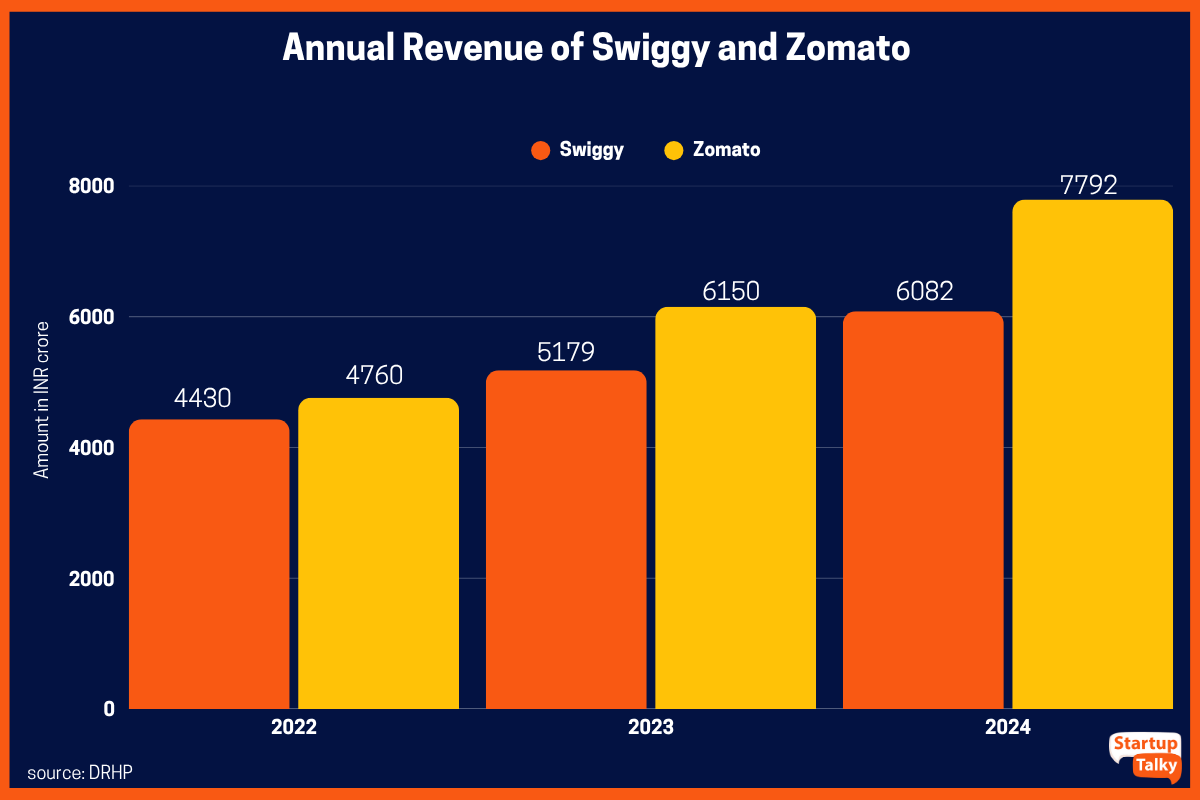
Annual Revenue of Swiggy and Zomato (FY2022 – FY2024)
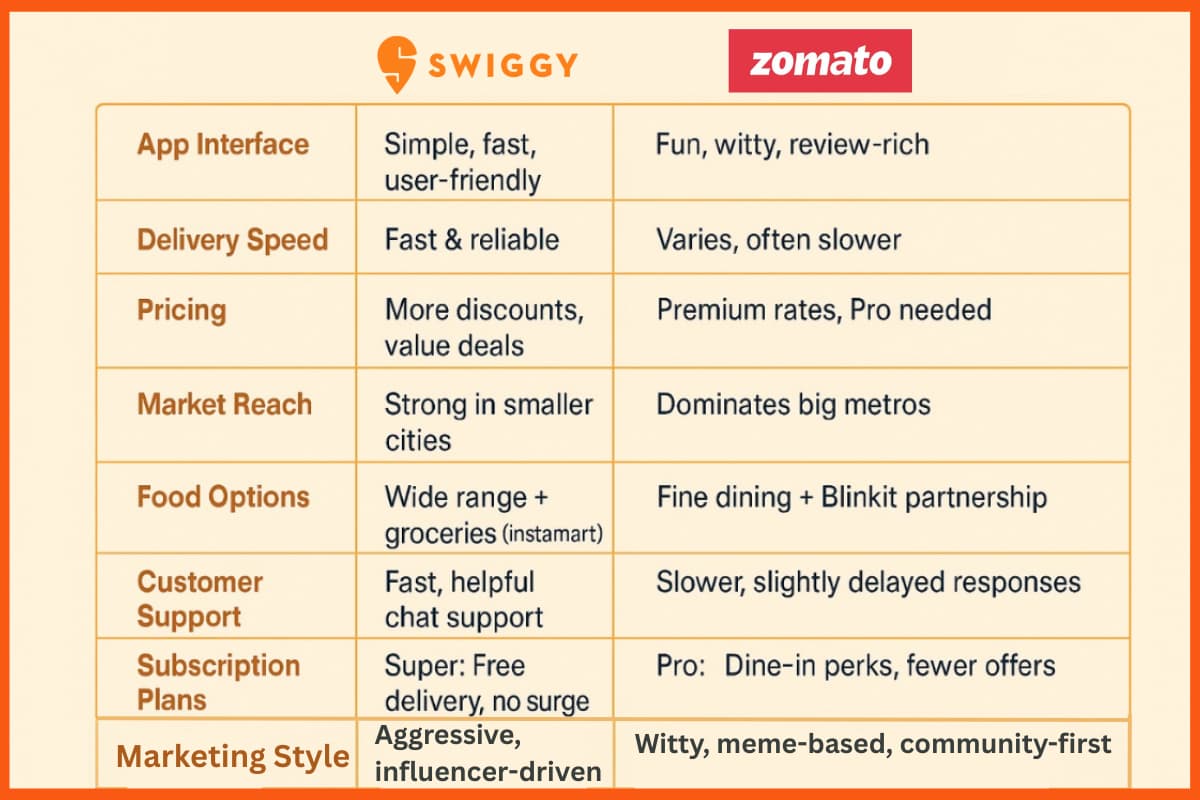
Swiggy Vs Zomato: The Ultimate Comparison
Feature
Swiggy
Zomato
1. App Interface
Simple, fast, user-friendly
Fun, witty, review-rich
2. Delivery Speed
Fast & reliable
Varies, often slower
3. Pricing
More discounts, value deals
Premium rates, Pro needed
4. Market Reach
Strong in smaller cities
Dominates big metros
5. Food Options
Wide range + groceries (Instamart)
Fine dining + Blinkit partnership
6. Customer Support
Fast, helpful chat support
Slower, slightly delayed responses
7. Subscription Plans
Super: Free delivery, no surge
Pro: Dine-in perks, fewer offers
8. Marketing Style
Aggressive, influencer-driven
Witty, meme-based, community-first
Swiggy Vs Zomato: The Ultimate Comparison
Innovations of Zomato
Zomato always strives for different innovative stuff to improve customer experience. Some innovations are the next level try, which has the capabilities to disrupt the market. Let’s have a closer look at what Zomato has done so far to stay ahead in the food delivery race.
Zomato Hyperpure
Swiggy vs Zomato – Hyperpure by Zomato
Hyperpure is one of Zomato’s initiatives to provide fresh and high-quality ingredients to restaurants. Restaurants can choose from 1200+ ingredients and kitchen products, which will be directly delivered to the restaurant’s address. Now, there is no headache for restaurant owners buying kitchen commodities for daily use.
For product outsourcing, Zomato has a network of professionals that includes farmers, mills, producers, and processors. Sellers on Hyperpure are verified and only those sellers are appointed who are looking for a long-term partnership.
10-min Delivery by Zomato Instant
Swiggy vs Zomato – 10 min Delivery by Zomato Instant
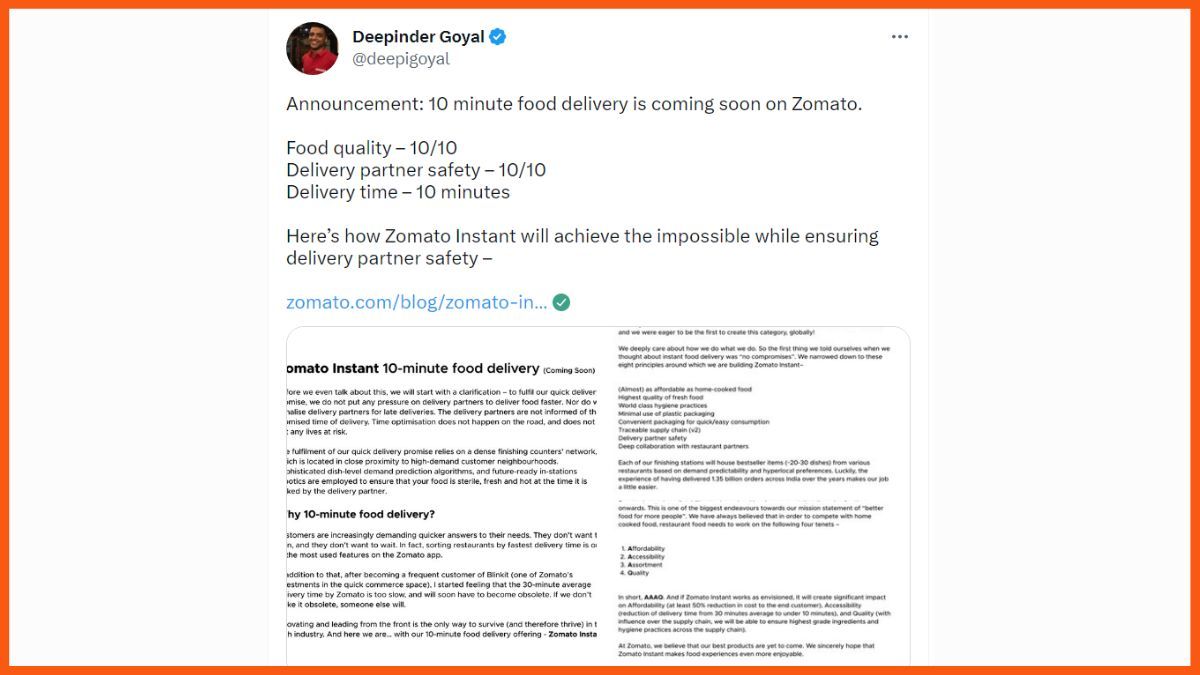
According to Zomato, sorting restaurants by delivery time is the most used feature in the app. This shows that customers want quicker delivery; they don’t want to wait. Zomato recognized this and launched Zomato Instant, which is a 10-minute food delivery service for restaurants.
After listening to Allforthis, you might think that Zomato is putting extra pressure on its delivery partners and restaurant partners, but it’s not like that. According to Zomato, their delivery partners are not informed about the promised delivery time, nor are they penalized for late delivery.
All this delivery works on a demand prediction algorithm. There is a network of finishing stations located near the high-demand area for the fulfillment of each order.
Ordering legendary and famous foods from any state to your home is the concept introduced by Zomato. Now you can order biryani from Hyderabad and rasgullas from Kolkata, and they will be delivered to you the next day. ‘Intercity Legends’ is a way to enjoy iconic dishes from different cities and states.
‘Intercity Legends’ is still in the pilot stage, but the response is extremely good. It is available for selected customers in Gurgaon and some parts of South Delhi. But the innovative step taken by Zomato to bring iconic of different states to our doorstep is appreciable.
Your order reaches you via a flight with proper packaging; there is a proper logistics system designed to deliver the order to you within the given time.
Voice Instructions for Delivery Location
Mapping in India is not that precise, and sometimes, it is hard to find locations based on written delivery addresses. Zomato, which always tries to enhance user experience, brings a new feature in its app that allows users to provide voice instructions for directions to their homes.
To use this feature, you need to click on the delivery direction tab and then hold the record button to give the information related to your delivery location. This feature is helpful because sometimes delivery partners face issues in finding the delivery location, and they need to call the customer, which ultimately delays the delivery and leaves a bad taste in customer satisfaction.
Street food is the best, cheapest, and most tasty alternative we prefer over restaurants. Sometimes we are used to eating food from any street vendor and often say, ‘Chal kallu ke chhole bhature khane Chalte hai.’ These street vendors suffered a lot during the lockdown period.
Zomato, in collaboration with the Government of India, started an initiative to bring this street vendors onto its platform. The government launched the Prime Minister Street Vendor’s AtmaNirbhar Nidhi scheme (PM SVAnidhi scheme) to provide working capital loans and increase digital payments for these vendors.
So far, Zomato has onboarded approximately 965 street vendors on its platform across different cities like Vadodara, Bhopal, Nagpur, Jabalpur, and Ludhiana.
Zomato AI
Swiggy vs Zomato – Zomato AI
Zomato, a top food delivery company, has launched an AI-based customer support tool called Nugget. This new step is part of the company’s plan to use more technology and reduce manual work. Zomato, a top food delivery company, has launched an AI-based customer support tool called Nugget. This new step is part of the company’s plan to use more technology and reduce manual work. As a result, Zomato has let go of 600 customer support employees.
The goal of Nugget is to make customer service faster and more efficient. With AI growing quickly, more companies like Zomato are now choosing smart bots to handle customer queries instead of relying only on human staff.
This move shows Zomato’s focus on using advanced technology to improve how they work and help customers. It also points to a big change in the food tech industry, where automation and AI are becoming the new normal for better service.
The goal of Nugget is to make customer service faster and more efficient. With AI growing quickly, more companies like Zomato are now choosing smart bots to handle customer queries instead of relying only on human staff.
This move shows Zomato’s focus on using advanced technology to improve how they work and help customers. It also points to a big change in the food tech industry, where automation and AI are becoming the new normal for better service.
Earlier, Zomato launched something super cool called Zomato AI, and it’s like having a foodie friend in your pocket! The best part? It can do many things simultaneously, making it a multitasking food guru.
Let’s say you’re craving a specific dish. Well, Zomato AI can show you a list of all the places around you that serve exactly what you’re hankering for. And if you’re feeling indecisive about what to order, no worries! Zomato AI can suggest popular dishes or great restaurants to make your decision a breeze.
But what makes it even cooler is how you can chat with it just like you would with a friend. You can send multiple messages, and Zomato AI responds almost instantly, making the whole experience smooth and natural, unlike other AI things that only handle one message at a time. Zomato AI is like your foodie BFF, ready to help you out with any food-related question you throw at it.
Swiggy is also not behind in the race for innovation; Swiggy has taken various steps to improve its delivery services and user experience.
AI to Improve Delivery Services
Swiggy is using AI to enhance user experience across its platform. Its AI-powered neural search allows users to find food and groceries in a conversational way, offering personalized recommendations. For dining out, Swiggy is developing a generative AI-based Dineout bot that helps users discover restaurants based on their preferences. Additionally, the company is building AI-driven tools to support its network of restaurant and delivery partners, streamlining operations and improving service quality.
Swiggy is using AI technology to fill the loopholes present in the different stages of delivery. Swiggy has improved its AI to the extent that delivery executives can’t change their status to ‘Arrived’ before they reach the restaurant. Everything is connected with GPS for location tracking to ensure transparency.
Data is the fuel for today’s world, and this company is leveraging it very efficiently. AI is used for the future prediction of orders, customer behavior, and interaction with the help of previously available data.
With the help of AI, Swiggy provides a personalized list of restaurants based on your previous order, reviews, search, and interaction. It also recommends different dishes that you are most likely to order.
The first membership program launched by Swiggy was Swiggy Super in 2018, which provides free delivery on restaurant orders. Since then, Swiggy has launched different services, like Instamart and Swiggy Genie, to boost its quick commerce.
So, despite installing the different apps and using these services separately, Swiggy has integrated all these services under one roof called Swiggy One. Now, users have to install only one app, which is Swiggy, create only one account, and buy only one membership plan offered by Swiggy.
Just by using one app, users can order food from the restaurant, buy groceries using Instamart services, and deliver anything with Swiggy Genie. Benefits like discounts and free delivery can be availed by membership users.
Swiggy One
Delivery by Drone
Zomato vs Swiggy – Swiggy Delivery by Drone
The food-tech space in India is going through a revolution phase. Swiggy is working on providing delivery using drones, and multiple pilots are conducting tests to make this concept operational. The whole concept revolves around transferring the goods from the dark stores to the nearest seller location of the customer.
Garuda Aerospace commenced the first trial in Delhi-NCR and Bengaluru to use drones for grocery delivery. Based on the performance of the first trial in Bengaluru and Delhi-NCR, Swiggy will conduct a second trial with ANRA technology, Techeagle, and Marut drone tech.
Multimedia Card Insights: Enhanced User Experience
Providing a better Customer Experience is the way to build long-term trust among customers. Today, companies are doing so many things to enrich the user experience on their platforms. They know very well that a bad user experience will directly lead to a decrease in customer base.
Swiggy has launched a new innovative multimedia card insights, which is a new way to showcase the product overview. Images and Lottie animations are old; things have changed in this new era. In this new multimedia card, informative videos are used to show the product’s features.
Swiggy, the food and grocery delivery service, has introduced a new feature called Pocket Hero. It’s like a money-saving sidekick for users who want to spend smart. It’s being tested in Delhi, giving you extra cashback and discounts of up to 60% on food orders from specific restaurants. You can enjoy these benefits at five places: Pink Box, 34 Chowringhee Lane, Cold Love Ice Cream, The Chai Story, and Chai Chapter.
“Pockethero aims to make food delivery accessible to a set of users who today may find online food delivery less value for money … Pockethero delivers the best of discounts from our partner restaurants and gives free delivery on top of it to give our customers a taste of convenience without having to think much about their pockets,” said Sidharth Bhakoo, VP, National Business Head at Swiggy.
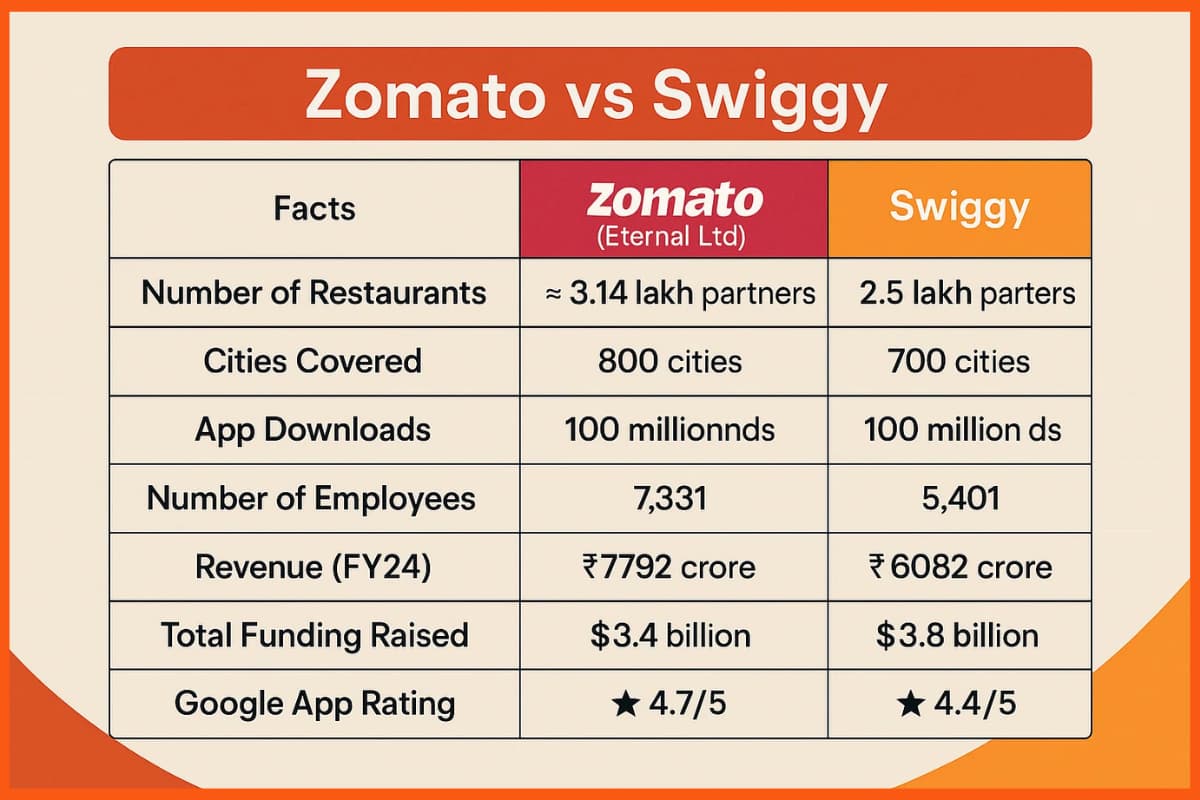
Figure Overview: Zomato vs Swiggy
Zomato Vs Swiggy
Facts
Zomato (Eternal Ltd)
Swiggy
Number of Restaurants
~3.14 lakh partners
2.5 lakh+ partners
Cities Covered
800+ cities
700+ cities
App Downloads
100 million+
100 million+
Number of Employees
7,331 employees
5,401 employees
Revenue (FY24)
INR 7792 crore
INR 6082 crore
Total Funding Raised
$3.4 billion
$3.8 billion
Google App Rating
4.7 / 5
4.4 / 5
Marketing of Zomato
Zomato’s top-notch marketing strategy always supports its presence in the market. The food delivery industry has never been so interesting, but things have changed now. Let’s have a look at some of the popular marketing of Zomato.
Zomaland
Swiggy vs Zomato – Zomaland by Zomato
Zomaland is a carnival consisting of the best restaurants, powerful performances, amazing attractions, and a plethora of other events, making this a food festival.
Started in 2019, this food carnival of Zomato became successful by hosting 1.5 lakh+ visitors, 300+ restaurants, and serving more than 3.5 lakh dishes. Many famous artists like Badshah, Hardy Sandhu, Divine, and many more were reported to perform in order to entertain the visitors.
Now, Zomaland season 2 has arrived with full energy in cities like Pune, Ahmedabad, Mumbai, New Delhi, Kolkata, Bengaluru, and Hyderabad. This marketing event by Zomato is one of the most popular and successful.
Meme and Creative Marketing
Swiggy vs Zomato – Zomato Creative Marketing
Meme and creative marketing of Zomato are the best in the industry. If you look at the social media handle, you will find so many creative marketing memes that connect with the audience and, interestingly, convey the message.
Paid Advertising Campaigns
While paid advertising is typically a short-term marketing approach, its impact on maintaining engagement cannot be overlooked. Zomato strategically utilizes paid advertising, complementing its organic optimization efforts to enhance brand visibility in search results. The key to Zomato’s advertising lies in audience retention.
Employing Google Ads, Zomato precisely targets specific customer segments. These paid ads, seamlessly integrated with organic results, enable the brand to reach a broad spectrum of keywords that might be challenging through organic efforts alone. Zomato’s marketing campaigns predominantly involve paid advertisements, serving as a proactive means to connect and sustain engagement with their audience.
Marketing of Swiggy
Zomato vs Swiggy – Why is This a Swiggy Ad?
The marketing campaign is an integral part of Swiggy; it gives neck-to-neck competition to its biggest rival, Zomato. Swiggy’s recently launched marketing campaign is the best example of it.
Why is this a Swiggy ad? It is a marketing campaign introduced by Swiggy in which you have to answer, ‘Why is this a Swiggy ad?’ After looking at the picture published by Swiggy.
This marketing move grabbed the attention of many customers because of the challenge they had given. Swiggy also announced Rupees 1 lakh worth of Swiggy money to the person who gave the right answer.
Approximately 800,000 people participated online with their theories behind the campaign, making it one of the most successful Swiggy user-generated campaigns. The question “Why is this a Swiggy ad?” was one of the most searched topics on Google that week.
Email and Social Media Marketing
Zomato vs Swiggy – Email and Social Media Marketing
Regularly engaging with its customer base, Swiggy employs dynamic email campaigns featuring captivating graphics, catchy slogans, and irresistible deals. The brand strategically enhances its email content, especially during major events like the Indian Premier League, the World Cup, and the Olympics, entertaining and ensuring relevance and heightened consumer interest during these periods.
Across various social media platforms, Swiggy maintains a robust presence. Their innovative use of hashtags, such as #EarnYourCheatMeal, #NoOrderTooSmall, and #EatYourVeggies, exemplifies the brand’s creativity in connecting with its audience. Swiggy leverages humor in posts, cleverly weaving current trends into content that entertains and aligns with the company’s services and vision. This multi-faceted approach reflects Swiggy’s commitment to staying dynamic, entertaining, and closely connected to its customers.
PPC Advertising Strategy
Swiggy, the big food delivery company, is good at using online ads. They choose specific words (like “food delivery near me”) that people often type when looking for food. They also use catchy phrases for specific cravings, like “midnight chicken delivery.” Swiggy shows its ads to the right people by avoiding words that don’t match, like “homemade food.”
Their short and clear ads talk about quick delivery and good deals. They create a feeling of urgency, like saying, “Order now!” Swiggy makes ordering easy by designing its website and app to be simple and quick, especially on phones. They even suggest dishes based on what you might like. Swiggy doesn’t use the same ads everywhere; they change them for Google, Facebook, and others, depending on where people are looking. They also test different ads to see what works best and keep improving. Swiggy also does things like reminding people about their orders or making special holiday ads. They work with popular restaurants and influencers to reach more people and make their brand trustworthy.
Conclusion
In the competitive landscape of food delivery services, the Swiggy vs Zomato comparison reveals interesting dynamics. Both companies excel in delivering quality food, but Zomato currently holds a stronger position in terms of market share, marketing strategies, innovation, and successful acquisitions. On the flip side, Swiggy takes the lead in prioritizing the well-being of its delivery executives, a crucial factor contributing to heightened consumer satisfaction. Zomato or Swiggy which is better, depends on what you prefer—faster delivery and groceries with Swiggy, or detailed reviews and a fun app with Zomato. The Swiggy vs Zomato debate showcases the nuanced strengths of each, with Zomato dominating certain business aspects while Swiggy takes a commendable lead in ensuring the welfare of its delivery workforce.
FAQs
What are the top 3 food delivery apps?
The top 3 food delivery apps in India are Zomato, Swiggy, and Domino’s.
Is Swiggy successful in India?
Yes, Swiggy is considered a successful startup in India. Regardless of its rough path, it has successfully created a great example in the market for other startups to learn from.
Swiggy or Zomato which is best?
Choosing between Zomato and Swiggy depends on your priorities. Zomato shines in restaurant discovery and reviews, while Swiggy excels in delivery speed and interface. Ultimately, the “best” depends on what matters most to you: food research or swift delivery.
Is Swiggy losing to Zomato?
As for the insights shared by Jefferies, the gross value of Swiggy’s food delivery operation in the first half of 2022 was $1.3 billion, whereas Zomato recorded $1.6 billion of the order value for its food delivery operations. From this, it can be estimated that Swiggy has lagged at several points to Zomato. However, the real winner is still a debatable topic.
Is Swiggy ahead of Zomato?
Both companies are fierce in their competition. When we talk about gross value, Swiggy lagged behind Zomato. However, with the acquisition of a quick commerce platform, Blinkit, Swiggy crossed Zomato in the quick commerce space to capture all e-commerce markets and move ahead of Zomato.
India’s startup ecosystem continues to attract investor interest, with multiple early and growth-stage companies raising capital across sectors. Here’s a quick look at the major funding deals announced today:
🟢 Snabbit Raises $19 Million Led by Lightspeed
Logistics-tech platform Snabbit has secured $19 million in a fresh funding round led by Lightspeed Venture Partners, with participation from existing investors. The capital will fuel the company’s expansion plans and enhance its tech capabilities to streamline intra-city deliveries.
👗 Ziniosa Secures Undisclosed Funding from Inflection Point Ventures
Pre-loved fashion marketplace Ziniosa has received fresh funding from Inflection Point Ventures. The startup aims to lead the sustainable fashion movement in India, focusing on tech-driven resale experiences for fashion-conscious consumers.
🏏 KhiladiPro Raises $1 Million Pre-Seed for Sportstech Platform
KhiladiPro, a sports tech startup enhancing grassroots talent discovery, has raised $1 million in a pre-seed round. The funding will be used to refine its platform, grow user engagement, and build training partnerships.
🏠 Cleevo Raises $1 Million Seed Round Led by Eternal Capital
Home hygiene brand Cleevo has bagged $1 million in a seed round led by Eternal Capital, with participation from other investors. The startup aims to bring innovation and sustainability to India’s household cleaning segment.
✈️ GydExp Secures Funding at INR 15 Crore Valuation
AI-powered travel-tech startup GydExp has raised an undisclosed amount at a valuation of INR 15 crore. The platform offers personalised experiential travel planning using AI and aims to disrupt the premium travel space.
🦄 Dhan Nears Unicorn Status with $200 Million Fundraise
Investment platform Dhan is poised to join the unicorn club after raising $200 million in a new round led by ChrysCapital, Alpha Wave, and MUFG Bank. The funds will be used to broaden its wealth-tech offerings and scale operations in tier-2 and tier-3 cities.
Stay tuned for more funding updates on StartupTalky as India’s startup scene continues to thrive across sectors and cities.
This article has been contributed byVinil Chandra, CEO, Squarebox.ai.
If you’re a small business owner in India, chances are your customer conversations already happen on WhatsApp. I’ve seen it firsthand with shop owners, real estate agents, and tuition centres, they’re not emailing leads or logging into CRMs. They’re replying to chats on their phone between appointments, sometimes late at night.
WhatsApp is the heartbeat of business for India’s small and mid-sized entrepreneurs. But here’s the problem: it’s still mostly manual.
What if you could run sales, support, reminders, and follow-ups all automatically without sounding like a robot? That’s exactly what we’ve been building at Squarebox, and here’s what we’ve learned after working with hundreds of SMBs across India.
Start With One Thing: Know Who You’re Talking To
Don’t start with automation. Start with clarity. Who are your customers?
You don’t need expensive analytics, just segment people based on where they are in your journey:
New inquiries
First-time buyers
Repeat customers
Ghosted leads
Past customers
One gym owner we worked with just tagged people into “Trial,” “Joined,” and “Dropped Off.” That alone helped him send better, more timely WhatsApp messages — no tech needed.
How to get this data:
Website pop-ups with a “Chat on WhatsApp” CTA
QR codes in your store or packaging
A simple form that says “Want offers? Drop your number”
Once you have that, you can talk to people, not at them.
Most businesses treat WhatsApp like it’s email. They blast out long messages and wonder why no one replies.
That’s not how people use WhatsApp. They want short, natural, one-line messages. Think:
“Hey, your appointment is tomorrow at 3PM.”
“Here are three easy exercises you can try today.”
“Pooja lost 4kg in 60 days — here’s how.”
Short. Friendly. Scroll-friendly.
The best-performing content we’ve seen? Tips, reminders, transformation stories – not sales pitches. And always end with a button or reply prompt. That’s what makes it feel like a conversation.
Get Found First, Then Engage
Before you talk to anyone, you need to be discovered. For most small businesses, that means SEO, not the complicated kind, just being searchable locally.
Three easy wins:
Set up your Google Business Profile with your WhatsApp number included
Add a Click-to-WhatsApp button on your website and Instagram bio
Write three to four simple blog posts answering questions your customers ask
For example, a physiotherapist in Pune started ranking for “sports injury specialist Pune.” He added a “Chat with us on WhatsApp” button, and now, 45% of new leads come straight from search to chat. It’s not about traffic. It’s about conversations.
Run Click-to-WhatsApp Ads – But Do It Smartly
If you have even a modest ad budget, run ads that start chats, not send people to websites.
Here’s what works:
“Want a home loan quote? Message us instantly.”
“Book your free demo class — chat with us now.”
“Need a cake in two hours? WhatsApp us.”
Every extra click is a lost lead. Ads that open a WhatsApp conversation convert better, especially for impulse products like real estate site visits or birthday cakes.
Turn Happy Customers into Growth Engines
One thing we always tell our clients: your best salesperson is your last happy customer.
Referrals work beautifully on WhatsApp if you ask correctly. Don’t wait weeks.
A hair salon client sends this three days after the visit:
“Glad you loved your look. Refer a friend and both of you get 15% off next time.”
No complicated referral programs. Just a message and a button to forward. That’s it.
It’s inexpensive, effective, and scalable.
Watch the Data – Then Tweak Like a Human
Here’s the truth: no automation works forever. It has to evolve.
Even basic numbers can tell you what’s working:
Percentage of people replying
Percentage of chats that lead to a sale or booking
Drop-off rate
Unsubscribes
If 50 people read but no one replies, maybe the first message is too long. If people keep unsubscribing, maybe you’re over-messaging. Think of your automation like a sales intern where you can train it, tweak it, and it gets better.
The Point Isn’t to Sound Smart – It’s to Stay Human (at Scale)
We didn’t build Squarebox to replace people. We built it so small teams don’t burn out trying to do everything manually.
A WhatsApp CRM powered by AI doesn’t mean you send robotic messages. It means:
You remember birthdays without effort
You follow up on leads at the right time
You ask “Need help?” before the customer even asks
And you do this every day, for hundreds of customers, without hiring five new team members.
Final Word
Automation doesn’t mean losing your voice. It means amplifying it at scale, with consistency, and care. The small businesses that win on WhatsApp aren’t the loudest they’re the ones who have real conversations. At the right time. With the right people. Without dropping the ball. And with the right tools, that’s possible even if you’re a team of one. Let’s build businesses that talk, not just sell.
In December 2023, a struggling founder facing lawsuits, zero income, and personal breakdown met one of India’s most successful entrepreneurs. What happened next will restore your faith in the startup world.
Imagine being at your lowest.
You’ve quit your job in the US. You’re not doing food brand deals anymore. Your bank balance is almost empty. And if that wasn’t enough—you have 8 legal notices staring you in the face.
No income. No fallback. No roadmap.
That was the situation one entrepreneur found themselves in late 2023. Then, at an event in December, they met Zerodha co-founder Nithin Kamath.
“He barely knew me. We had never even met before,” the founder recalls.
But what Kamath said in that moment changed everything:
“If you need any financial help, let me know. I’ll help out.”
Shocked by the offer, the founder hesitantly asked:
“How much equity would you want if you help me?”
Nithin smiled.
“None. I don’t want anything. I just want to support you.”
In an industry where every deal is a negotiation, this was unfiltered kindness.
No term sheet. No agenda. Just belief.
Belief that good work, good intentions, and good people deserve support—even when they’re down.
In an era obsessed with ROI, exits, and vanity metrics, this moment stood out for what it represented:
🟢 The ROI of character. 🟢 The value of integrity. 🟢 Backing people, not just spreadsheets.
“I didn’t take the money,” the founder later shared. “Because I want to try building something sustainable, not survive on contributions.”
But the gesture? It stayed.
“You didn’t just offer me help, Nithin. You inspired me.”
Why This Matters:
In a cutthroat ecosystem where VCs chase unicorns and founders are forced to pitch for basic survival, Nithin Kamath’s gesture stands tall.
He didn’t have to help. He chose to. That’s leadership.
TL;DR:
✅ One of India’s top founders offered financial help to someone he didn’t even know. ✅ Asked for zero equity. ✅ Did it quietly—offstage, no PR, no posturing. ✅ Gave something more valuable than money: belief.
🔥 Moral of the Story:
True wealth isn’t measured in stock price or exits. It’s measured in character.
Nithin Kamath just reminded the Indian startup ecosystem of that.
Ziniosa is India’s leading platform for buying and selling authenticated preloved luxury fashion.
The funds will be used to build the core team, enhance brand visibility, scale tech, and launch a physical store.
Ziniosa is the exclusive preloved fashion partner on the Tata CliQ Luxury with an 80% sell-through rate.
So far, Inflection Point Ventures has invested over INR 800 Cr across 210+ startups.
Ziniosa, a pre-loved luxury fashion platform, has raised an undisclosed amount of funding from Inflection Point Ventures (IPV), one of India’s largest angel investing platforms, to accelerate growth by building its core team, increasing consumer awareness, expanding brand exposure, enhancing technical capabilities, and opening a physical store.
Founded in 2020, Ziniosa has rapidly emerged as India’s leading platform for secondhand luxury fashion, enabling consumers to buy and sell authenticated preloved fashion items with ease. The platform hosts over 10,000 products across seven categories, including high-end brands like Louis Vuitton, Gucci, and Chanel.
Ziniosa was co-founded by Ashri Jaiswal and Varun Ramani, engineers-turned-entrepreneurs with extensive experience in e-commerce and product development across India and the US. Ashri brings over five years of project management expertise and is also a TEDx speaker and UN Women mentor. Varun has worked with global firms like Philips and Keithley and shares a strong background in e-commerce alongside Ashri.
Mitesh Shah, Co-Founder, Inflection Point Ventures, says, “The thrifting movement is gaining a lot of popularity in India. It makes luxury fashion more accessible and affordable, along with driving sustainable and mindful consumption. We’re very excited to be a part of this, along with Ziniosa and be able to offer high-end, quality fashion items to a growing market in India.”
Ziniosa is headquartered in Bangalore, with a warehouse in the same city. With a YoY growth rate of 40%, it currently has ₹15 crore worth of inventory entirely sourced at zero cost. Its platform boasts over 30,000 products and a database of 60+ brands, while maintaining CM1 profitability with minimal burn.
The startup operates on a zero-inventory acquisition cost model, resulting in higher margins and reduced financial risk. Its price protocols are data-backed, ensuring transparency, and its strict authentication system helps eliminate counterfeits, enhancing buyer trust and reinforcing its category leadership.
Ashri Jaiswal, Co-founder, Ziniosa, shares, “The preloved movement is just getting started—and at Ziniosa, we’re proud to be leading it as India’s fastest-growing, organised platform for luxury resale. We’re not just selling fashion; we’re changing how India shops.”
Varun Ramani, Co-founder, Ziniosa, adds, “With the support from IPV, we’re gearing up to scale Ziniosa across all fronts—expanding our team, strengthening our tech, and opening our first store within the next two years. We’re also growing our men’s category and significantly expanding our product catalogue to meet rising demand.”
Ziniosa is the only exclusive partner for preloved fashion on Tata Cliq Luxury. The startup has been incubated at NSRCEL (IIM Bangalore’s Entrepreneurship Cell) and NASSCOM/CWE, and boasts an 80% sell-through rate, among the highest in the industry.
The Indian luxury market is currently valued at INR 82,000 crore (~USD 10B), while the secondhand market in India is estimated at $3 billion. Globally, the preloved fashion market is projected to reach $350 billion by 2027, underscoring the vast opportunity Ziniosa is tapping into.
About Ziniosa
Ziniosa is redefining the secondhand fashion industry with a unique, tech-driven platform that makes buying and selling preloved luxury seamless and trustworthy. Founded by Ashri Jaiswal and Varun Ramani in 2020, the company operates in the circular fashion space and stands out with its zero-inventory model and strict authentication protocols.
About Inflection Point Ventures and Physis Capital
Inflection Point Ventures (IPV) is an angel investing platform with over 23,500+ CXOs, HNIs, and Professionals to invest in startups. The firm supports new-age entrepreneurs by providing them with monetary & experiential capital and connecting them with a diverse group of investors. IPV has launched a $50 Mn CAT 2 VC fund, Physis Capital, to invest in Pre-Series A to Series B growth-stage start-ups. The fund has already deployed capital in two startups so far, with a few deals in advanced stages of the pipeline.
On World Hunger Day, it commits to distribute 70,000 meals daily in India and Zambia, totalling 2.50 crore meals in 2025-26 under its Hunger Free World initiative.
In the last 3 years since its launch, the initiative has provided 2.5 crore meals to the underprivileged.
Malabar Group has dedicated 60% of its annual CSR budget to initiatives aimed at eradicating hunger and poverty, reinforcing its commitment to make a deeper social impact.
Malabar Group, India’s leading business conglomerate and the parent company of Malabar Gold & Diamonds, has allocated INR 150 crore in 2025-26 for scaling up its CSR initiatives focused on healthcare, education, hunger & poverty alleviation, women empowerment, environment protection and housing for the less privileged.
Under its flagship CSR initiative ‘The Hunger Free World’, the Group has committed to distribute 70,000 meals daily in India and Zambia to the underprivileged, totalling 2.50 crore meals in 2025- 26. This represents a significant leap from its cumulative achievement of 2.5 crore meals served over the past 3 years and signals a deepened commitment to the cause of food security for underserved communities. The initiative is aligned with the United Nations’ Sustainable Development Goal 2 – Zero Hunger.
At an event held at the Dr. Ambedkar International Centre, Janpath, New Delhi, on May 28, 2025, which also marks World Hunger Day, Dr. Amitabh Kant, former CEO of NITI Aayog & G-20 Sherpa, launched the next phase of the Group’s CSR programmes. Other dignitaries included M.P. Ahammed, Chairman of Malabar Group; KP Abdul Salam, Vice Chairman; O Asher, Managing Director of India Operations; Group Executive Directors Nishad A K and K P Veerankutty; Group Director PA Abdulla Ibrahim; Dr. Idrees V, Chairman, THANAL Daya Rehabilitation Trust; Jishad N K, Zonal Head – North and other management officiates.
Commenting on the initiative, MP Ahammed, Chairman of Malabar Group said, “At Malabar Group, CSR is an integral part of our culture and we believe in giving back to society. We dedicate May 28 as our annual CSR day; we reaffirm our pledge to stand with the underserved through sustained and impactful action. Our CSR initiatives are a reflection of that enduring commitment. While we are doing our utmost, a greater impact can be achieved if more organisations join this mission. With 295 million people globally facing acute hunger (as per UN data), immediate action is non-negotiable. This urgency drives our meal distribution efforts under the Hunger Free World initiative. Having said that, along with food distribution, the need of the hour is concerted efforts to boost production, creating jobs, and fostering economic growth to bring in sustainable change.”
The Hunger Free World project currently distributes 70,000 meal packets daily across India and Zambia. In India, over 60,000 nutrient-rich meals are provided daily through 167 centres spanning 20 states. In Zambia, the group collaborates with the Zambian government to serve daily meals to 10,000 students across three schools. The Hunger Free World project operates state-of-the-art kitchens equipped with modern facilities and staffed by trained culinary experts and hygiene-conscious personnel.
Under its educational and social welfare initiative, Malabar Group has established 716 micro learning centres across India, providing primary education and nutrition to street children. Over 32,000 children have enrolled, with 9,000 already integrated into formal schools. This project is being run in collaboration with Thanal. In addition, scholarships have been awarded to 1,14,000 girls to support their education.
The Group has also launched an initiative called Grandma Homes, under which shelters have been built to offer free accommodation and care for destitute women. Currently operational in Bengaluru, Kerala and Hyderabad. Plans are underway to expand the initiative to Chennai, Kolkata, Delhi, and Mumbai.
On the healthcare and disaster relief front, the Group has plans to set up non-profit medical stores in all 140 locations in Kerala, offering medicines at subsidised rates. Such stores are already operational in 27 locations in the state.
Malabar Group has also launched the Uyirppu Project, which supports higher education for children affected by last year’s landslide in Wayanad, providing financial aid to 134 students. Since its inception, Malabar Gold and Diamonds has been allocating 5% of its profits to social welfare.
About Malabar Gold & Diamonds
Malabar Gold & Diamonds was established in 1993 and is the flagship company of Malabar Group, a leading diversified Indian business conglomerate. With an annual turnover of $6.2 billion, the company is currently the 6th largest jewellery retailer globally and the 19th ranked brand in Deloitte’s Luxury Goods World Ranking. They have a strong retail network of over 390 showrooms spread across 13 countries in addition to multiple offices, design centres, wholesale units, and factories spread across India, the Middle East, the Far East, the USA, the UK, Canada & Australia. Malabar Gold & Diamonds also features an online showroom www.malabargoldanddiamonds.com providing customers the opportunity to purchase their favourite jewellery at any time and on any day from the comfort of their homes.
ESG (Environmental, Social & Governance) and CSR have been the primary commitments of the group since its inception. The key focus areas of the Malabar Group are Health, Housing, Hunger Free World, Education, Environment and Women empowerment, integrating the principles of responsibility and sustainability into its core business.
Set to expand to 200+ micro-markets across Metro cities in India in the next 9 months
Snabbit has raised $19 million in its Series B round, led by Lightspeed, with continued participation from Elevation Capital and Nexus Venture Partners. This comes just four months after its Series A and reflects deep conviction in Snabbit’s breakout potential and the massive white space it is unlocking in the Indian consumer internet ecosystem.
Founded in 2024 by Aayush Agarwal, Snabbit has sparked a digital revolution in regular home services, one of India’s largest yet most underserved categories. For decades, this space has remained fragmented, informal, and overlooked by innovation. Snabbit’s unique hyperlocal model, where trained and verified Experts are allocated in real-time to deliver high-frequency home services, is fundamentally reimagining how urban Indian households function.
“At Snabbit, we’re leading the biggest disruption in Indian consumer internet today, fundamentally changing how households access regular services,” said Aayush Agarwal, Founder & CEO. “While ride-hailing transformed mobility and e-commerce reshaped fashion, regular home services remained largely undigitized. With Snabbit, we’re solving for trust, quality and speed, all at the tap of a button. The need is universal, the category is massive, and we’re just getting started.”
Snabbit’s impact goes well beyond convenience for customers. At the heart of the platform are women who were once part of an unstructured, unstable ecosystem. “What makes this journey truly meaningful is the transformation in their lives,” said Aayush. “They now have Aadhaar-linked bank accounts, personal and family insurance, and steady monthly incomes. Once invisible and underpaid, they’re now trained, trusted, and celebrated professionals. For customers, Snabbit is about quality and speed – for our Experts, it’s about dignity, stability, and real upward mobility.”
Rahul Taneja, Partner at Lightspeed, shared: “Snabbit is transforming home services in India by bringing speed, structure, and trust to a sector that has largely operated informally until now. Aayush and the team are building a platform for urban households; a completely new category that will cater to the needs of millions. We are excited to join them on this journey and support their mission to transform and scale what was once considered a luxury into a day-to-day necessity.”
“Snabbit continues to execute with clarity and purpose in a space that’s long overdue for change,” said Suvir Sujan, Co-Founder and Managing Director, Nexus Venture Partners. “They’ve taken a complex, hyperlocal problem and built a scalable, full-stack solution that delivers value to both consumers and professionals.”
Talking about the investment, Manish Advani, Principal, Elevation Capital, said, “Snabbit’s hyperlocal model is cracking the code in one of India’s most complex and underserved categories. Their rapid growth underscores both the scale of unmet demand and their ability to convert a trust-deficit sector into a seamless, on-demand experience. We have deep conviction in Aayush and the team as they build the backbone infrastructure that will make quality home services routine, reliable and extremely convenient.”
With this fresh capital, Snabbit aims to scale across India’s top metro cities and launch in 200+ micro-markets over the next 9 months, building India’s first true operating system for quick home services, powered by tech, trust, and trained Experts.
About Snabbit
Founded in 2024 by Aayush Agarwal, Snabbit is India’s first Quick-Service App offering on-demand home services. With a hyperlocal network operating in dense residential clusters, Snabbit guarantees quality and speed, pioneering a service delivery model that provides trusted and trained experts within 10 minutes. Backed by Lightspeed, Nexus Venture Partners and Elevation Capital, Snabbit takes a full-stack approach to sourcing, training, and managing experts. Combined with an innovative time-based pricing model, Snabbit simplifies daily life for urban families while creating respectable, well-paying opportunities for a workforce that has long been fragmented and unorganised.
About Lightspeed
Lightspeed is a global multi-stage venture capital firm focused on accelerating disruptive innovations and trends in the Enterprise, Consumer, Health, and Fintech sectors. Over the past two decades, the Lightspeed team has backed hundreds of entrepreneurs and helped build more than 500 companies globally, including Affirm, Acceldata, Carta, Cato Networks, Darwinbox, Epic Games, Faire, Guardant Health, Mulesoft, Navan, Netskope, Nutanix, Physics Wallah, Razorpay, Rubrik, Sharechat, Snap, OYO Rooms, Ultima Genomics, Zepto and more. Lightspeed and its global team currently manage $25B+ in AUM across the Lightspeed platform, with investment professionals and advisors in the U.S., Europe, India, Israel, and Southeast Asia.
Sunlight is an important source of renewable energy. Solar power is the conversion of this energy from sunlight into electricity, either directly using photovoltaics or indirectly using concentrated solar power. Anyone can use solar cells to generate electricity from sunlight. Nowadays, the demand for solar arrangements as an alternate source of energy is growing tremendously.
This increasing popularity is creating huge potential for entrepreneurs to start a solar energy business. India is endowed with vast solar energy potential. The solar business in India is booming, offering great potential for investors and entrepreneurs. Starting a solar products business can be a profitable venture due to the growing demand for clean energy solutions.
India’s solar business is growing very fast. It is expected to rise from $45 billion in 2024 to $1254 billion by 2033, with a growth rate of 41.5% every year. This growth is helping promote clean energy for both homes and large power plants. About 5,000 trillion kWh per year of energy is consumed over India’s land area, with most parts receiving 4-7 kWh per sq. m per day.
Hence, both technology routes for the conversion of solar radiation into heat and electricity, namely, solar thermal and solar photovoltaics, can effectively be harnessed while providing huge scalability for the solar energy business in India. Therefore, starting a solar energy business is a lucrative opportunity for entrepreneurs. Opportunities in solar industry include innovations in energy storage, installation, and solar panel manufacturing, all contributing to a sustainable future.
Solar Photovoltaic Energy Capacity in India From 2013 to 2023
If you are interested in making money from solar energy-related business ideas, then here are some of the best solar energy business ideas that can set you above the competition.
Billions of dollars of solar PV, solar thermal systems, solar attic fans, solar cooling systems, etc., are sold each year, not to mention all the parts that are required to build and operate such installations. In addition to that, solar lights, solar gadgets, solar rechargers, and a growing list of related products. Clearly, you have a lot to choose from.
Solar Products Distribution
If you can’t go into the manufacturing of solar panels, then one of your best bets when it comes to starting a solar energy-related business is to engage in the sales and distribution of solar panels. Just ensure that you network with solar panel manufacturers both within and outside your country and that you position your business in the right location. Starting a solar product distribution will require less investment and can be started by anyone.
Solar System Repairing & Maintenance
Solar Business Ideas – Solar System Repairing & Maintenance
This is an aftermarket service-based business. After the installation of the solar project, it demands regular maintenance, checks, and repairs. Therefore, offering repair and maintenance services is a lucrative business to start in the solar industry. However, the business demands both technical and networking skills. Also, it is a low-cost startup opportunity.
Solar item repairing is one of the most profitable solar business opportunities in India.
Global Rooftop Solar Photovoltaic Market Share
Solar Energy Auditing
Another service that is growing in demand is conducting solar energy audits. Basically, in this profession, you will have to make recommendations on how people can reduce their electrical consumption. This is a highly knowledge-based solar business opportunity. As a solar energy auditor, your primary responsibility is the determination of the energy requirement. This is the basic requirement when anyone wants to install solar energy panels.
However, an auditor is actually a salesperson, marketing conservation and renewable energy resources, offering people a way to control energy consumption. The business demands very small startup capital to commence.
Starting a Solar Farm Business
Solar Business Ideas – Solar Farm Business
An average person is familiar with solar panels mounted on the rooftops of houses, but the truth is that both the solar panels in our homes and solar farms serve the same purpose, but in varying degrees. Installing solar panels for business helps reduce energy costs and promotes sustainability.
The solar panels in our homes are single panels mounted on the roof that get energy from the sun and convert it into Alternating Current (AC) for use in the house, while solar farms, which are also known as Photovoltaic Power, are large areas of land where solar tracking towers are mounted to provide power to a community. Using solar panels for a small business is a smart way to cut electricity costs and increase savings.
Turning Farmland Into Solar Farm – PM Kusum Yojana
Solar Consultancy
Solar energy consultants supervise, monitor, and make recommendations when a solar installation project is being/about to be carried out. A lot of people would like to know if it makes sense to install solar on their property. Additionally, people look for a professional opinion that looks at the various options and guides them through the entire process.
If you have experience in developing solar projects, starting a solar project consultancy can fetch you good returns. You can work independently or together with like-minded consultants.
Becoming a solar product marketer is also a smart business idea. Some of your responsibilities will be to introduce business owners to the benefits of switching to solar energy as a source of power. You may do this as an independent solar product seller or as an affiliate of a solar installation company.
Solar Panel Cleaning
There is a growing need for cleaning solar panels in the solar panel business. It is observed that dirty panels do not work as efficiently as clean panels. The solar panel cleaning business can be started with very low capital. It is one of the most profitable solar panel business ideas.
Solar Blogging
Blogging on solar energy-related topics is one cool way of starting a solar energy-related business. Blogging is all about creating useful and perhaps educational content for a target audience on the internet. If you think that you have good knowledge of the solar energy industry, you can make money by sharing your knowledge with a wide range of audiences via your blog.
Education and training are the keys to any industry, which is why you can find specialized universities like oil and gas universities, marine universities, and film and art colleges. So, suppose you are looking to start a business in the value chain of the solar energy industry. In that case, one of your options is to start a specialized solar energy university or training institute.
Solar Panel Installation Business
Solar Business Ideas – Solar Panel Installation Business
Starting a solar panel installation business means learning the necessary skills and getting certified while forming good partnerships with solar panel suppliers. In these solar panel business ideas, you’d offer services like checking sites, designing personalized solar systems, and installing them efficiently. To succeed, you’d need a strong plan to tell people about the money they can save and the good things it does for the environment. Keeping up with what’s happening in the solar energy industry, like new trends and government support, is important to offer the latest solutions and stay competitive.
Solar Power Generation
In India, a big opportunity for a solar business is to generate solar power. The government wants to produce 500 GW of solar power by 2030, so there are lots of new solar power plants everywhere. If you want to start a business, you can either create your own solar power plant or invest in existing ones. This not only helps the environment but also gives a good opportunity to make money. Just make sure to keep up with new technology and government rules to stay successful in this changing market.
Solar Water Pumping
In India, farmers need a lot of water for their crops, but electricity is not reliable in many places, making it hard to pump water. Entrepreneurs can help by setting up solar water pumping systems, which are reliable and affordable. This not only solves the farmers’ problem but also helps India use clean energy for farming, making it better for the environment. By bringing solar water pumping systems to areas with unreliable electricity, entrepreneurs can make farming easier, more dependable, and environmentally friendly, benefitting both farmers and the planet.
Solar water heating systems use the sun’s energy to warm up water, providing a cheap and eco-friendly solution for homes and businesses. Entrepreneurs can take advantage of this opportunity by setting up these systems, helping both their businesses and the environment. As more people care about being green, the demand for these eco-friendly solutions is increasing, making it a smart and timely business choice.
Global Solar Power Market Size
Solar System Integrator or Installer
If you like fixing things and know a lot about technology, you can choose to be a solar system installer. Your job will be to help people by setting up solar systems in their homes or businesses. To do this, you’ll need to work with companies that sell solar systems and figure out which places need them by asking around.
Being a solar installer isn’t a solo job, so you’ll need a team of people who are also good at technical stuff, and they should have the right certifications. Starting this job will cost you around fifty thousand to two lakhs, and you’ll get paid for each project you complete.
Solar-Powered Lighting Solutions
Another innovative business idea is offering solar-powered lighting solutions, such as manufacturing or distributing solar streetlights, garden lights, or indoor lighting systems. With the growing focus on energy efficiency by municipalities and businesses, the demand for solar-powered lighting is steadily increasing.
Solar-Powered Mobile Charging Stations
In areas with unreliable electricity access, there is a growing need for alternative power sources, especially for charging mobile devices. Entrepreneurs can tap into this demand by setting up solar-powered mobile charging stations in public spaces, at events, or in remote regions. Pairing this with a solar panel business—offering the sale, installation, or maintenance of solar panels—can create additional revenue streams.
Solar-Powered Home Appliances
Making or selling solar-powered home appliances is a smart business idea for the future. Products like solar cookers and solar-powered air conditioners are popular with eco-friendly consumers who want to lower their carbon footprint.
Solar Energy Software Solutions
Integrating technology with solar energy systems creates opportunities for software solutions. Entrepreneurs can develop tools for monitoring, optimization, and management, including performance analysis, energy forecasting, and remote system tracking.
Solar-Powered EV Charging Stations
Solar Business Ideas – Solar Powered EV Charging Stations
Strategically placing charging stations in urban areas or along highways and partnering with EV manufacturers boosts visibility and profits. This approach positions entrepreneurs at the intersection of two growing industries: solar energy and electric mobility. These stations harness solar power to charge EVs, reducing reliance on traditional grids.
Is Solar Business Profitable in India?
Is Solar Business Profitable in India
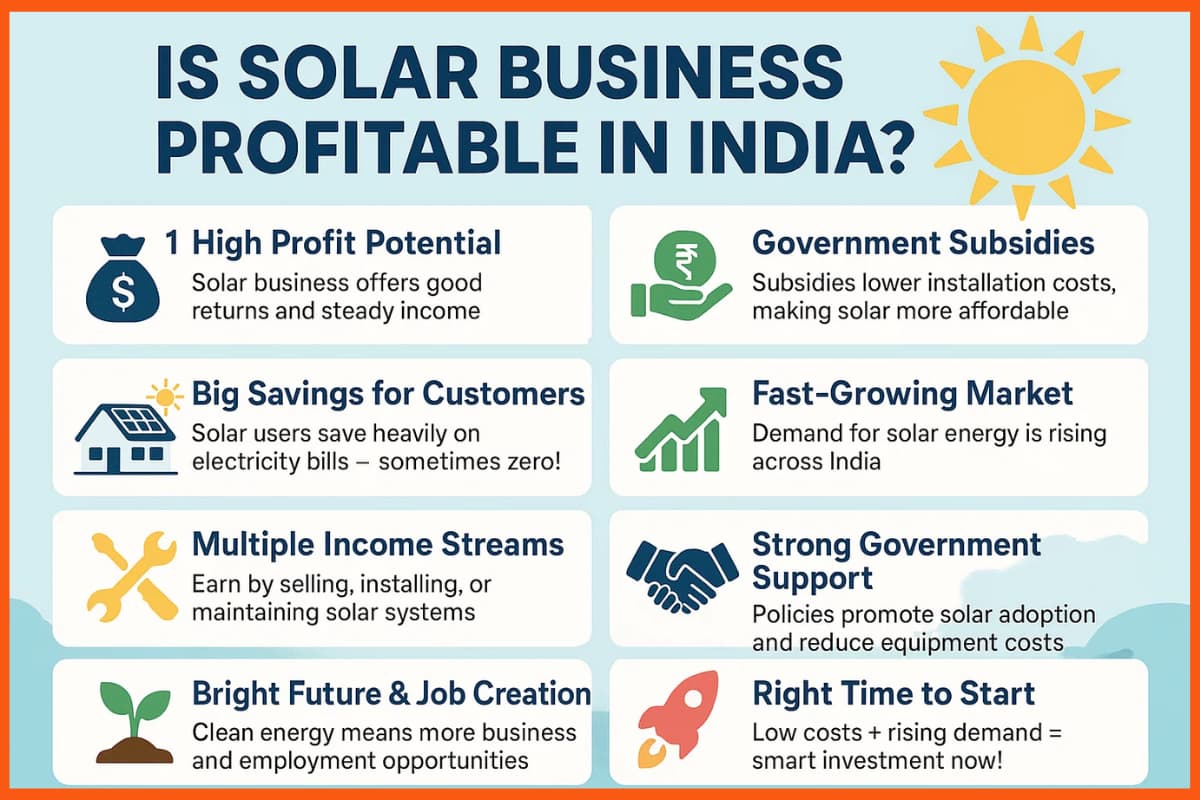
The solar business is a good way to make money in India. The government offers subsidies that help lower the cost of installing solar systems. Even though the setup cost might seem high at first, people save a lot on electricity bills—some even pay nothing! So, solar is not just good for business owners but also helps customers save money in the long run.
Solar energy is becoming more popular in India, and the government is helping by promoting it and reducing prices. There are many ways to earn in this field, like selling, installing, or maintaining solar systems.
Because solar energy has many benefits, the future of this business in India looks bright. The government supports clean energy, which means more business and job opportunities. As more people start using solar power, there will be a bigger need for solar services.
If you’re thinking about starting a solar business, now is a great time. Costs are coming down, the demand is growing, and the support from the government makes it a smart and profitable choice.
Conclusion
To sum it up, the solar business opportunities discussed in this article offer great chances to make money while helping the environment. Whether setting up solar panels or developing cool ideas like solar consultancy, these solar business opportunities don’t need much money. They fit well with the growing interest in clean energy, giving entrepreneurs a way to make a difference while earning profits. As the world keeps moving towards cleaner energy, getting into solar energy businesses makes good business sense and supports the planet. The solar power business ideas we’ve shared are like doors opening for people who want to start something in solar energy, bringing both business success and a positive environmental impact.
FAQs
What is the solar related business?
“Solar business” encompasses companies working with solar energy, from manufacturing panels to installing systems and generating power.
What are the various business opportunities in solar energy in India?
Business related to solar energy are:
Selling Solar Products
Solar Products Distribution
Solar System Repairing & Maintenance
Solar Energy Auditing
Starting a Solar Farm Business
Solar Consultancy
Solar Product Marketing
Solar Panel Cleaning
Solar Blogging
Starting a Solar Energy Training Institute
Solar Panel Installation
Solar Power Generation
Solar Water Pumping
Solar Water Heating
Solar System Integrator or Installer
What is the biggest solar panel company?
Tongwei Solar is the biggest solar panel company.
Which are the best solar companies?
The best solar companies are:
Sunrun
ADT Solar
Freedom Solar Power
Blue Raven Solar
Momentum Solar
SunPower
Tesla Energy
How to make money in solar business?
Make money in the solar business by offering services like solar panel installation, consultancy, or developing innovative solar solutions.
Which country uses the most solar energy?
China leads in the Solar energy usage.
Which country is the largest producer of solar energy?
The largest producers of solar energy are:
China
United States
Japan
Germany
India
What is the solar panel trading business?
A solar panel trading business involves buying and selling solar panels to consumers, installers, and businesses, capitalizing on the growing demand for renewable energy.
If you’re considering venturing into the fashion industry and want to explore the world of clothing brand franchises, you’re in the right place. India’s retail sector is thriving, and clothing franchises offer a lucrative opportunity to tap into this booming market.
Clothing franchises have the potential to yield significant profits when strategically positioned. Successful marketing also plays a crucial role in their prosperity. Opting for a reputable brand ensures these aspects are well-managed. Requirements for a clothing franchise may vary depending on the brand. Luxurious brands may demand a larger land area and more intricate architectural designs. Conversely, urban brands prioritize locality and sales over aesthetics. With a diverse array of clothing franchises available, you have numerous options to choose from.
In the global market, clothing companies have always been extremely popular. Because of the quality and positioning of their products, these businesses have established a standard in their industry. Through franchising, these brands have grown their global footprint over the years. These foreign apparel franchises have made India one of their top business destinations since it’s one of the most lucrative marketplaces with lots of business opportunities. However, as numerous local businesses have entered this market and are currently expanding, the rivalry in this space has been fiercer.
A clothes franchise offers a great opportunity to start a business by selling popular clothing brands with established customer bases and support from the franchisor. In this blog, we will showcase some of the top clothing brand franchises in India that have established a strong presence and have a proven track record of success. Whether you’re interested in high-end luxury fashion, trendy urban wear, ethnic clothing, or sportswear, we’ve got you covered.
Apparel or Clothing Market Size 2025
The global apparel market is growing fast. It is expected to increase from $708.81 billion in 2024 to $766.62 billion in 2025, at a CAGR of 8.2%, driven by strong economies, rising investments, and better technology.
By 2029, the market is projected to reach $1012.31 billion with a CAGR of 7.2%, supported by e-commerce growth, social media, and demand for sportswear. Key trends include the use of AI, blockchain, IoT, and VR/AR to improve fashion, supply chains, and shopping experiences.
Meena Bindra launched her homegrown fashion label BIBA in Delhi in 1988. The name BIBA means beautiful woman in Punjabi. BIBA is a well-known name in Indian ethnic apparel among Indian customers. BIBA has a wide variety of products, including sarees, salwar, Kurtis, lehenga sets, palazzo pants, dupatta, Anarkali, and more. Its lush and vibrant clothes attract both youngsters and elderly fellows. It has a strong presence in the international market too. Biba also deals in unstitched clothing material for both kids and adults and is one of the most profitable clothing franchise in India.
An initial investment of 2-5 crore and a retail space ranging from 1000 sqft to 2000 sqft are necessary to launch this garments franchise. Investors must also have a Shop and Establishment Act Licence, GST registration, and company registration as a Private Limited or Limited Liability Partnership. BIBA is one of the best clothing franchises in India. They will provide training and marketing support to the franchise.
Allen Solly, a renowned clothing brand, offers trendy and stylish apparel for men and women. Established in 1993, the brand is known for its contemporary designs and high-quality fashion offerings. Allen Solly has emerged as one of the top retail fashion franchises in India. With its fresh and trendy range of clothing, the brand has played a significant role in shaping the style of the contemporary Indian generation. Offering an incomparable and classy fashion experience, Allen Solly has become a go-to choice for those seeking a unique and stylish wardrobe.
Peter England, a well-established clothing brand, has gained prominence as a leading name in men’s fashion in India. It was bought out by Kumar Mangalam Birla’s Aditya Birla Fashion label in the year 2000 after it had been founded in Ireland in 1889. If you want to start a successful business, investing in a mens wear franchise can be a great option with strong demand and popular brands. Tops, pants, denim, suits, jackets, and t-shirts are just some of the items available at this men’s wear franchise. With its wide range of stylish apparel and accessories, Peter England has become a go-to brand for men seeking quality, comfort, and modern designs.
Peter England provides its investors with several services, including consignment stock supply, branding and marketing, store setup assistance, efficient operations, and administration of human resources.
To embark on a Peter England franchise journey, a minimum initial investment ranging from ₹25 lakhs to ₹35 lakhs is required. Additionally, aspiring franchisees should have access to a dedicated floor area of over 1200 square feet to accommodate the brand’s offerings. As a Peter England franchise owner, you can benefit from the brand’s established reputation, extensive product range, and loyal customer base.
In 2009, Aurelia was established by OS and AS Pasricha, two brothers. Staying true to traditions while incorporating some modern ideas, this clothing franchise redefines Indian ethnicity. Aurelia has gained popularity among young females and boasts Disha Patani as its brand ambassador. Known for its fancier offerings, Aurelia requires its franchise stores to reflect the brand’s aesthetic. As a franchisee, you can expect training and marketing support from the brand, backed by a 9-year agreement. To succeed as an Aurelia franchise owner, it is essential to possess strong business acumen and a thorough understanding of the industry.
Investors are helped to elevate their new businesses by Aurelia’s outstanding franchise business plan, which makes it one of the top clothing franchises in India. Aurelia assists its investors with staff training, inventory maintenance, and the seamless operation of their outlets.
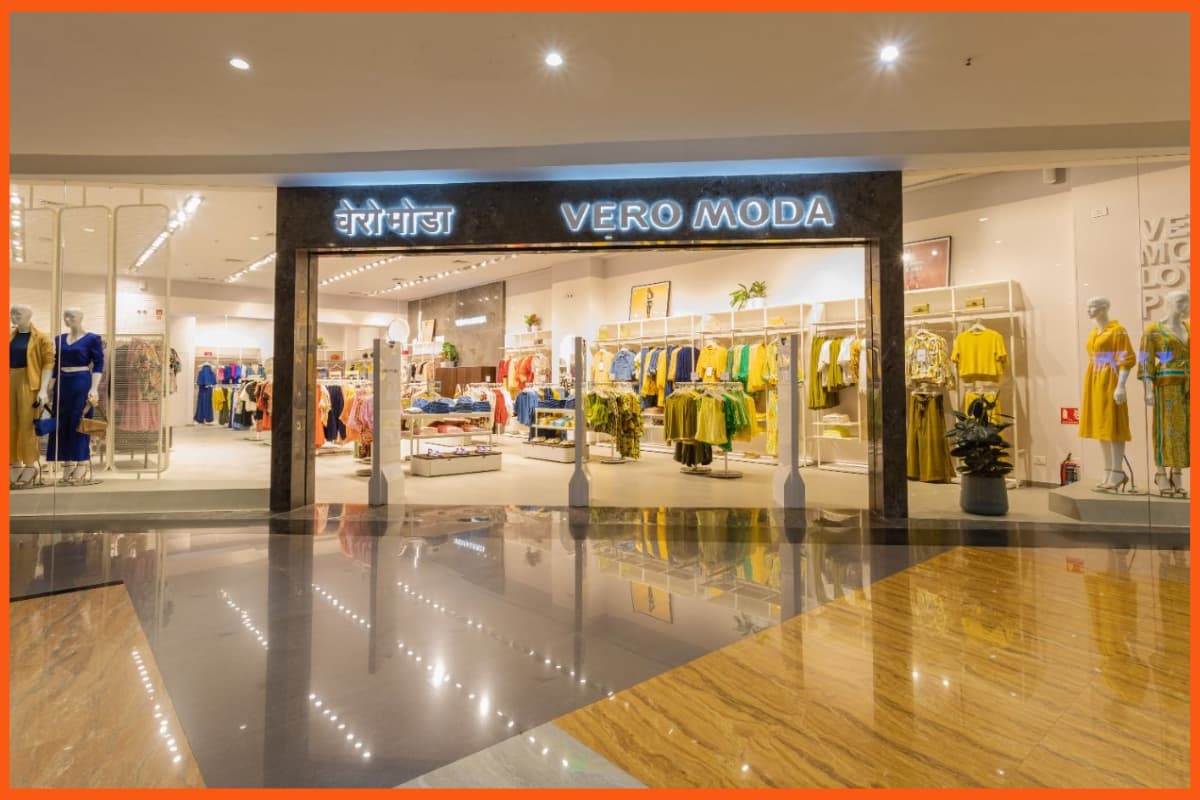
H&M is a popular clothing brand from Sweden with over 63 stores in India. For current investors, opening a Vero Moda franchise could be a good choice, as it is well-loved by many people. Its popularity makes it one of the best clothing franchises in India. The franchisor takes only 4% of the revenue from the franchisees. An H&M store should have trial rooms, billing counters, and areas to display products. The franchise also needs to hire 6 to 15 staff members and set up ACs, CCTV, and computers with internet access.
Jockey, a well-known innerwear brand catering to both men and women, has established a strong reputation in the country. With its brand reliability and quality products, Jockey items are in high demand and sell easily. Jockey has been producing and advertising superior wool socks to unisex undergarments ever since. Jockey India is one of the best clothing franchises in India, and it’s a favorite with both adults and children.
The brand stands firmly behind its franchise partners, offering comprehensive support for training, store design, and ensuring a high-profit margin. For a Jockey franchise, a land area ranging from 1000 to 1400 sq. ft. is required to set up the store.
Franchisees receive first-rate advertising and promotion assistance from Jockey India. Boosting recognition of the brand at the national and regional levels is the objective of these campaigns. Promotional events, sales, and the grand opening of the new store will all be announced through digital channels by the marketing team.
SNITCH is a menswear brand aiming to offer affordable fashion for young men in India, with products like formal, casual, sportswear, innerwear, accessories, and perfumes.
The franchise cost ranges from INR 20 Lakhs to INR 30 Lakhs, depending on location, and requires a store size of 2000 to 2500 sqft in high-traffic areas. Details like franchise fees, royalty, and profit margins are not fully disclosed, so consulting a franchise advisor is recommended.
SNITCH provides full support and training for business setup, staff, and marketing. The brand plans to open 8-10 franchise stores in South Indian cities like Hyderabad and Chennai.
Raymond, a prestigious men’s clothing brand in India, is widely recognized for its quality and style. It was in Mumbai that Vijaypat Singhania established Raymond in 1925. This clothing franchise has been around for a long time and is well-respected in India. Raymond offers comprehensive fabric solutions, including the production of wool, linen, and coated fabrics as well as the design and production of suits, trousers, and other garments.
Raymond is currently focusing on expanding to cities with populations below 5 lakhs. The goal of Raymond’s expansion into tier 4 and tier 5 towns is to further strengthen its leadership position in the fashion and lifestyle industry and to increase its existing franchise footprint.
When you partner with Raymond as a franchise, you can expect comprehensive support in various aspects. This includes assistance with in-shop design, construction, and business development. To maintain the brand’s standards, a minimum footage requirement of 15 feet is necessary to open a Raymond franchise. With over 90 years of experience, Raymond has earned the trust of customers, ensuring a strong customer base for franchisees. Additionally, the franchisees can benefit from expert guidance provided by the head office, along with the installation of current IT systems to streamline operations and enhance efficiency.
Established in Kolkata in 1968 by Prahlad Rai Agarwala, Rupa & Company is a prominent name in Indian knitwear, producing an impressive 7 lakh pieces of finished goods daily. Introducing new variants within each sub-brand is something Rupa does regularly to keep up with changing consumer tastes and market demands.
With a commitment to profitability, Rupa guarantees a 52% return on investment within 1.6 years. When it comes to location, Rupa prefers franchise stores to be situated in high-traffic areas such as malls or bustling high streets. An ideal land area requirement for a Rupa franchise is around 500 sq. ft. These factors contribute to Rupa’s strong presence and success in the innerwear market.
Even though this clothing franchise is well-established in India, Rupa & Company Ltd. is planning to further increase its footprint by opening additional franchises. Investors are assured of Rupa and Company’s complete backing to establish a successful franchise outlet. Rupa & Company Ltd. has devised a strategy to keep franchise stores from competing with one another and this helps the company’s business to grow further. Rupa & Company Ltd. is one of the low-cost franchises in India.
Trylo, a well-known name in the lingerie manufacturing business, boasts nearly 25 years of industry experience and has garnered the trust of the masses. As a franchise partner, you can expect strong support from Trylo, including comprehensive training and assistance with store design. They prioritize the success of their franchise owners, considering it integral to their success. Trylo is dedicated to ensuring that franchise owners do not incur any financial loss while conducting business, reflecting their commitment to fostering mutually beneficial partnerships.
Kasturbhai, Narottambhai, and Chimanbhai were three brothers from Ahmedabad who formed Arvind Ltd in 1931 under the name Arvind Mills Ltd.It is a men’s clothing and suiting fabric dealer. On a global and national scale, Arvind’s fabric market has remained unrivaled. Worldwide clothing brands like Arrow, US Polo Assn, Tommy Hilfiger, Gant, GAP, and private labels like Flying Machine, Newport, Excalibur, and Cherokee are exclusively licensed and marketed by Arvind Ltd. The brand reflects India’s youth fashion.
The franchise land area is required to be 800-1200 sq. ft. The brand caters to upscale customers and offers Italian fabrics for those who prefer them. The brand will support the franchise with advertising and marketing to increase visibility and guide them to launch festive season campaigns and end-of-season sale promotions.
With the construction of state-of-the-art garment facilities and the introduction of garment packages to both domestic and foreign clients, the Arvind Ltd franchise has devised a bold plan to consolidate its present operations which makes Arvind Ltd. one of the best clothing franchises in India.
Dharaprasad Poddar established Siyaram’s Silk Mills Ltd. in Mumbai in 1978. Some of its well-known brands are Oxemberg, Siyaram’s Suitings & Shirtings, J. Hampstead Fabric & Apparel, Mistair, Cadini, Royale Linen, and Miniature. Siyaram boasts an extensive network of 1 lakh retail stores, indicating its popularity among the masses. As a franchise owner, Siyaram expects you to possess a comprehensive understanding of fashion trends and a relentless pursuit of perfection. In return, the company promises a substantial 30% return on investment within a span of 3 to 4 years. This commitment to profitability reflects Siyaram’s dedication to fostering successful and mutually beneficial partnerships with their franchise owners.
In addition to offering an attractive franchise opportunity to potential investors, Siyaram’s provides a range of services, including assistance with site evaluation, and selection as well as design and layout assistance for each shop. To make management easy and deliver the finest client experience, this clothing franchise also offers IT and continuous operational assistance, as well as audits. To help franchises succeed, the company offers unmatched advertising and marketing resources which helps in making it one of the best clothing franchises in India.
VF Corporation offers a unique proposition by bringing together multiple popular fashion brands under one roof. With a diverse portfolio of fashion labels, VF Corporation provides a promising opportunity for franchisees to capitalize on the wide variety of offerings and generate profits. The company takes responsibility for training and development, ensuring franchisees receive the necessary support to thrive. For additional details and inquiries, interested franchise owners are encouraged to contact the corporation directly for further information. It is one of the low-cost clothing franchise in India.
Top Clothing Franchise in India – Gravity Creation
Gravity Creation is a prominent brand specializing in men’s ready-made garments. They offer franchise opportunities that can be established anywhere in India, as they have no specific location preferences. When partnering with Gravity Creation, franchisees can benefit from various support services. This includes assistance with interior setup, site selection, comprehensive training programs, inventory management, digital marketing support, administrative guidance, brand promotion initiatives, and assistance with staff recruitment. To become a franchise owner, it is necessary to have your property and apply through Franchise India. The minimum required land area for a Gravity Creation franchise is 300 square feet.
Top Clothing Franchise in India – Pratibha Syntex Ltd.
Starting with spinning mills in the Pithampur district, Shiv Kumar Chaudhary embarked on a path that would become Pratibha Syntex Ltd. in 1997. Pratibha Syntex has made a name for itself by curating a diverse collection of popular brands, including renowned names like Zara and Nike, under one roof. Pratibha Syntex Ltd. not only contracts manufactures and exports for Zara and Nike, but also for leading US and European brands such as H&M, Patagonia, G-Star, Columbia, and more.
Their strategic approach of creating a one-stop shop for all these popular brands has contributed significantly to their substantial growth in recent years. Moreover, Pratibha Syntex is deeply committed to creating opportunities not only for its employees but also for farmers and individuals from across the globe. Their dedication to fostering a global network of opportunities reflects their vision of inclusivity and sustainable growth.
With a focus on building relationships across the value chain, Pratibha Syntex Ltd. brings together revered global fashion companies from more than 20 countries with more than 35,000 farmers and 10,000 employees. Pratibha Syntex Ltd. is the best clothing brand franchise under 10 Lakh.
Canary London is a leading purveyor of fine fashion, delivering exquisite clothing to its customers. It has rapidly emerged as one of the fastest-growing clothing chains in India. True to its name, Canary London brings an international flair to its clothing, captivating the discerning shoppers. Franchise owners partnering with Canary London can expect comprehensive guidance in marketing and designing, alleviating the hassle associated with these aspects of the business. Additionally, franchisees will receive valuable training and ongoing support to ensure their success within the brand.
K-Lounge entices a large number of young buyers with its fashionable clothing offerings. Over the years, the brand has significantly expanded its presence in the Indian market. With a focus on young girls and boys, K-Lounge caters to the preferences of its target shoppers. To become a franchise owner, a genuine passion for fashion is essential, as is a dedicated commitment to gradually increasing sales. By aligning with K-Lounge, franchise owners can tap into the growing demand for trendy clothing among the youth demographic.
Under the leadership of CMD Narinder Singh Dhingra, Hi Fashion Clothing Co. founded Numero Uno in 1987, making it one of the first denim labels in India to be made indigenously. The company’s name was changed to Numero Uno Clothing Ltd. on April 1, 2007, to reflect its expanding presence in both domestic and international markets. A new and modern experience is offered to customers by reflecting the new identity across all Numero Uno products, retail, and digital channels.
Providing investors with several services, including staff training, marketing assistance, store support, and assistance with inventory management, this apparel franchise is further expanding its wings through its franchise company. To establish a franchise, a minimum land area of 500-1000 sq. ft. is required, and franchise locations can be chosen anywhere across India. The brand offers a lifetime tenure, allowing franchise owners to have a long-term association. Numero Uno has gained popularity, particularly among young individuals, with its trendy denim offerings and stylish t-shirts. By partnering with Numero Uno, franchise owners can tap into the brand’s appeal among the youth demographic and capitalize on the demand for cool and fashionable clothing.
Top Clothing Franchise in India – Duke India Fashion Ltd.
In 1966, Komal Kumar Jain founded Duke Fashions in Ludhiana, which is now one of the most prominent footwear and clothing brands in India. Duke Fashions offers a customized selection of inexpensive, high-quality fashion and fashion basics at over 400 Exclusive Brand Outlets (EBOs) and over 4000 Multi-Brand Outlets (MBOs) around the country. Duke Fashions is a multi brand clothing store franchise.
More than 250 towns and cities in India are home to Duke Fashions stores. Duke’s goal is to cater to the Premium and Mid-Premium market by offering reasonably priced, high-quality apparel with modern designs. Duke Clothing is one of the best clothing franchise businesses in India.
Wrangler is one of the pioneers in the apparel business. In 1947, CC Hudson and Homer Hudson started the clothing franchise in Greensboro, USA. As soon as Wrangler achieved popularity in the US market, it began to spread its wings to other nations. To strengthen its position in the global market, Wrangler launched its franchise business in the year 2000. Investors receive training and marketing assistance as the Wrangler expands across India. With more than 60 units across the country, Wrangler operates with a standard agreement of 5 years.
Top Clothing Franchise in India – Levi Strauss Co.
Levi Strauss established the Levi Strauss Co. in San Francisco in 1853. As of May 2024, this apparel franchise has over 500 locations worldwide, and it is steadily expanding its franchise company footprints in the international market. Investors receive a wealth of services from this clothing franchise including free consultations, assistance in finding a store’s location, a retail layout design, staff training, and much more. Levi Strauss Co. is one of the famous clothing brand franchises in India.
John Bissell established Fabindia in New Delhi in the year 1960. The diverse and vibrant craft traditions of India are celebrated by this clothing franchise. Fabindia is a prominent player in the Indian market and the largest private marketplace for products crafted using traditional arts and expertise.
Because of its emphasis on handicrafts and handmade goods, Fabindia acts as a perfect connector between urban and rural regions. Because of this link, Fabindia generates money and jobs in both regions.
One unique selling point of the Fabindia brand is the business’s franchising cost flexibility. Opening a small store can cost anywhere from 10 to 15 lakhs rupees, with a contract charge of around 5 lakhs rupees and a waived royalty fee added on top.
In 2012, the Being Human – The Salman Khan Foundation established the Being Human Clothing franchise to advance their mission. Being Human is one of the most prominent apparel franchises in India. Being Human is a well-known brand of Mandhana Industries Ltd, a diverse and multi-locational textile and clothing manufacturing company. Fast return on investment (ROI), assistance with outlet promotion planning and implementation, and hassle-free advertising and marketing programs are all benefits of investing in this clothing franchise. Among Indian franchises, Being Human is by far the most well-liked and quickly expanding.
Vero Moda is a well-known European clothing brand and has ranked 10th among the best clothing franchises in India.
To open a Vero Moda store, you need to have air conditioning, CCTV cameras, an internet connection, a trial room, a billing counter, and space to display clothes.
The brand is popular for its stylish and trendy women’s fashion. It is a great option for people who want to invest in a well-known clothing business.
Starting a Rare Rabbit franchise is a step-by-step process. First, do some research about the brand, its market, and competitors. Then, make a simple business plan and contact Rare Rabbit to apply for the franchise.
Next, arrange money through savings, loans, or investors. Choose a good location for your store and set it up as per Rare Rabbit’s brand style. You’ll also need to hire staff and attend training sessions given by the company.
Once everything is ready, use the company’s marketing help to promote your store. A grand opening event can help attract customers and build interest.
Conclusion
Investing in a clothing brand franchise in India can be a rewarding and exciting venture, leveraging the country’s thriving retail industry. Each brand mentioned in this blog offers unique opportunities for aspiring franchisees to enter the fashion market with established and reputable labels. Carefully evaluate factors such as brand positioning, investment requirements, growth potential, and ongoing support before making a decision. Remember, partnering with a renowned clothing brand can provide a solid foundation for success in the competitive Indian fashion landscape. Choose wisely, embrace the possibilities, and embark on your journey to becoming a part of the thriving clothing franchise industry in India.
FAQ
What is a clothing brand franchise?
A clothing brand franchise is a business opportunity where individuals can partner with an established clothing brand to open and operate a retail store or outlet. Franchisees benefit from the brand’s reputation, marketing support, training, and operational assistance.
Which clothing franchises are the most popular in India?
Biba, Aurelia, Jockey, Raymond, Rupa Garments, Zara, Siyaram, K-Lounge, and more are some of the most popular clothing franchise in India.
Is clothing franchise profitable in India?
Yes, Clothing franchise business is a lucrative business if established properly.
How do I choose the best clothing brand franchise in India?
Choosing the best clothing brand franchise involves considering factors such as brand reputation, target market, investment requirements, growth potential, ongoing support, and personal interests. It’s important to conduct thorough research, evaluate different options, and match them with your business goals and capabilities.
How to open fashion franchise?
To open a fashion franchise, start by researching and selecting a reputable fashion brand that aligns with your interests and target market. Contact the brand’s franchise department to inquire about their requirements, investment details, and support provided. Once you meet the criteria, sign the franchise agreement, secure a suitable location, and follow the brand’s guidelines to set up your fashion franchise store.
What kind of support can I expect from a clothing brand franchise?
Clothing brand franchises generally provide support in areas such as store setup, site selection, training programs, marketing and advertising, inventory management, and ongoing operational guidance.
Are financing options available for clothing brand franchises?
Some clothing brand franchises may have partnerships or tie-ups with financial institutions that offer financing options to potential franchisees. It’s recommended to inquire about such options and explore financing opportunities during the franchise evaluation process.
Which are the clothing brand franchise under 10 lakhs?
Manyavar, FabIndia, W for WOmen, Biba, Zudio, Peter England are a few clothing franchise under 10 lakhs.
Which is the best clothing franchise in India?
The best clothing franchises in India include brands like Biba, Allen Solly, Peter England, Raymond, and Vero Moda. They are popular for quality products, strong brand presence, and good business opportunities.
What is the clothing franchise cost in India?
Clothing franchise costs in India usually range from INR20 lakhs to INR 2 crores, depending on the brand and store size.
Which is the clothing franchise under 5 lakhs?
Some clothing franchises in India are available for under ₹5 lakhs, making them perfect for small investors or first-time business owners. Brands like Snitch, Gravity Creation, K-Lounge, and Canary London offer affordable franchise options with good growth potential in the market.
What is Rare Rabbit franchise cost?
Rare Rabbit franchise costs lie between INR 20 lakhs to INR 30 lakhs.
What is Snitch franchise profit margin?
The Snitch franchise profit margin is 30% or 40% of retail sales and Snitch franchise cost is INR 20-30 lakhs.